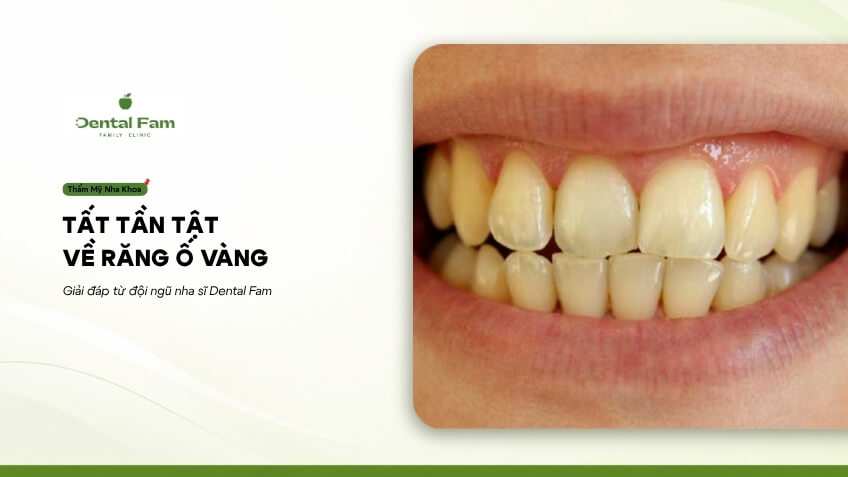
"## What is Yellow Teeth?
According to the ADA (American Dental Association), yellow teeth are classified into two groups of causes: those that form outside the enamel (Extrinsic), due to contact with food, drinks, and tobacco; and those that form inside the tooth structure (Intrinsic), due to genetics, age, or medication. Morphologically, this is the phenomenon where the surface or hard tissue layer of the tooth turns yellow, brown, or dull compared to its original color.
The most important point that many people often overlook when trying to fix it at home is that the degree of yellowing and the appropriate treatment depend entirely on correctly identifying which group you belong to. So, how many groups are there, and how do they differ?
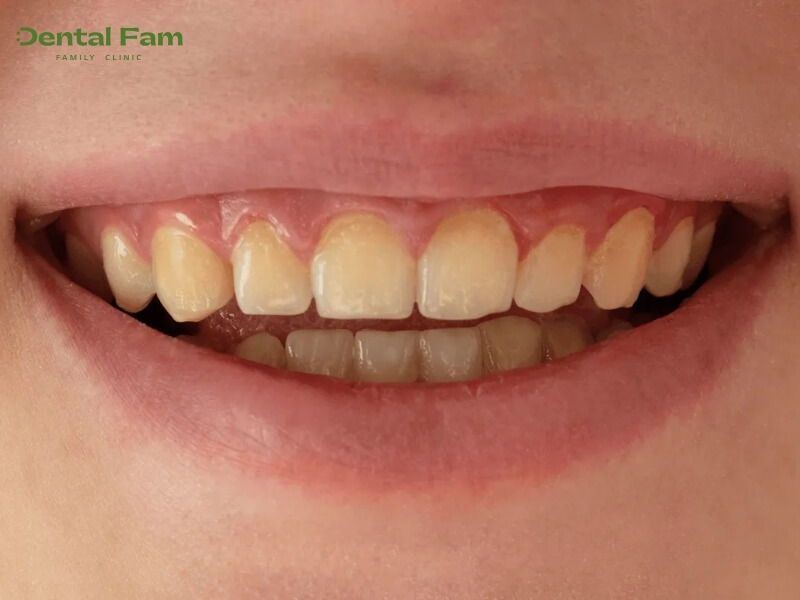
How many types of yellow teeth are there?
Yellow teeth are divided into two main groups: yellowing that forms on the outer enamel, and yellowing that forms from within the tooth structure. These two groups have different mechanisms, so the treatment methods are also different. The following section will describe each group specifically.
Yellowing formed on the outermost enamel layer
These are stains located directly on the outermost enamel layer of the teeth, usually improved with proper hygiene or professional cleaning. This type forms due to contact with dark-colored foods, drinks, or tobacco over time, and because the stains haven't penetrated deep into the tooth structure, there is still room for home treatment.
Identifying signs: The yellow color is often uneven, darker in the spaces between teeth and along the gum line, and more noticeable after eating or drinking dark-colored foods.
Internal Yellowing
This is a condition where the dentin (the layer of tissue beneath the enamel) changes color due to developmental factors, age, or trauma, and does not improve with regular cleaning. According to research on tooth stain classification, some cases of external staining can penetrate through small cracks in the enamel and into the dentin, and are therefore also included in this group.
Identifying signs: The color is relatively uniform but darker, does not improve with thorough cleaning, and sometimes some teeth show a noticeable difference in color compared to the others.
| Signs | External | Internal |
| Color Distribution | Uneven, darker in interdental spaces/gingival margins | Relatively even, darker |
| Response to Hygiene | Significant Improvement | No Improvement |
| Miscolor Between Teeth | Rare | Possible occurs |
So, specifically, what habits or factors cause teeth to fall into the external staining group?
Causes of External Staining
There are three main groups of factors causing external staining: dark-colored foods/drinks, tobacco, and improper oral hygiene, all three stemming from lifestyle habits and therefore largely controllable. How does each group specifically work?
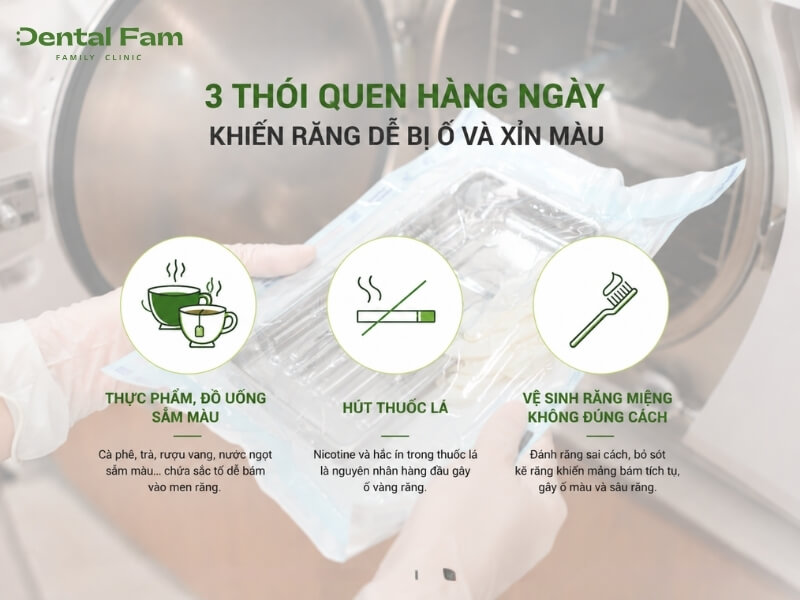
Dark-colored foods and drinks (coffee, tea, wine)
Coffee, tea, and red wine contain tannins (a type of polyphenol compound), which can adhere to the protein film on the enamel surface and accumulate over time. The degree of impact is usually proportional to the frequency of use; daily coffee drinkers will see more noticeable stains than those who only drink occasionally.
Tobacco
Nicotine and tar in tobacco stick to the tooth surface and darken over time, often being more difficult to clean than food stains.
Improper Oral Hygiene
Irregular or incorrect brushing techniques cause plaque buildup, allowing external stains to adhere more firmly to the enamel.
If hygiene and eating habits are the causes of external staining, where does internal staining come from?
Causes of Internal Staining
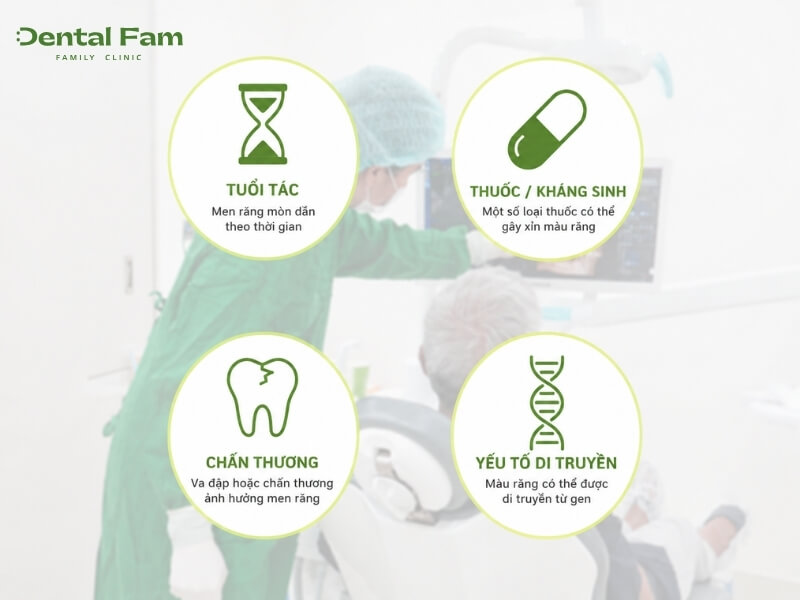
Internal staining originates from four groups of factors: age, antibiotics used during tooth development, trauma, and other factors such as genetics or fluoride exposure. Unlike external causes, these issues originate from within the tooth structure and cannot be remedied by regular hygiene alone.
Age and Dentin Exposure
According to the ADA, aging is one of the most common causes of yellowing from within the tooth structure, as the enamel thins over time, exposing the naturally yellow dentin underneath. This is why older adults' teeth are often yellower than younger people's, even with regular and proper hygiene.
Antibiotics (Tetracycline) During Tooth Development
Tetracycline antibiotics, if used in young children during tooth formation, can leave gray or brown discoloration on permanent teeth that cannot be removed with regular cleaning.
Trauma, Pulp Death
When pulp tissue is damaged and destroyed due to trauma or pulp death, dark pigments can seep into the dentin, causing tooth discoloration from the inside even if the outer surface is unaffected.
Other Factors (Genetics, Fluorosis)
According to the ADA, fluorosis (the condition of excessive fluoride absorption during tooth formation) is a factor that can cause internal yellowing; enamel structure due to genetics also has a similar effect [the genetics section needs more specific sources].
So, after knowing the cause, how can you identify which type of yellowing your teeth belong to?
How to Identify Your Teeth's Yellowing Type
You can get a preliminary idea of your yellowing type through three observational questions before needing a dentist's confirmation. This is something many people overlook when trying to fix it themselves, and it's also why many people spend money on whitening without improvement, or conversely, use home remedies when proper hygiene is the only solution.
Try asking yourself:
-
Is the staining evenly distributed across your entire set of teeth, or is it only darker in a few areas like between teeth or along the gum line?
-
Have you been cleaning regularly and correctly, and has the condition improved?
-
Are any teeth noticeably different in color from the others?
If the stains are uneven, dark in the spaces between teeth or along the gum line, and tend to improve with more thorough cleaning, it's likely external yellowing. Conversely, if the tooth color is relatively uniform but dark, doesn't improve even with proper cleaning for a while, or there are noticeable color discrepancies, this could be a sign of internal yellowing. Note that this is only a preliminary way to identify the problem; an accurate diagnosis still requires a direct examination by a dentist.

Now that you know which group you belong to, the next question will surely be: can teeth whitening solve this?
Can Yellow Teeth Be Whitened?
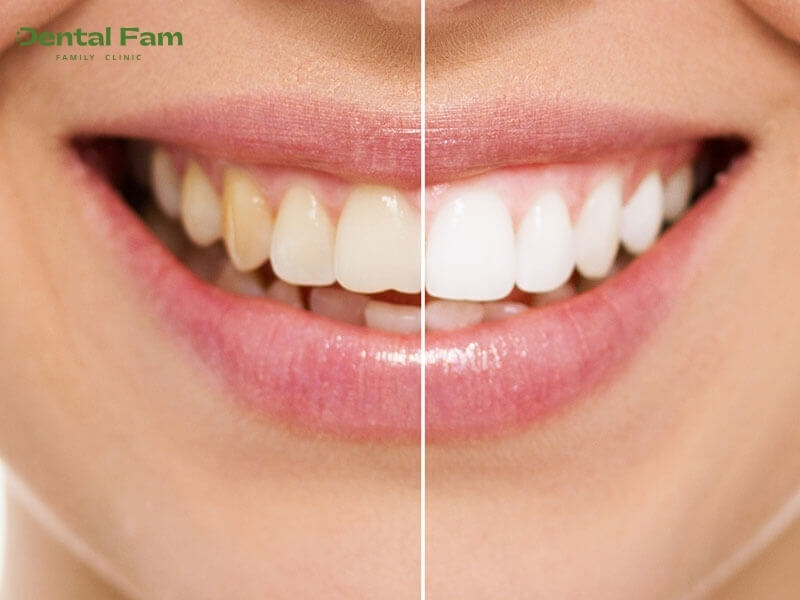
Yellow teeth can be whitened, but the effectiveness depends entirely on the type of yellowing you have. This is the answer to the worry of ""will I waste my money?"" that many people have before deciding to whiten their teeth.
Effective Whitening Cases (External Stains)
For external stains, whitening usually yields noticeable results because the stains are only on the surface layer of the enamel, allowing the whitening agents to act directly.
Limited Whitening Cases (Severe Internal Stains)
For severe internal stains, conventional whitening may not be as effective as expected, as the stains are deep within the dentin, making them difficult to reach with conventional whitening agents. In this case, the dentist may need to consider a more suitable alternative after a direct examination, instead of repeating whitening multiple times without achieving results.
Knowing the limitations of teeth whitening, what about the folk remedies circulating online?
Why you shouldn't use folk remedies (lemon, baking soda) to remove stains from teeth
Lemon and apple cider vinegar are quite acidic. Frequent contact with teeth can gradually dissolve minerals in enamel, causing it to thin over time, and worn enamel cannot regenerate. If you've seen tips on social media about using lemon juice, apple cider vinegar, or a mixture of baking soda and hydrogen peroxide to remove stains at home, this is the part you should read carefully before trying.
A seemingly harmless trick, used a few times a week for months, can have far longer-lasting consequences than the initial yellowing you want to fix. Instead of resorting to unproven tips, a safer approach is to correctly identify your type of yellowing (following the instructions above) and choose the appropriate treatment.
So, if you're still unsure, when should you stop guessing and see a dentist?
When to see a dentist for an accurate diagnosis
If you're unsure what type of yellowing you have, or if proper cleaning hasn't improved your teeth, it's time to consider a check-up instead of continuing to guess. A check-up helps determine the exact cause before choosing the right solution, avoiding wasted time and money on an incorrect treatment, such as repeated whitening for severe internal yellowing that doesn't yield results.
At Dental Fam, you will receive a thorough examination and consultation regarding your actual dental condition before any treatment decisions are made. There will be no hasty whitening treatments prescribed without first determining the underlying cause.

While waiting for an appointment, there are things you can do at home to minimize yellowing.
How to properly care for and prevent yellowing teeth at home
There are two things you can do immediately to reduce external yellowing: proper oral hygiene and controlling foods that cause staining. This is a safe preventative measure, replacing the potentially risky home remedies mentioned earlier.
Proper Oral Hygiene Technique
After eating or drinking acidic foods, tooth enamel is temporarily softer than usual, so wait about 30 minutes before brushing, and brush gently instead of forcefully.
Limit Staining Foods/Drinks
Rinse your mouth with water immediately after consuming coffee, tea, or wine to reduce the amount of chromogen (the pigment that causes color) that adheres to tooth enamel, without having to completely eliminate your favorite habits.
Frequently Asked Questions about Yellow Teeth
How Long Does Teeth Whitening Last?
The duration of whitening results depends on each individual's diet and post-treatment care..
Is Teeth Whitening Painful?
Some people may experience mild, temporary sensitivity during or after the whitening process..
Yellow teeth don't always require immediate whitening. There are two groups of causes: external (due to food, tobacco, hygiene) which usually improve well with proper hygiene or whitening, and internal (due to age, medication, injury, genetics) which require more careful evaluation before choosing an option. Self-observation of signs can help with initial guidance, but an accurate diagnosis still requires a dentist.
If you are unsure, or want to receive proper advice on the cause before deciding on teeth whitening, Dental Fam (https://dentalfam.vn/en) is ready to assist you in finding the most suitable solution for your specific dental condition. Alternatively, you can view details of our teeth whitening services at our dental clinic!
Dental Fam - Family Clinic
- Address: NOTT 28, 29, 30 Phuoc Long A, Nam Nha Trang, Khanh Hoa
- Phone/Hotline: +84 582 582 345 / +84 983 001 768
- Website: dentalfam.vn
- Email: info@dentalfam.vn"