What are the signs of an underbite?
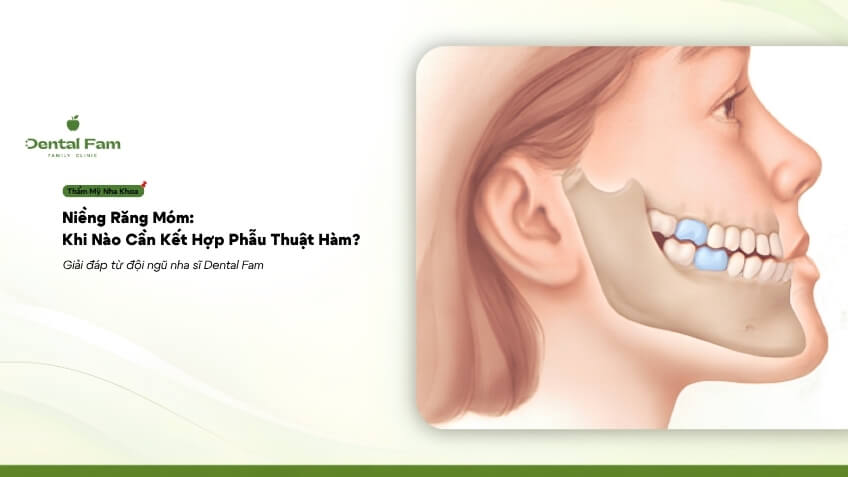
The easiest sign of an underbite is that when viewed from the side, the chin and lower jaw protrude significantly forward compared to the upper lip and upper jaw, accompanied by the lower incisors overlapping the upper incisors instead of occluding normally. In people with a normal bite, when the mouth is closed, the upper incisors slightly overlap the lower incisors; with an underbite, this relationship is reversed, making the lower jaw appear to protrude forward.
Other common accompanying signs include difficulty biting down food with the incisors because the two jaws don't align correctly, and a noticeable imbalance when viewed from the side in a mirror or photograph. The severity can vary greatly between mild and severe cases, so self-observation is only an initial reference and does not replace a doctor's assessment.
Is an underbite the same as a Class III malocclusion?
Yes, ""underbite"" is a common colloquial term for what dentistry calls a Class III malocclusion. These are different names for the same condition: the lower jaw is positioned further forward than the upper jaw when the mouth is closed, unlike a normal bite (Class I) or an overbite (Class II, where the upper jaw protrudes).
Knowing these terms is helpful when researching or discussing with your dentist, as professional examination records or X-rays may use the term ""Class III malocclusion"" instead of the commonly used term ""underbite.""
Is an underbite caused by teeth or jawbone?
Underbites have two main causes: teeth or jawbone, and differentiating between these two directly determines the treatment approach. Underbite caused by teeth occurs when the lower incisors protrude forward or the upper incisors recede, while the upper and lower jaw bone structures remain in normal alignment. Underbite caused by bone structure occurs when the lower jaw bone is overdeveloped or the upper jaw bone is underdeveloped, causing the entire lower jaw to protrude significantly.
This distinction is important because severe underbites caused by bone structure often cannot be completely corrected by simply moving the teeth, while underbites caused by teeth can be treated directly with orthodontics by adjusting the position of the incisors in both jaws.
What are the long-term effects on chewing, speech, or health if an underbite is left untreated?
An untreated underbite can affect the ability to bite and grind food because the two jaws do not align correctly, and in some cases, it can also affect speech due to the misalignment of the lower and upper incisors. In the long term, an untreated underbite can cause uneven chewing forces between the teeth and temporomandibular joint, increasing the risk of abnormal tooth wear or jaw muscle tension in some individuals.
With severe, untreated underbites caused by bone structure, in addition to functional effects, the asymmetry between the two jaws when viewed from the side is often the reason many people seek treatment, although the level of concern varies from person to person, whether aesthetics or function is more important.
Can Braces Correct an Underbite?
Braces can correct an underbite if the primary cause is dental, but if the underbite is due to severe bone structure, especially in adults whose bones have stopped growing, orthodontics alone is not enough and may require jaw surgery. This is why there is no single answer to ""can braces correct an underbite?"", the result depends entirely on the type of underbite identified.
For underbites caused by teeth, orthodontics adjusts the relationship between the upper and lower incisors, significantly improving both aesthetics and chewing function. For mild underbites caused by bone, orthodontics can still partially improve the condition by compensating for tooth position, but for severe underbites caused by bone, especially after bone development has passed, jaw surgery is often necessary to achieve comprehensive results, not just moving the teeth.
The next natural question for anyone suspecting an underbite due to bone is: how can I determine this without waiting for a doctor to say ""surgery is needed""?
How to know if my underbite is due to teeth or jawbone?
Only a doctor can accurately determine the type of underbite through clinical examination combined with X-ray analysis, similar to how overbites are determined; it cannot be assessed through mirrors or photographs. Cephalometric radiographs (lateral cephalometric radiographs) accurately measure the relationship between the upper and lower jaws and tooth positions, thereby differentiating between dental and skeletal malocclusion.
For children still in their developmental stage, early detection of skeletal malocclusion is far more important than in adults, as this is the only stage where intervention can be made to reorient the jaw before bone growth completely stops.
Does orthodontic treatment for malocclusion require any additional interventions besides braces or aligners?
Some cases of dental malocclusion may require tooth extraction or the use of additional appliances such as mini-screws to adjust the relationship between the two jaws, but this is not the default indication for all cases. The decision on whether tooth extraction, mini-screw placement, or simply braces/clear aligners is needed depends entirely on the specific treatment plan after the doctor analyzes the radiographs and dental models.
Which method is suitable for correcting an underbite?
Braces are generally preferred for moderate to severe underbites, especially those caused by bone structure, while clear aligners are only suitable for mild underbites caused by teeth, as some severe misalignments cannot be corrected with clear aligners. The reason is similar to overbites: braces allow the dentist to control the pulling force more precisely in cases requiring significant tooth movement in both directions, while clear aligners are more suitable for minor adjustments and depend on the patient's willingness to wear them for the required number of hours.
How long does orthodontic treatment for an underbite take, and is it more painful than other cases?
The treatment time for underbites caused by bone structure or requiring multiple orthodontic appliances is usually moderate to complex, with details for each method explained in the article how long does orthodontic treatment take. For cases requiring jaw surgery, the overall time also depends on the surgical schedule and recovery phase, which is outside the scope of the orthodontic treatment itself.
Regarding pain, underbites do not produce a different type of pain compared to other conditions; the feeling of soreness and tightness mainly occurs after the appliances are fitted and after each force adjustment, as described in the article is orthodontic treatment painful?.
How much does orthodontic treatment for an underbite cost?
The cost of orthodontic treatment for an underbite depends on the chosen method, plus additional costs if tooth extraction, mini-screw placement, or combined jaw surgery is required. For underbites caused by bone issues requiring surgery, the total cost will include the separate surgical fee, which is outside the standard orthodontic price list and requires specific consultation with a maxillofacial surgeon.
Frequently Asked Questions about Orthodontic Treatment for Underbites
Do children with underbites need braces earlier than adults?
Yes, especially if the underbite is suspected to be due to bone structure. Children are in their developmental stage, which is the only time when the jawbone can be oriented before growth stops, unlike adults where the bone structure is already fully fixed.
Can children with underbites due to bone issues use functional orthodontic appliances instead of waiting for traditional braces?
Yes, it is possible. In some cases of underbite in growing children, additional support appliances such as palatal expanders are considered to reorient jaw bone development before switching to conventional braces when the child is older.
Does mild underbite require braces or just cosmetic correction?
Cosmetic restoration methods such as crowns or veneers only change the surface shape of the teeth; they do not adjust the bite relationship between the two jaws. For underbite, even mild cases, orthodontics is a method that addresses both tooth position and bite, rather than just masking the external appearance.
Will underbite return after braces are removed?
Possibly, if the retainer is not worn correctly after removing the braces. Because underbite cases usually require more adjustment of the bite relationship than normal cases, proper retention according to instructions is crucial to maintaining the achieved results.
Is there a separate fee for taking Cephalometric X-rays to determine the type of underbite?
No, if the X-rays are for treatment purposes, including Cephalometric X-rays used to determine the type of underbite, the cost only applies if the client requests the X-rays be sent via email or Zalo for private storage.
Is surgery for an underbite caused by bone structure more expensive than regular braces?
Yes, because this case incurs additional surgical costs on top of the orthodontic treatment cost.