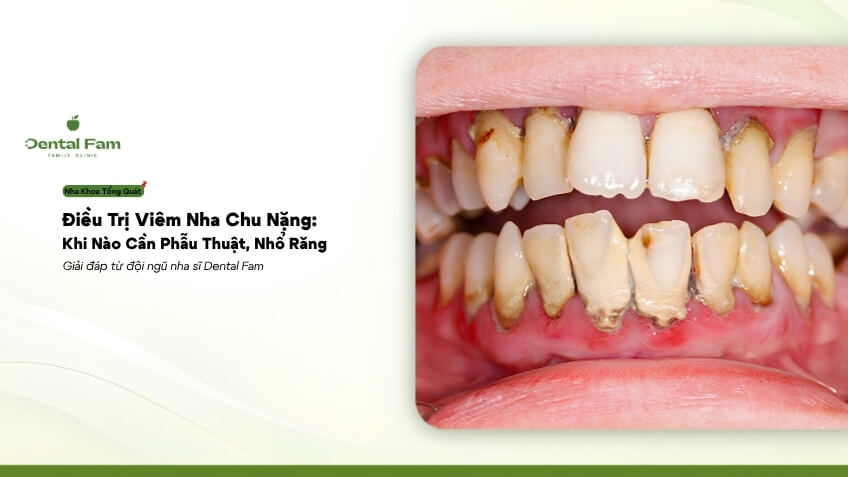
What does a dentist assess in severe periodontitis?
The dentist assesses the degree of tissue loss, bone resorption, looseness, and the salvageability of each tooth, rather than making a general conclusion for the entire jaw. This is based on a direct examination and X-rays. Because each tooth has its own unique condition, a person may have teeth that can be saved and others that require different considerations.
During the examination, the dentist measures the depth of the periodontal pockets, assesses the degree of attachment loss (the extent to which the tooth loses its attachment to the supporting tissue), checks for looseness, and examines damage to the root cleft (where the root splits), if present. Some cases require additional 3D imaging to clearly visualize the bone.
The stage and progression of the disease are classified into Stages and Grades, not just by the term ""severe."" See the explanation in the article ""Mild, Severe, Chronic, and Acute Periodontitis."" You cannot determine if you belong to the severe group by observation at home. After the assessment, treatment options are chosen for each tooth.
What are the treatment options for severe periodontitis?
Severe cases may require specialized treatment such as flap surgery and restorative treatment, depending on the condition of each tooth. These two approaches are considered by the dentist based on the assessment results; there is no one-size-fits-all formula for all patients. The sections below discuss flap surgery, restorative treatment, and supporting procedures.
When is flap surgery used?
Flap surgery is a procedure that opens the gum tissue to clean the area around the decayed tooth root. It is used when the dentist determines that non-surgical treatment has not adequately addressed the affected area. This is a general knowledge description; the specific indication is decided by the dentist after examination. Surgical interventions are usually performed under local anesthesia, and Dental Fam follows a step-by-step process to ensure your maximum comfort.
Surgery is indicated independently from the outset if the tooth condition requires it; you don't have to undergo non-surgical treatment first and then move on to surgery. Conversely, some teeth, even in severe cases, are suitable for non-surgical or LASER treatment; LASER is different in technology, not an upgrade, and doesn't necessarily mean the condition is worse.
What is Reconstructive Treatment?
Reconstructive treatment is a supportive approach to partially restore the lost supporting tissue of the tooth, and is only performed when the doctor deems it appropriate. Lost tissue and bone often don't fully recover, so the practical goal is to stabilize and preserve the tooth, possibly with partial reconstruction depending on the case. The doctor will explain the reasonable expectations for your tooth before treatment.
What is the Role of Assistive Devices?
Assistive devices are only used when the doctor determines they are necessary; they do not replace clinical assessment. 3D Cone Beam CT (CTS) provides a 3D view of the bone for diagnosis and planning, not direct treatment. PRF (platelet-rich fibrin) is a procedure that aids healing and reduces pain, while the ATP38 laser helps reduce pain, inflammation, swelling, and promotes healing.
See the function of each device in the article Periodontal Treatment Devices. When intensive treatment is insufficient to save a tooth, the next question is which teeth cannot be preserved.
When are teeth no longer salvageable?
Tooth extraction may be indicated when the supporting tissue and bone are too severely damaged to maintain long-term tooth stability. This decision rests with the dentist after evaluating each tooth, not based on a single sign such as a loose tooth.
If extraction is indicated, the dentist will simultaneously develop a restoration plan to ensure you can still eat and chew, rather than simply removing the tooth. You should ask clearly why that tooth cannot be preserved and the subsequent restoration options. Whether to restore it immediately or wait a while depends on the condition of your bone and gums, as assessed by your dentist. Some loose teeth don't necessarily need extraction, so a direct assessment is more meaningful than self-guessing. For those who are undecided between keeping and extracting, the cost breakdown below will help you get an idea.
What is the reference cost for treating severe periodontal disease?
Costs are calculated per tooth and according to indications. Surgical procedures cost 2,000,000 VND per tooth, including examination and consultation. Additional costs such as Conebeam CT scans or PRF are only incurred if the dentist determines they are necessary. The calculation of each cost, with illustrative examples and conditions, can be found in the article ""Periodontal Disease Treatment Price List"". The examples in that article are for illustrative purposes only and are not price quotes.
Dental Fam conducts examinations, measurements, and X-rays for pre-treatment, then advises on treatment plans and costs for each tooth before treatment. Each treatment session lasts approximately 30 minutes; typically, 1 to 4 intensive treatment sessions are needed depending on the plan, with more complex cases requiring more. After treatment, maintenance is crucial to maintaining the results.
What to do after treating severe periodontitis to maintain results?
You need to maintain proper oral hygiene and attend follow-up appointments as scheduled by your dentist, as periodontitis has a risk of recurrence if plaque and risk factors are not controlled. ""Stable"" in severe cases means the disease has stopped progressing, not that lost tissue has returned to its original state.
Home care maintains results, it doesn't create them; the dentist monitors using measurements taken at the clinic. Many professional guidelines recommend scheduled follow-up appointments every few months; the specific schedule is determined by the Dental Fam dentist based on each individual's condition.
In the first few days after surgery, the sensations and care instructions will be tailored to each individual case by the doctor. The general guidelines are usually to eat soft foods, avoid brushing the treated area vigorously, maintain gentle hygiene, use medication or mouthwash as directed, and attend follow-up appointments. You should contact your doctor if swelling and pain increase or bleeding persists.
If you are experiencing loose teeth, pus in the gums, or noticeable gum recession, scheduling an appointment early will give you more treatment options.
Severe periodontal disease can still be treated, and the first step is for the doctor to assess each tooth. Depending on the condition, teeth may require specialized treatment to save them, or a restoration plan may be developed if preservation is not possible. Surgery is indicated when necessary, not as the final step in every case, and this procedure costs 2,000,000 VND per tooth, including examination and consultation.
If you are concerned about loose teeth or gum recession, schedule an appointment at Dental Fam for a direct assessment.
Dental Fam - Family Clinic
- Address: NOTT 28, 29, 30, Phuoc Long A Urban Area, Nha Trang, Khanh Hoa
- Hotline: +84 582 582 345 / +84 983 001 768
- Email: info@dentalfam.vn