"## What are the steps in the teeth whitening procedure at the clinic?
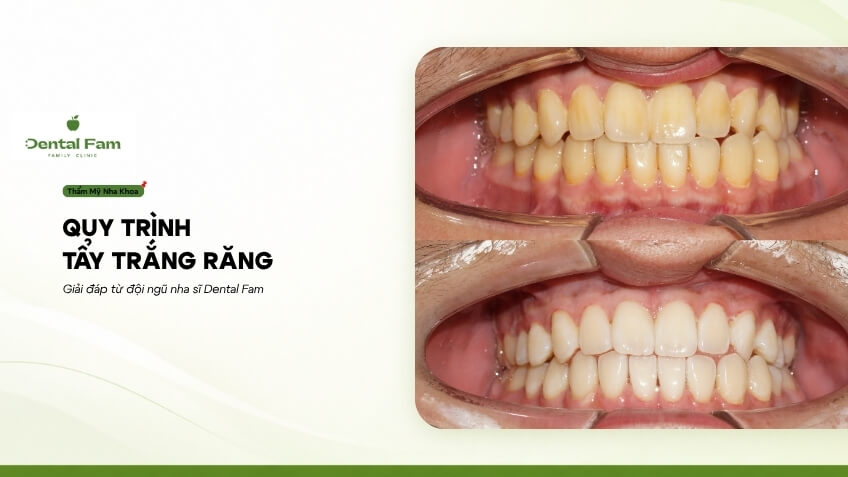
The teeth whitening procedure at Dental Fam consists of 6 steps: cleaning the teeth, protecting the gums, applying desensitizing gel, applying the whitening agent to the entire upper and lower teeth, the activation light cycle, and finally, taking before-and-after photos to compare the results. The total time (excluding cleaning) is approximately 40 minutes to 1 hour.
Each step serves a specific safety purpose. So, how does each step work, and why is it done in this particular order?
Step 1: Teeth Cleaning
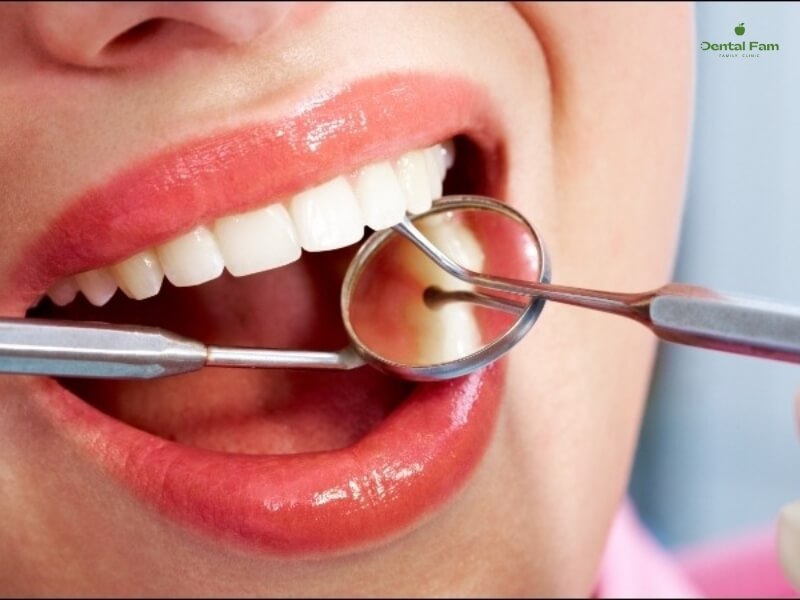
Before applying any whitening agent, the teeth are thoroughly cleaned to remove tartar and plaque. This is a mandatory step, as these layers of plaque prevent the whitening agent from evenly contacting the tooth surface, easily leading to uneven whitening after treatment. This basic cleaning step is free when customers use the teeth whitening service at Dental Fam.
If you want to know specifically who should and shouldn't whiten their teeth (for example, teeth with yellow or brown spots due to poor enamel mineralization), the article ""Who Should and Shouldn't Whiten Their Teeth"" explains it in detail.
Step 2: Protecting Your Gums
This is a step many people overlook, but it's the most important for safety. The gums are covered and protected to prevent burns from contact with the whitening agent, as the concentration of the active ingredient used in the clinic (15–35% Peroxide) is quite high compared to home use.
If you've ever heard someone describe gum damage after teeth whitening, it's almost certain this step was done carelessly or skipped. This is also one of the things you can observe yourself to determine if a place is doing things correctly; the end of the article will discuss this in more detail.
Step 3: Applying Desensitizing Agent
Before applying the whitening agent, the dentist applies a layer of desensitizing agent to the teeth. This step helps reduce discomfort during and after the whitening process, combined with Crystal cold LED light technology to minimize sensitivity better than traditional laser technology (which generates heat and easily irritates the tooth pulp).
Step 4: Applying the Whitening Agent and Using the Activating Light
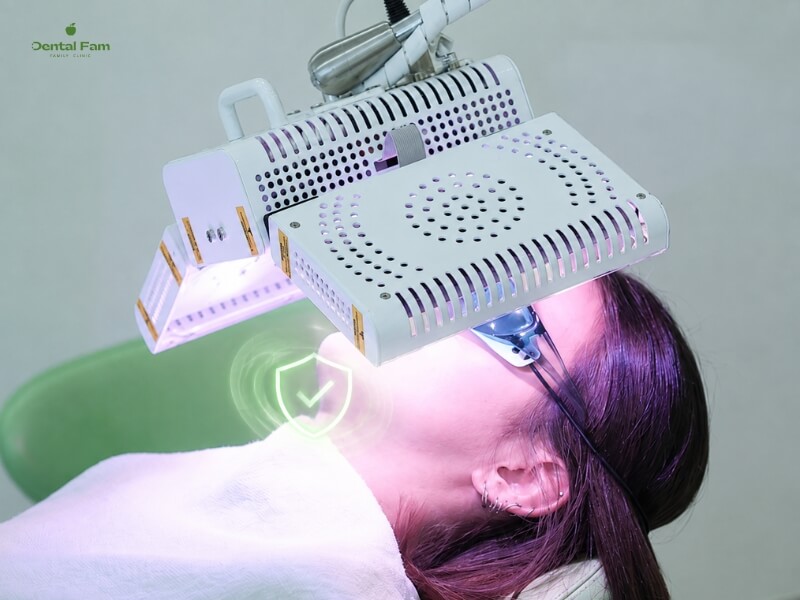
The whitening agent (15–35% Peroxide) is applied to the entire upper and lower teeth, then a Crystal cold LED light is used to activate the enamel whitening reaction. The light doesn't whiten the teeth itself; it only acts to activate the active ingredients in the agent, making them work faster and more evenly.
Treatment cycle: Apply medication for 5 minutes – rest for 5 minutes – light treatment for 5 minutes – rest for 5 minutes, repeat. The number of repetitions is usually 2 times per session; for more severely stained teeth, the doctor may prescribe up to 3 additional sessions, depending on the individual's condition. The entire process is performed directly by the doctor, not delegated to an assistant.
Step 5: Take Before and After Photos
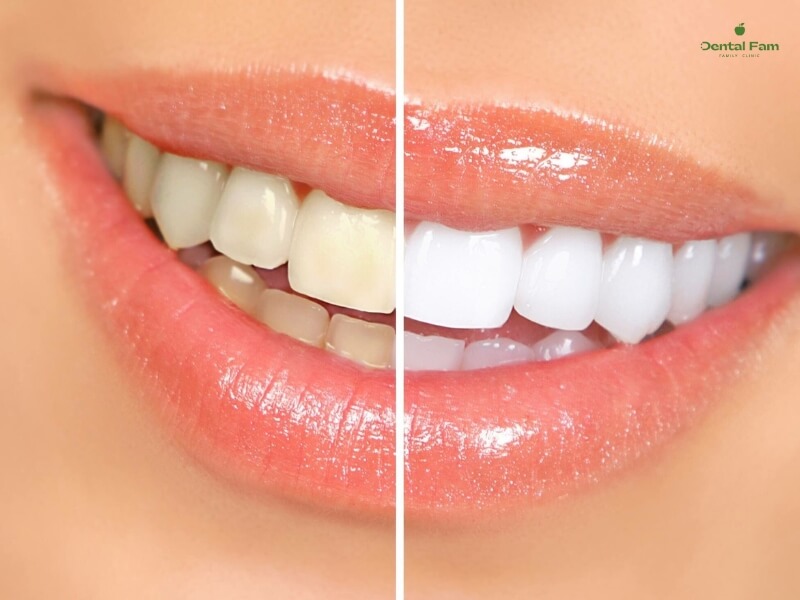
This is the final step to visually compare the results and to provide the doctor with advice on appropriate aftercare for each individual.
After the procedures at the clinic, a frequently asked question arises: how do cold LED lights and traditional laser technology differ, and which one is Dental Fam using?
How does the Crystal Cold LED light differ from traditional laser?
Dental Fam uses the Crystal LED Teeth Whitening System (cold LED light) throughout the entire teeth whitening process at the clinic, not traditional laser technology. This is a deliberate choice, not a coincidence.
SensationIn other words, choosing cold LED lights instead of traditional lasers is part of the reason for reduced sensitivity during the procedure at Dental Fam, rather than the two technologies feeling equally good. So, if you can't visit the clinic regularly, how can you perform teeth whitening at home?
How does the at-home teeth whitening process work?
The at-home teeth whitening process at Dental Fam consists of 5 steps:
-
Examination and consultation at the clinic
-
Scanning and taking impressions to create custom-made trays
-
Receiving the trays and whitening gel (16–22% peroxide, usually completed within the day, fastest in about 2 hours if urgent)
-
Applying the gel to the trays and wearing them at home according to the doctor's instructions
-
Finally, a follow-up appointment for the doctor to check the results.
Unlike in-office whitening, which takes place in one session with direct supervision from the doctor, at-home whitening requires the user to strictly follow the doctor's instructions regarding dosage and wearing time. This is also where errors are most likely to occur if adjustments are made independently.
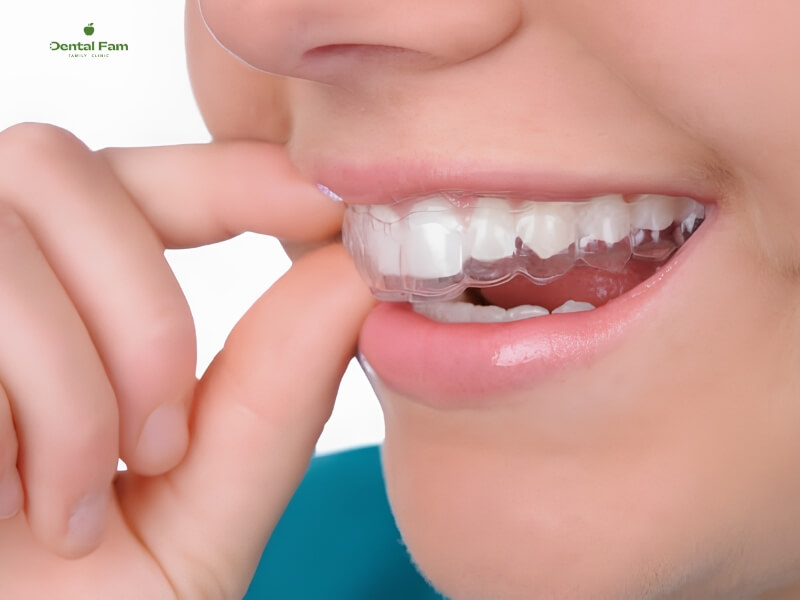
How are personalized teeth whitening trays different from mass-produced trays?
The whitening trays are custom-made to fit each individual's dental impressions, not ready-made trays purchased from the market. Personalized trays fit snugly against the teeth, ensuring even contact of the whitening gel on the tooth surface and minimizing spillage onto the gums. If the tray is damaged during use, Dental Fam will remake it free of charge.
Why you shouldn't increase the dosage or extend the wearing time of the tray on your own
The whitening gel used for at-home whitening (16–22% Peroxide) has a significantly lower concentration than that used in clinics, but that doesn't mean it's absolutely safe if you use the wrong dosage on your own. Your dentist will prescribe the exact amount of bleaching agent and the daily wearing time of the trays, tailored to your individual dental condition. Extending the wearing time or increasing the dosage to whiten faster is not recommended, and if you experience any unusual symptoms such as prolonged sensitivity or gum irritation, contact your dentist immediately instead of stopping or continuing treatment on your own.
Whether whitening at the clinic or at home, the question almost everyone asks is: what concentration of bleaching agent is considered safe?
What concentration of bleaching agent is safe?
At Dental Fam, the concentration of bleaching agent ranges from 15% to 35% peroxide when performed at the clinic under the direct supervision of a dentist, and from 16% to 22% peroxide when used at home according to a personalized treatment plan.
| Criteria | Crystal Cold LED (Dental Fam is using) | Traditional Laser |
| Mechanism | Activates medication with LED light, does not generate high heat | Activates medication with focused laser energy, generates heat |
| Effect on tooth pulp | Less pulp irritation due to no heat generation | Heat generated can irritate tooth pulp |
| Level of sensitivity | At a lower level | At a medium level |
| Context | Drug Concentration | Reason |
| At the clinic | 15% – 35% Peroxide | Direct physician supervision, reaction can be treated immediately during the appointment |
| At home | 16% – 22% Peroxide | No continuous supervision, lower safety level required |
At the clinic, the doctor directly monitors the reaction of the gums and teeth during Throughout the process, a higher concentration can be used to shorten the treatment time. At home, because there is no one constantly supervising, the concentration must be lower to reduce the risk if the user accidentally wears the tray for too long or uses the wrong amount of medication.
This is the internal concentration range that the Dental Fam team applies based on actual clinical assessment, adjusted according to each specific case, not a fixed number applied mechanically to all customers.
So, does this concentration cause sensitivity, and if so, to what extent?
Does teeth whitening cause pain or sensitivity, and how to control it?
According to actual observations at Dental Fam, not all customers experience sensitivity after whitening; this is not a cause for concern if the procedure is performed correctly.
If sensitivity does occur, it lasts a maximum of 2 days; the clinic has not recorded any cases lasting longer than this. This result comes from applying a desensitizing cream before the whitening gel, combined with a Crystal cold LED light instead of a traditional heat-generating laser.
If you experience sensitivity lasting more than a few days, this is considered a separate issue, not caused by the whitening itself, and you should return to the clinic for a direct check-up instead of enduring it on your own.
But how can you know in advance if a place is implementing all these risk control steps before deciding to sit down?
How to identify a standard teeth whitening procedure?
This is an important question, because the most important thing is not ""is whitening painful?"", but ""how to know if the place you choose is doing it correctly."" A standard procedure typically exhibits the following signs, which you can observe yourself at any dental clinic:
-
A dental cleaning and oral examination are performed before deciding on whitening, not immediately upon request.
-
Gum protection is provided using specialized materials before applying the whitening agent.
-
Sensitivity-relieving medication is applied before applying the whitening agent.
-
The concentration of the whitening agent used is adjusted according to each individual's dental condition, not a fixed level applied to everyone.
-
Before and after photos are taken, along with specific aftercare instructions, and the process doesn't end as soon as you leave the chair.
Before agreeing to whitening, you can simply ask: ""Will my gums be protected and sensitivity-relieving medication applied before the procedure?"" If the clinic proactively explains each step without requiring further questioning, it's usually a sign of a transparent procedure.
That's also how the teeth whitening process at Dental Fam is performed, not because it's a ""special procedure,"" but because these are necessary steps to ensure the safety of the patient.
Besides recognizing a standard procedure, another frequently asked question is: how long do the whitening results last?
How long do teeth whitening results last?
The whiteness after whitening at Dental Fam lasts approximately 1–2 years, depending on individual lifestyle habits (eating, smoking). This is different from the 6–12 month routine dental check-up; these two timeframes serve two different purposes: one is to check for cavities and general oral health issues, and the other is to consider re-whitening if teeth have become stained again.
Restricting dark-colored foods and drinks for the first 24–48 hours after whitening, along with regular oral hygiene, directly affects how long your teeth will maintain their whiteness.
How much does teeth whitening cost at Dental Fam?
Teeth whitening at Dental Fam has two fixed prices that do not change depending on the season or the condition of your teeth: 1,500,000 VND/treatment for the at-home package, and 3,000,000 VND/treatment for the in-office package. Both packages include free basic dental cleaning.
The difference between the two packages comes from choosing to have the procedure done at home or at the clinic, not from additional fees based on the degree of tooth discoloration. These are two options suitable for two different needs: those who need quick results in one session under the direct supervision of a dentist, and those who want to do it themselves at home at a lower cost. Initial consultations are free if you decide to proceed with the service immediately after the consultation.

Besides price, another factor affecting the long-term experience is: should you choose teeth whitening at a single clinic or at a family dental practice with a thorough screening process for various age groups?
Why choose a certified family dental practice for teeth whitening?
A certified family dental practice usually has a more thorough screening process before whitening, as it serves a wider range of ages and oral health conditions within the same family, from young people seeking aesthetic improvements to older adults requiring more careful assessment. This requires the team to be accustomed to carefully evaluating each case instead of applying a one-size-fits-all procedure.
If you want to understand more about the family dentistry model and why it's a factor to consider when choosing where to get any dental service, you can refer to the article ""What is family dentistry?"".
Frequently Asked Questions about Teeth Whitening
What should I avoid eating after teeth whitening?
You should limit dark-colored foods and drinks such as coffee, tea, soy sauce, and wine for at least the first 24 hours after whitening; it's better to avoid them for 48 hours.
Does teeth whitening affect tooth enamel?
If performed correctly with the appropriate concentration of whitening agent as prescribed by a dentist, teeth whitening does not damage tooth enamel. Risks only arise from skipping the screening step or using the wrong concentration, as explained in the ""how to identify a standard procedure"" section above.
Is a follow-up appointment necessary after teeth whitening?
Yes. For at-home whitening, a follow-up appointment at the end of the treatment for the dentist to check the results is necessary. For in-office whitening, taking before-and-after photos during the same session is a form of on-site result verification. In addition, regular dental check-ups every 6–12 months should be maintained, separate from repeat whitening.
Does cold LED light reduce sensitivity compared to traditional laser?
Yes. Crystal cold LED lights do not generate as much heat as traditional lasers, so they stimulate the tooth pulp less, resulting in lower sensitivity levels. This is also why Dental Fam uses this technology instead of traditional lasers in all in-office whitening procedures.
A proper teeth whitening procedure isn't about the technology used, but about ensuring all the necessary steps are followed: initial examination and screening, gum protection, application of desensitizing medication, correct concentration of whitening agent, and post-whitening care instructions. Whether you choose to whiten at a clinic or at home, you can easily check these signs yourself wherever you go.
At Dental Fam, the teeth whitening procedure is performed according to all the above steps, with a team of dentists with over 10 years of experience directly performing the procedure in a family dental model. Schedule a consultation to have your teeth checked and choose the right package.
Dental Fam - Family Clinic
- Address: NOTT 28, 29, 30, Phuoc Long A Urban Area, South Nha Trang, Khanh Hoa
- Hotline: +84 582 582 345 / +84 983 001 768
- Website: dentalfam.vn
- Email: info@dentalfam.vn"