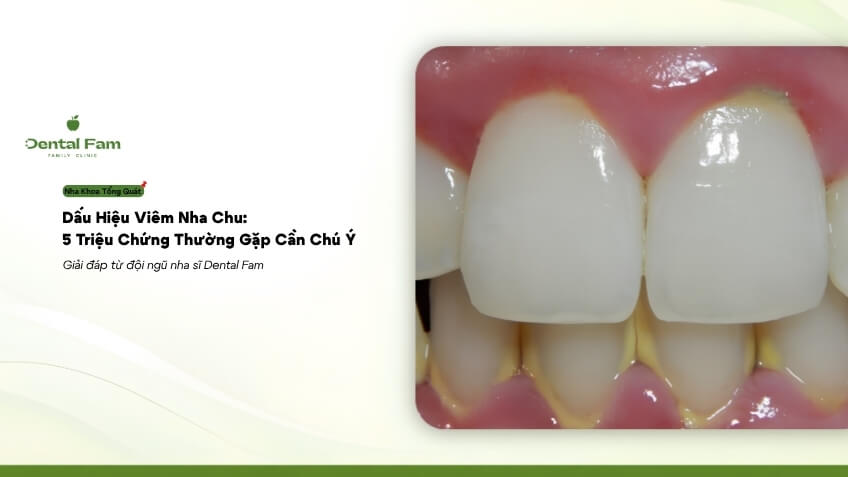
5 Common Signs of Periodontal Disease
There are five common signs: swollen, red, and bleeding gums; persistent bad breath; receding gums; loose or spaced teeth; and pus between the teeth and gums. Each sign reflects a different aspect of inflammation and loss of supporting tooth tissue. You don't need all five signs to see a dentist.
Swollen, Red, and Bleeding Gums When Brushing
Swollen, red gums that bleed easily when brushing or flossing are the earliest and most common sign. Healthy gums are usually pale pink and firm. When bacterial plaque accumulates in the gum area, the body reacts with inflammation, causing the gums to become red, tender, and prone to bleeding.
This sign is also seen in gingivitis, meaning the inflammation is still in the gum layer, so bleeding alone is not enough to conclude that you have periodontal disease. If you only have this one symptom, for example, slight bleeding when brushing your teeth, you should still see a dentist because only a doctor can differentiate between gingivitis and periodontitis; if you have multiple symptoms at the same time, or if there is pus, or loose teeth, you should see a dentist sooner. You can refer to the article on the differences between gingivitis and periodontitis for more information.
Persistent Bad Breath
Persistent bad breath despite regular brushing is a noteworthy sign. Bacteria accumulating in the gums and between the teeth and gums can create an unpleasant odor that brushing or rinsing only provides temporary relief. Bad breath can also stem from other causes, so a dentist needs to examine you to determine the exact source.
Gum Recession, Exposed Tooth Roots
Gum recession, exposing the tooth roots and making the teeth appear longer, is a sign that the tissues surrounding the teeth are being affected. You may notice this when looking in the mirror and seeing more of the teeth exposed than before, or the gum line no longer tightly hugging the neck of the tooth. These are signs that require a dentist's assessment, not just visual observation.
Loose or Gapped Teeth
Loose or gapped teeth often indicate bone loss in the alveolar bone, the part of the jawbone that holds the tooth roots. As the bone loss diminishes, the teeth are no longer as firmly supported, so you may notice the teeth wobbling when chewing or the gaps between teeth widening. This is a sign of a more advanced stage, so early examination will give you more treatment options.
Whether a loose tooth can be saved or extracted depends on the degree of bone loss and the condition of each tooth. Therefore, the dentist will assess each tooth individually; they cannot make a promise, and it doesn't mean every loose tooth needs to be extracted. See also the article on treating severe periodontal disease.
Pus Between Teeth and Gums
The presence of pus between the teeth and gums when pressed is a sign that should be checked by a dentist early. This could be a periodontal abscess, a pocket of pus that has formed in the tissue surrounding the tooth. You shouldn't self-medicate with antibiotics without a doctor's examination, as medication should be based on a direct assessment of your condition.
The five signs above often appear slowly and mildly, so the following section explains why they are easily overlooked.
Why are signs of periodontal disease easily overlooked?
Signs of periodontal disease are easily overlooked because the disease usually progresses slowly and the damage is located beneath the gums, out of sight. Slight bleeding when brushing is easily considered normal, bad breath is easily attributed to food, and swollen gums are often understood as ""internal heat.""
Meanwhile, loss of attachment between teeth and gums, along with bone loss, occurs beneath the surface and is invisible to the naked eye; only a doctor's measurements and X-rays can assess it. Therefore, you should consider each recurring sign as a reason to get checked. If not checked, the consequences can gradually worsen, as described below.
Complications of Periodontitis When Not Checked Early
A serious complication of periodontitis is tooth loss due to the loss of supporting tissue and bone. When inflammation persists, the supporting tissue is gradually destroyed, teeth become loose and may be lost, affecting chewing ability.
Besides oral health, periodontitis is associated with diabetes and cardiovascular disease, but current evidence does not allow us to say that periodontitis directly causes these two diseases. If you have underlying conditions, you can learn more in the article on periodontitis and chronic diseases. Understanding these risks, the next question is when should you see a doctor?
When Should You See a Doctor for Periodontitis?
You should schedule an appointment when you notice one or more of the signs above, and don't wait until you experience pain or loose teeth. If there is pus between the teeth and gums, see a doctor sooner. Home care, such as proper brushing techniques or flossing, helps maintain results but doesn't create them. Therefore, you shouldn't expect symptoms to resolve on their own with better home care: proper brushing doesn't eliminate the underlying cause, and if symptoms persist, you need a doctor's assessment.
See the limitations of self-care in the article on treating periodontal disease at home. When you visit the clinic, the doctor will perform the following steps:
How does Dental Fam assess the signs of periodontal disease?
Dental Fam assesses the signs using measurements and X-rays, not just visual observation. The doctor examines the gums, measures the depth of the periodontal pockets (the space between the teeth and gums), assesses the degree of attachment loss, checks for bleeding during exploration and tooth looseness, and then takes X-rays to examine the alveolar bone.
From these results, the doctor determines the severity of the disease and develops a suitable treatment plan for each tooth. Periodontal treatment at Dental Fam costs from 500,000 VND per tooth, including examination and consultation. Finally, here's a summary of what you need to remember:
The five signs of periodontal disease include swollen, red, and bleeding gums, persistent bad breath, receding gums, loose or spaced teeth, and pus. The disease is often insidious, so recognizing even one sign is a reason to seek early treatment instead of waiting until you experience pain. Severe complications include tooth loss due to the loss of supporting tissue and bone.
At Dental Fam, our doctors assess your condition using measurements and X-rays, with treatment starting from 500,000 VND per tooth. Please schedule an appointment to determine your exact condition.
Dental Fam - Family Clinic
- Address: NOTT 28, 29, 30, Phuoc Long A Urban Area, Nha Trang, Khanh Hoa
- Hotline: +84 582 582 345 / +84 983 001 768
- Email: info@dentalfam.vn