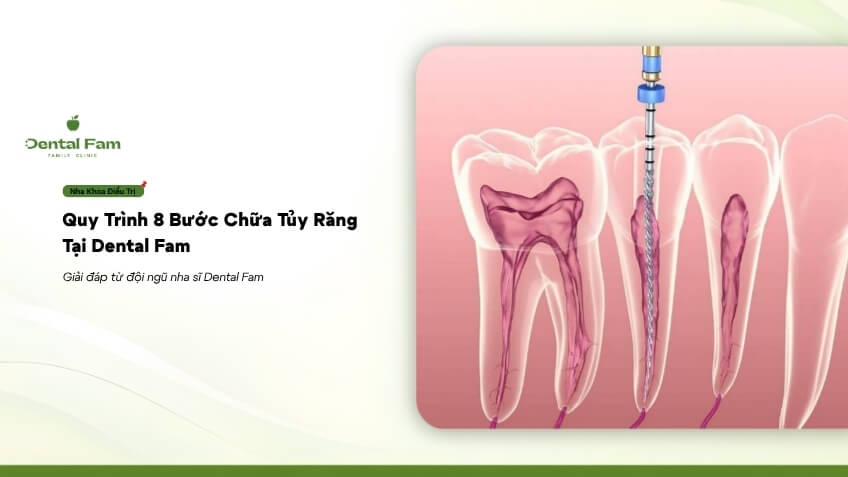
What are the steps in the root canal treatment process?
The root canal treatment process at Dental Fam consists of 8 steps:
-
Examination and diagnosis.
-
Anesthesia.
-
Tooth isolation.
-
Accessing the pulp chamber.
-
Cleaning and shaping the root canal.
-
Root canal filling.
-
Tooth restoration.
-
Follow-up examination.
Compared to common procedures on the market that often combine 5-7 steps, the process at Dental Fam separates the ""accessing the pulp chamber"" and ""cleaning and shaping the root canal"" into two independent steps. These two stages require distinctly different techniques and equipment, separated to ensure tighter quality control at each stage. Below is a detailed breakdown of the content and equipment used in each step.
Detailed Step-by-Step Process for Root Canal Treatment
Step 1: Examination and Diagnosis
The dentist examines the tooth, asks about your symptoms, and then performs a pulp test to assess whether the pulp is still alive or has necrotized. This step determines the treatment approach, as the dentist will choose to remove the entire pulp or preserve the living pulp depending on the extent of pulp damage.
Equipment used includes a pulp testing machine to check the pulp's reaction and digital X-rays to examine the condition of the tooth, root, and root canals. For complex cases requiring 3D imaging to accurately assess the root structure, the dentist may order CBCT (cone beam computed tomography).
Also at this step, based on the X-ray results, the dentist will determine whether the pulp is still viable: if the pulp is still alive and usable, the treatment approach will be to preserve the living pulp; If the pulp is no longer preserveable, the dentist will order a complete root canal treatment following the 8 steps outlined in this article.
Step 2: Anesthesia
The dentist will administer local anesthesia to the area around the tooth to be treated so you won't feel any pain throughout the procedure. This is also why most patients don't feel pain during root canal treatment, contrary to many people's concerns before treatment.
Step 3: Isolating the Tooth
The tooth under treatment is isolated using a rubber dam, a thin piece of rubber covering the tooth to prevent saliva from entering the treatment area. This step is important because it helps control infection throughout the treatment, preventing bacteria from the oral cavity from entering the cleaned root canal.
Step 4: Opening the Pulp Chamber
The dentist uses a dental drill to open a path into the pulp chamber, removing decayed tooth tissue and creating access to the internal root canal system. Opening the root canal at the correct position and angle facilitates subsequent cleaning steps and minimizes further damage to the tooth.
Step 5: Cleaning and Shaping the Root Canal
This is the most important step in the entire process, directly determining the long-term effectiveness of the treatment. The dentist removes diseased or necrotic pulp tissue, cleans and disinfects the entire root canal system, including small and curved accessory canals that are difficult to access with the naked eye.
Supporting equipment includes an endodontic machine combined with rotary files to clean and shape the root canal faster and more evenly than using only hand files, an electronic apex locator to accurately determine the working length of the root canal (avoiding under-cleaning or over-cleaning the root apex), an irrigation system to deliver disinfectant solution into the root canal, and a vibrating or activating device for the irrigation solution to increase cleaning efficiency in narrow and curved root canal areas.
Step 6: Root Canal Filling
After thorough cleaning and infection control, the root canal system is sealed using specialized filling equipment, preventing bacterial re-entry and ensuring long-term treatment stability.
Step 7: Tooth Restoration
The tooth is filled or restored appropriately to protect the remaining structure, especially important for teeth that have lost a significant amount of tissue due to previous decay. Without timely restoration, the tooth is prone to fracture or chipping because the remaining tissue is weakened after root canal treatment. This step uses a handpiece and restorative equipment to shape and adjust the bite to match the opposing tooth.
Restoration is usually performed immediately after root canal filling, either during the same appointment or the next appointment, so you don't need to worry too much about a long wait for restoration.
Step 8: Follow-up Appointment
Your dentist will schedule a follow-up appointment to check the treatment results and the condition of your teeth according to a schedule appropriate for each case, ensuring that the root canals have been sealed and are stable, with no signs of recurrent infection, before you complete your permanent restoration (filling or crown).
Summary Table of Equipment Used in Root Canal Treatment Procedures
Throughout the entire process| Equipment / Instruments | Role | Used in which step | |
| Pulp Tester | Checking Pulp Reaction | Examination and Diagnosis | |
| Digital X-ray | Checking the Condition of the Tooth, Root, and Root Canal | Examination and Diagnosis | |
| CBCT | 3D imaging for complex cases | Examination and diagnosis | |
| Dental handpiece | Access to the pulp chamber, removal of deep tissue | Opening the pulp chamber, restoring the tooth | |
| Endodontic instruments and rotary files | Cleaning and shaping the root canal | Cleaning and shaping the root canal | Cleaning and shaping the root canal |
| Apex locator | Determining the working length of the root canal | Cleaning and shaping the root canal | |
| Irrigation system | Delivers disinfectant solution into the root canal | Cleans and shapes the root canal | |
| Vibrating/activating irrigation solution | Increases cleaning and disinfection efficiency | Cleans and shapes the root canal | |
| Enclosing device | Seals the root canal system | Encloses the root canal system | Encloses the root canal |
| Rubber dam | Isolates the tooth, limits infection |
Not all clinics are fully equipped with electronic apex locators, CBCT, and vibratory irrigation systems; many still use manual root canal length measurement via conventional X-rays. Having all three devices allows for more precise control in the cleaning and shaping of the root canal, which is crucial for long-term treatment effectiveness.
How long does root canal treatment take, and how many appointments are needed?
The number of appointments is not fixed for all cases but depends on the tooth's location, the number of root canals, and the degree of infection:
- 1 appointment: applies to simple cases where the pulp and root canal system can be cleaned, disinfected, and filled in a single appointment. * Two or more sessions: This applies when the tooth has a complex infection or damage, requiring medication to be placed in the root canal and monitoring before complete filling.
The duration of each session also varies depending on the tooth's location: front teeth (single root) usually take about 45-90 minutes, while molars (multiple roots, more root canals) usually take about 60-120 minutes.
What complications can occur if the procedure is not performed correctly?
If the cleaning, disinfection, or root canal filling steps are not fully performed, the tooth may experience recurrent infection, prolonged pain, or require further treatment. This is why standardized procedures and infection control at each step, especially the tooth isolation and root canal cleaning, must be strictly followed.
Frequently Asked Questions about Root Canal Treatment
Who performs root canal treatment at Dental Fam?
All dentists at Dental Fam can perform root canal treatment according to the 8-step procedure outlined above.
Is root canal treatment painful?
You will receive local anesthesia before the procedure, so it is usually painless during treatment.
What types of instruments are used in root canal treatment?
These include pulp testing machines, digital X-ray machines, CBCT, dental handpieces, endodontic machines and rotary files, apex locators, irrigation systems, vibratory irrigation systems, sealing devices, and rubber dams. See the summary table above for details on the role of each instrument.
Is the root canal treatment procedure different between single- and double-rooted teeth and molars?
The steps are the same, but molars have more root canals, so the cleaning and shaping of the canals is usually more complex and time-consuming than for single- and double-rooted teeth, sometimes requiring additional appointments.
How does machine-assisted root canal treatment differ from completely manual treatment?
Machine-assisted endodontic machines combined with rotary files help to clean and shape the root canals more evenly and quickly, combined with electronic apex locators to accurately measure the length of the root canals. This is the technique currently used at Dental Fam for root canal treatment.
The root canal treatment process at Dental Fam consists of 8 distinct steps, from examination and diagnosis, anesthesia, tooth isolation, cleaning and shaping of the root canal, filling, restoration, to follow-up examination, adhering to specialized dental techniques and supported by specialized equipment at each step.