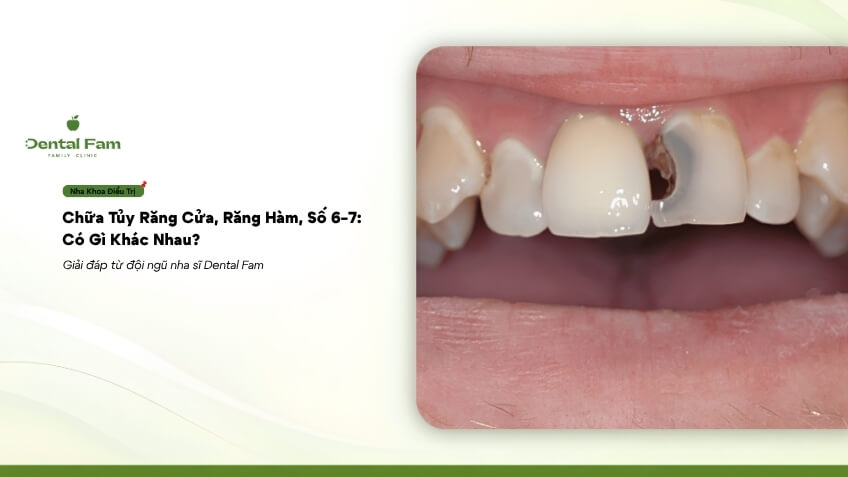
How is root canal treatment for incisors different from root canal treatment for molars (numbers 6-7)?
In terms of tooth structure, incisors and canines usually have one root canal, while molars, especially molars number 6 and 7, often have more roots and root canals, commonly 2 to 4. The more root canals a tooth has, the more time and skill are required in the cleaning and shaping process.
This is why root canal treatment for molars (numbers 6-7) is usually more complex, takes more time, and is more expensive than root canal treatment for incisors.
Why is the price of root canal treatment not fixed according to the tooth's location?
The actual number of roots and root canals of a tooth is not entirely fixed according to its location. For example, premolars (small molars, numbers 4 and 5) may have one or two roots depending on the individual, while molars number 6 and 7, although often having multiple root canals, still require precise identification via X-ray, not rigidly based on the tooth's name.
Therefore, at Dental Fam, dentists always take X-rays to accurately determine the number of roots and root canals of the tooth needing treatment before classifying it into the 1-2 root or large molar category, instead of quoting prices based on the tooth's position (incisors or number 6, number 7). This ensures you receive the correct price based on your actual tooth condition, avoiding incorrect pricing.
How much does root canal treatment for incisors and molars (numbers 6-7) cost?
Prices are determined according to two groups: 1-2 root teeth and large molars, based on actual X-ray results, not on the tooth's position.
Is root canal treatment for incisors more or less painful than root canal treatment for molars?
The pain level during root canal treatment doesn't depend on whether it's an incisor or a molar, as both are treated with local anesthesia beforehand. The main difference between the two groups of teeth lies in the treatment time, as molars usually have more root canals.
Does root canal treatment for molars (numbers 6-7) take longer than for incisors?
Yes. Incisors (single root) usually take about 45-90 minutes per session, while molars (multiple roots, more root canals) usually take about 60-120 minutes per session, sometimes requiring additional appointments if the infection is more complex.
If my X-ray shows a different number of root canals than the ""normal"" number, which pricing group will apply?
The price is always calculated based on the actual number of roots and root canals shown on the X-ray of that specific tooth, not the common number for that tooth's position. For example, if your #6 tooth only has 2 root canals on the X-ray instead of the usual 3-4, that tooth will still be classified and priced according to the group corresponding to the actual 2 root canals, not the ""normal"" price for tooth #6.
Is there an extra charge for taking X-rays to determine the number of roots and root canals?
No. The cost of X-rays for diagnosis and treatment is already included in the root canal treatment price; you do not have to pay extra for this step.
Frequently Asked Questions about Root Canal Treatment Based on Tooth Location
Is root canal treatment for tooth #6 and #7 more difficult than for incisors?
Yes, because tooth #6 and #7 usually have more roots and root canals, requiring more complex cleaning and shaping techniques in the most crucial step of the procedure.
How do I know which price range my tooth belongs to before treatment?
The dentist will take an X-ray to accurately determine the number of roots and root canals of your tooth, then advise on the specific price before starting treatment. You don't need to guess based on the tooth's location.
Is a crown mandatory after root canal treatment for tooth #6 and #7?
The choice between filling or crowning after root canal treatment depends on the amount of remaining natural tooth tissue, not just the tooth's location. Large molars bear more chewing forces, so crowns are often recommended if a significant amount of tooth tissue is lost.
Is root canal treatment absolutely necessary for an inflamed incisor, or are there other options?
If the pulp is irreversibly inflamed or necrotic, root canal treatment is the option to preserve the natural tooth, similar to the principle applied to all other tooth positions.
What price group do wisdom teeth (number 8) or canine/premolar teeth fall into?
The same principle applies as with all other tooth positions: the price group is determined by the actual number of roots and root canals as seen on X-rays, not separately by the tooth's location name. You should contact Dental Fam directly for a specific examination and consultation for each tooth.
If additional root canals are discovered during treatment compared to the initial estimate on the X-ray, will the price increase?
No. The price quoted initially after the X-ray is the final price; no additional costs will arise even if the dentist discovers additional root canals during treatment.
Root canal treatment for incisors and molars (numbers 6-7) differs mainly in the number of roots and root canals, affecting the complexity, duration, and cost of treatment. At Dental Fam, the price is determined based on actual X-ray images of each tooth, not rigidly based on the tooth's location.
If you want to know exactly which price group your tooth falls into, schedule a root canal appointment at Dental Fam to have an X-ray taken and receive specific advice from our dentists.