Why Wear a Retainer After Braces Removal?
Teeth that have just been moved to a new position by orthodontic forces haven't fully anchored to the alveolar bone immediately after the braces are removed. Therefore, they tend to shift back to their original position because the periodontal ligaments around the tooth roots still retain their ""memory"" of the old position. This phenomenon is called relapse, and the retainer's role is to hold the teeth in the new position long enough for the alveolar bone to regenerate and stabilize completely around the tooth roots.
Wearing a retainer is not a ""preventive measure,"" but a mandatory step to preserve the results of the entire 24-48 months of orthodontic treatment. Skipping this stage means accepting the risk that all the effort and cost of the previous treatment may be partially or completely lost over time.
How long do retainers need to be worn?
Retainers are typically worn for 6 months to a lifetime, depending on the condition of the teeth and the dentist's recommendations. In general orthodontics, the initial stage usually requires wearing them almost continuously, then gradually reducing to wearing them only at night for longer periods. However, the exact duration needs to be confirmed by the dentist before being included in the patient consultation.
It's important to note that the duration of wearing retainers is usually significantly longer than the time spent wearing braces, as this is the long-term stabilization phase, not the phase of applying force to move the teeth.
What types of retainers are there?
Currently, after braces are removed, there are three most common types of retainers: fixed retainers, clear removable retainers, and metal removable retainers.
**1. Fixed retainers: Use a small piece of wire or metal fixed to the inner (lingual) surface of the front teeth with dental adhesive (composite).
Advantages:
-
Keeps teeth fixed 24/7 without worrying about forgetting to wear them.
-
Completely hidden on the inner surface, so it's very aesthetically pleasing; it's invisible to others.
Disadvantages:
-
Difficult to clean between teeth, easily accumulates plaque or tartar.
-
Risk of adhesive coming loose if biting on very hard food with the front teeth.
2. Clear removable retainers: Made from clear medical-grade plastic, they fit snugly to the shape of the teeth and have a similar shape to clear aligners.
Advantages:
-
High aesthetic appeal; looks natural when worn.
-
Easy to remove for eating or brushing.
Disadvantages:
-
May deform if exposed to high temperatures (above 40°C).
-
Easily forgotten to be worn or removed during meals, leading to breakage of the tray.
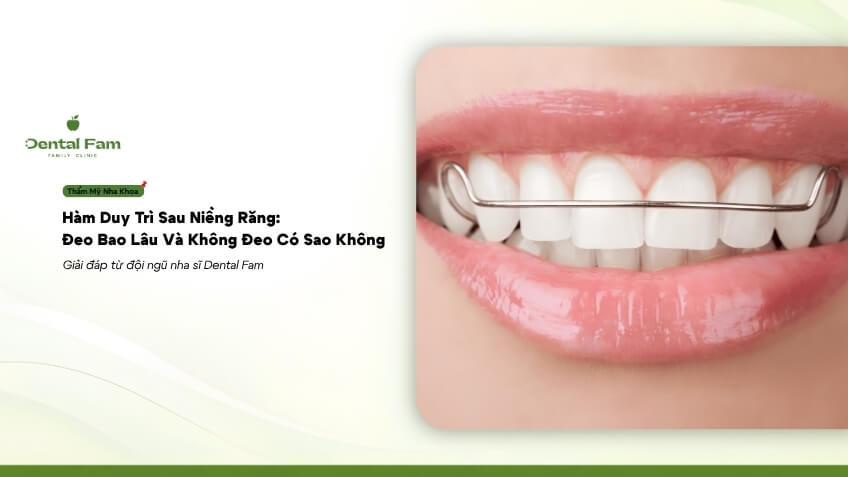
3. Removable Metal Retainer (Hawley Retainer): Consists of a metal archwire that fits snugly over the outer surface of the front teeth, combined with a plastic (acrylic) base located on the palate or inner surface of the teeth.
Advantages:
-
Very durable, sturdy, and the tightness can be adjusted slightly if necessary.
-
Convenient to remove for cleaning and eating.
Disadvantages:
- The metal archwire is visible, resulting in less aesthetic appeal compared to the other two types.
What happens if I don't wear my retainer properly?
Not wearing your retainer properly as prescribed increases the risk of teeth partially or completely shifting back to their original position, especially in the initial period after braces are removed when the teeth are not yet stable in the alveolar bone. The degree of shifting depends on the length of time you've been without wearing it and the initial misalignment before braces, but in general, the longer you've been without wearing it, the higher the risk of teeth shifting backward.
Forgetting to wear it for one evening or one day due to an unexpected incident doesn't necessarily mean an immediate risk of shifting, because teeth need time to accumulate the force of retention before they begin to move significantly, unlike continuously skipping it for many days or weeks. The real concern isn't a single instance of forgetting to wear it, but rather repeated or prolonged instances of not wearing it, as this allows the teeth sufficient time to become unstable in their new position.
If you notice slight tooth shifting after you've stopped wearing your retainer for a while, you should contact your dentist immediately for a check-up instead of putting the old retainer back on yourself. The retainer is designed to fit the tooth position at the time of braces removal and may no longer fit if the teeth have shifted. Trying to wear an ill-fitting retainer can cause discomfort or create uneven pressure on the teeth, which won't help correct the shifting.
How to care for your retainer to make it last longer?
Removable retainers need to be cleaned separately with a soft brush and clean water each time they are removed, similar to how you cleaned the clear aligners during braces. They should be stored in their separate case when not in use to avoid impact, deformation, or loss. Proper care of the appliance during this period follows the same principles as the hygiene habits established during the previous orthodontic treatment.
Frequently Asked Questions About Retainers After Braces
Are retainers a separate fee or included in the braces price?
They are included in the braces treatment price list; there are no additional costs for retainers during the initial treatment period.
If I lose or damage my retainer, do I have to start over?
Losing or damaging your retainer does not require starting over with braces, as long as you have a new one made at the dental clinic before your teeth shift.
Does wearing a retainer hurt or cause discomfort like wearing braces?
No, retainers do not create the pulling force that moves teeth like brackets or aligners, so they do not cause pain. A slight feeling of discomfort or awkwardness in the first few days is a normal adjustment reaction and not a sign of anything unusual.
How long after braces can I completely stop wearing my retainer?
You cannot completely stop wearing your retainer because teeth tend to shift throughout life.
In short, wearing a retainer is a mandatory and indispensable step after braces are removed, because the newly moved teeth are not yet firmly attached to the alveolar bone and tend to shift back to their original position if the holding force is insufficient.
Forgetting to wear it once is not as worrying as skipping it for several consecutive days, but the general principle is to maintain it regularly as directed to preserve the results of the entire treatment.