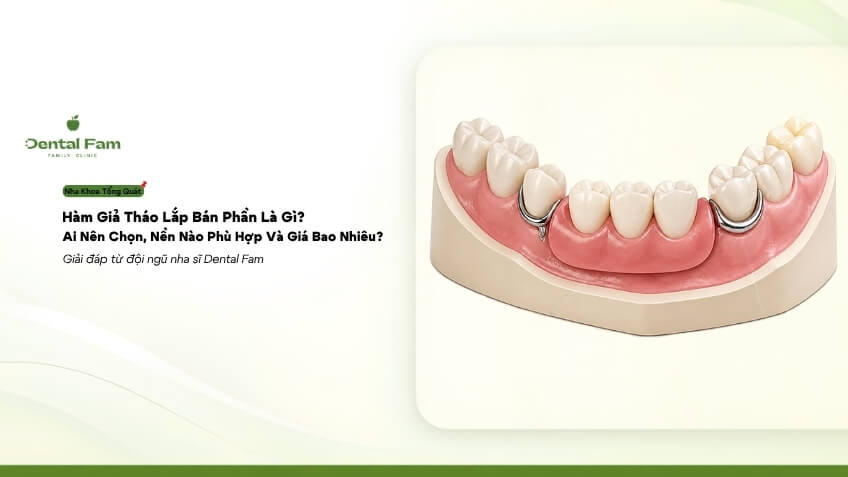
What is a partial removable denture and how is it different from losing one tooth versus losing all teeth?
A partial removable denture is indicated when you have lost nearly or about half of the teeth in one jaw, but still have some natural teeth remaining. The denture fills the gaps left by missing teeth to support chewing and aesthetics, and can be easily removed and reinserted.
A partial denture consists of three parts:
-
Base: The base that helps the denture stay in the mouth. It can be made of hard plastic, reinforced plastic, flexible plastic, or a titanium frame.
-
Dental teeth: The teeth attached to the base. You can choose Japanese, American, or composite dentures (teeth made from synthetic resin).
-
Hooks: The parts that hold the denture securely in place during chewing.
Three cases of tooth loss are often confused with each other, and here's how to distinguish them:
| Case | Number of teeth lost | Remaining natural teeth | Related articles | |
| Single tooth loss | 1 tooth | Almost all teeth remaining | Removable denture (1 tooth) | |
| Partial loss | Nearly or about half of the teeth in the jaw | Several healthy natural teeth remaining | This article | |
| Full Dentures | All the teeth in one jaw (usually 12 to 14 teeth) | No More Teeth | Price of Full Dentures |
The basic method for making partial and single dentures is the same, differing mainly in the number of teeth that need replacing. If you are in the partial denture category, the next question is whether this type of denture is right for you.
Who Should Get Partial Removable Dentures?
Partial dentures are suitable when you have lost a significant number of teeth, have healthy natural teeth, and cannot yet get implants or fixed dental bridges due to cost or other factors.
Doctors usually consider this option when:
-
Finance is limited: removable dentures are much cheaper than dental bridges or implants (posts implanted into the jawbone).
-
You are older or in poor health: This type of denture does not require invasive jawbone surgery or grinding down of natural teeth, making it safer for this group.
-
Your remaining natural teeth are healthy enough: This provides a place for the denture to attach, especially when choosing a framework denture.
Fixed dentures are always preferred, while removable dentures are considered as a last resort. You can see the comparison in the article on choosing between removable or fixed dentures.
If a partial denture is suitable, the most important step is choosing the base material.
Which base material should you choose for a removable partial denture?
You choose the base material based on the number of missing teeth and the condition of the supporting teeth: if the supporting teeth are strong, titanium framework dentures are preferred; if you have few missing teeth and need aesthetics, consider flexible resin; if you have many missing teeth and need an economical option, use rigid resin or high-strength resin. There is no single best type for everyone, as removable dentures are made to order.
| Dental Base | Dental Base Price | Suitable When | When dentures are broken or damaged |
| Hard Resin | Free | Many missing teeth, need a simple, economical solution | Repair 1,000,000 VND, add clasp 1,000,000 VND per clasp |
| High-strength Resin | 1,000,000 VND | Needs a resin base with higher load-bearing capacity than regular resin | Like resin Hard |
| Flexible plastic | 2,000,000 VND | Small tooth loss, aesthetic need, minimal visible clasps | No metal clasps, almost impossible to repair |
| Titanium framework denture | 2,500,000 VND | Good abutment teeth remaining, high stability needed, thin and lightweight base | If clasps break, a new denture is needed |
For partial dentures, a framework denture is the top priority when abutment teeth remain strong because it is more stable and causes less pain than a plastic base. You can read more details about removable framework dentures, the price of removable flexible plastic dentures, and removable rigid plastic dentures. If you want to compare all the materials, the article ""Which type of removable denture is best?"" will help you.
Once you've chosen the base, you'll want to know how much the whole denture will cost.
How much does a partial removable denture cost?
The price of a partial denture is equal to the base price plus the number of teeth multiplied by the price per tooth. Therefore, losing 3 teeth and choosing American-made dentures will cost a total of 2,400,000 VND (hard resin base) to 4,900,000 VND (titanium framework).
The price per tooth is 500,000 VND (Japanese teeth, 6-month warranty), 800,000 VND (American teeth, 1-year warranty), and 1,500,000 VND (Composite teeth, 3-year warranty). The table below calculates for the same situation: losing 3 teeth, choosing American-made teeth, which means 2,400,000 VND per tooth.
| Dental Base | Dental Base Price | Total Cost (3 American Teeth) |
| Hard Resin | Free | 2,400,000 VND |
| High-Strength Resin | 1,000,000 VND | 3,400,000 VND |
| Flexible Resin | 2,000,000 VND | 4,400,000 VND |
| Titanium Denture Frame | 2,500,000 VND | 4,900,000 VND |
With 3 teeth, the denture base accounts for more than half of the total cost (2,500,000 VND out of 4,900,000 VND), so the fewer teeth, the more the base determines the price. If you lose more teeth, you add the price per tooth. For example, if you lose 6 teeth, choosing Japanese dentures on a reinforced resin base: 1,000,000 VND plus 6 times 500,000 VND, which is 4,000,000 VND.
This cost is all-inclusive, with no additional charges, including follow-up appointments for denture adjustments. The warranty applies to the entire denture in case of technical problems, excluding damage caused by personal factors such as accidents, dropping, or being stepped on. Dental treatment before denture placement, such as tooth extraction or gum treatment, is charged separately. The consultation fee is 100,000 VND, waived if you have dentures made immediately. For assistance with payment methods, please contact the clinic's consulting department.
The price is clear, but what are the benefits and requirements for daily use?
Advantages and Disadvantages of Partial Removable Dentures
The biggest advantage of partial dentures is their low cost and the absence of surgery. The main limitation is their stability and chewing ability, which are not as good as fixed dentures.
Advantages:
-
Much lower cost compared to fixed dentures: porcelain crowns start from 4,000,000 VND per tooth and implants up to 18,000,000 VND per implant, while partial dentures for 3 missing teeth only cost from 2,400,000 VND.
-
No invasive surgery or grinding of natural teeth required: Suitable for older adults or those with weak health.
-
Teeth can be added to the existing dentures if more teeth are missing: It's not necessary to have a completely new denture, although this depends on the denture frame material and the condition of the remaining natural teeth.
Limitations:
-
Less stable and chewing ability compared to fixed dentures: The framework denture is more stable than a resin base when there are still good supporting teeth.
-
May become loose or shift during chewing: The lower denture is usually more prone to loosening than the upper denture.
-
Requires adjustment time: You may feel some discomfort and unfamiliarity with pronunciation in the first few days.
-
Jawbone continues to resorb over time: Because there are no tooth roots or implants to stimulate bone growth.
-
Requires removal and cleaning after each meal and before sleeping: You can see how to do this in the article on how to clean dentures.
Among the above limitations, the metal clasps are a unique feature of partial dentures, as they directly touch your natural teeth.
Do the metal clasps of a partial denture weaken the natural teeth?
Yes, it's possible, after prolonged use, because the metal clasps directly grip the adjacent natural teeth (called abutment teeth) to hold the denture in place.
The abutment teeth may weaken or become loose due to three reasons:
-
Pressure and pulling forces: Each time you chew or move your mouth, the clasps create pushing, pulling, or rotating forces on the abutment teeth.
-
Overloading: If the abutment teeth are already weak, have periodontal disease, or their roots are no longer stable, the additional force from the clasps will cause the teeth to be damaged quickly, leading to alveolar bone loss and increasing looseness.
-
Plaque buildup: The area where the clasps grip the roots easily traps food and is difficult to clean, leading to cavities, gingivitis, or periodontal disease, making the abutment teeth less secure.
Therefore, the dentist needs to carefully examine the remaining natural teeth before making a denture. If the supporting teeth are too weak or have severe periodontal disease, dentists usually don't use metal clasps on those teeth.
If you are concerned about clasps affecting your natural teeth, you can discuss other options with your dentist:
-
Resin: A metal-free base, suitable for minor tooth loss.
-
Fixed porcelain bridge: If adjacent teeth are suitable, see the fixed porcelain bridge service page.
-
Dental implant: An independent implant, non-invasive to surrounding natural teeth, see the full implant package.
Which method is suitable will depend on the specific case. If you choose a partial denture, the section below indicates the number of appointments you will have.
What are the steps involved in making a removable partial denture?
If everything goes smoothly, the denture will be completed in about 3 appointments within a week. The first appointment involves a general examination, CT scan or X-ray if needed, a treatment plan, and initial impressions; If dental treatment is needed, it will be handled on that day. The next two appointments are for fitting the dentures and receiving the full set. Each step is described in detail in the article on how to make removable dentures.
Frequently Asked Questions about Partial Removable Dentures
Can I get a partial denture if I've lost my front teeth?
Yes, the technique is no different from making dentures, but the aesthetics are not as good as natural teeth. The results for each person also depend on the lips, tongue, and other factors. If you prioritize aesthetics and want to minimize visible clasps, the dentist may consider flexible resin for cases with few missing teeth.
Are regular check-ups necessary?
After the initial adjustment phase, regular check-ups are not necessary. You can monitor your dentures at home and only visit the clinic when you encounter problems that require a dentist's attention. For example, if the dentures are loose, the clasps break, or they crack.
Partial removable dentures are for people who have lost almost or about half of the teeth in one jaw and still have natural teeth. You choose the base material based on the condition of your abutment teeth: a framework denture if you still have strong abutment teeth, a flexible resin denture if you have few missing teeth and need aesthetics, or a rigid or reinforced resin denture for a more economical option. At Dental Fam, the total cost for losing 3 teeth ranges from 2,400,000 VND to 4,900,000 VND, all-inclusive.
All dentists at Dental Fam can perform removable denture fabrication. This article is based on the current price list and consultations with the clinic's dentists. You can view an overview of the service on the removable denture page.
To find out which type of base material and number of teeth is right for you, you can schedule an appointment at Dental Fam. The 100,000 VND consultation fee is waived if you get your dentures made immediately.
Dental Fam - Family Clinic
- Address: NOTT 28, 29, 30, Phuoc Long A Urban Area, Nha Trang, Khanh Hoa
- Opening Hours:
-
Monday to Saturday: 8:00 AM to 6:00 PM;
-
Sunday: 8:00 AM to 12:00 PM
- Hotline: +84 582 582 345 / +84 983 001 768
- Email: info@dentalfam.vn