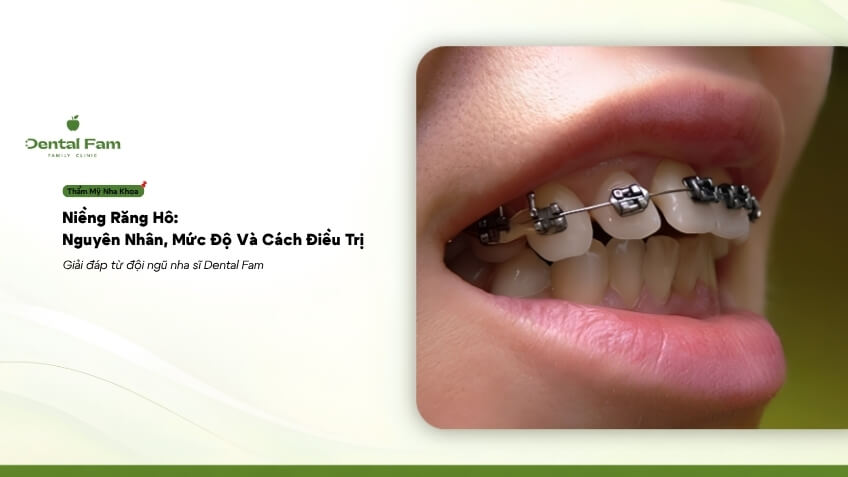
What is an overbite, is it due to the teeth or the jawbone?
An overbite is a condition where the upper teeth or jaw protrude forward compared to the lower teeth. The cause can be from the teeth, the jawbone, or a combination of both. Differentiating between these two groups of causes is the most important step before deciding on a treatment plan, as the approach differs significantly.
An overbite due to teeth occurs when the teeth themselves protrude while the jawbone remains in a normal position. In this case, orthodontics can directly correct the problem by moving the teeth back into the correct position. An overbite due to the jawbone occurs when the upper jawbone itself develops too much or the lower jawbone is underdeveloped. In this case, the teeth are simply ""following"" the bone structure, so simply moving the teeth without addressing the bone structure is not a complete solution.
How are mild, moderate, and severe overbites distinguished?
The degree of overbite is assessed by the dentist based on the distance between the upper and lower incisors, measured on X-rays, combined with the impact on the bite and facial aesthetics. It's not a fixed number applied universally to everyone.
The terms ""mild,"" ""moderate,"" and ""severe"" used throughout this article are relative descriptions, used to differentiate treatment approaches—whether orthodontic treatment alone is sufficient, or if it requires additional procedures like tooth extraction or jaw surgery. They are not a standardized classification with publicly available data across all dental clinics.
In other words, a person's condition cannot be determined solely by observation in the mirror; a dentist must take direct measurements on cephalometric X-rays during the initial examination. This is also why all conclusions about tooth extraction, method selection, or the possibility of completely correcting an overbite in this article are linked to correctly determining the severity first.
Does not straightening an overbite affect chewing, bite, or speech?
If left untreated, an overbite can affect chewing because the front teeth don't properly fit together when biting and tearing food, and in the long run, it can contribute to malocclusion between the two jaws. Mild effects on speech have also been observed in some people with severe overbites, due to the position of the front teeth affecting airflow when pronouncing certain sounds.
The actual level of impact varies from person to person and depending on the type of overbite, whether it's due to teeth or bone. This is also why early examination helps the doctor assess whether a specific condition requires intervention or should only be monitored.
Can Braces Correct an Overbite?
Braces can completely correct an overbite if the primary cause is dental, but if the overbite is due to a severe jawbone issue, orthodontic treatment alone is insufficient and may require additional jaw surgery or other treatments. This is why the answer to ""can braces correct an overbite?"" cannot be a simple ""yes"" or ""no"" for everyone, but depends on the type and severity of the overbite as determined in the two sections above.
For an overbite caused by teeth, orthodontic treatment moves the upper front teeth backward, narrowing the protruding space, and the results can significantly improve both aesthetics and bite. For mild to moderate overbites caused by jawbone, orthodontic treatment can still partially improve the condition by compensating for tooth position, but the improvement will be more limited compared to a purely dental overbite.
How to know if my overbite is due to the teeth or the jawbone?
Only a dentist can accurately determine the type of overbite through clinical examination combined with X-ray analysis. It cannot be assessed visually or by comparing images online. Cephalometric X-rays (lateral cephalometric X-rays) help the dentist accurately measure the angle and relationship between the upper and lower jawbones and the position of the teeth, thereby differentiating between the overbite caused by the teeth and the overbite caused by the bone.
This is also why the examination and planning phase is always the first mandatory step before starting any orthodontic treatment at Dental Fam, without exception for overbite cases, whether they seem simple or complex.
Does orthodontic treatment for overbite require treatment of both jaws?
Most overbite cases require orthodontic treatment of both jaws, not just the upper jaw, even though the upper jaw is where the overbite is most clearly visible. The reason lies in the fact that the bite is formed by the relationship between both jaws. Therefore, even if the lower teeth are not protruding, moving only the upper teeth without adjusting the lower jaw accordingly can result in an improper bite after treatment, affecting chewing function.
Cases where only one jaw needs intervention are possible but uncommon, and this decision is always based on the doctor's overall bite assessment during the initial examination, not a pre-determined rule based on the type of overbite.
Does orthodontic treatment for overbite require tooth extraction?
Not all overbite cases require tooth extraction, but it is a common indication for moderate to severe overbites caused by teeth, in order to create enough space to move the front teeth back into the correct position. If there is insufficient space in the dental arch, tooth retraction will be limited, resulting in unsatisfactory outcomes even after wearing the appliance for a sufficient amount of time.
The decision of whether or not to extract teeth, and which teeth to extract, depends entirely on the specific treatment plan developed by the dentist after analyzing X-rays and dental impressions, not on a one-size-fits-all approach for every case of overbite.
Which method is suitable for correcting overbite?
Braces are generally preferred for severe overbites or those caused by bone structure, while clear aligners are only suitable for mild to moderate overbites caused by teeth, as some severe misalignments cannot be corrected with clear aligners. This is because braces allow the dentist to control the pulling force more precisely in cases requiring significant tooth movement, while clear aligners depend on the patient's consistent wearing time and are more suitable for small movements.
The specific choice between metal braces, ceramic braces, or clear aligners for different degrees of overbite is compared in more detail in the article comparing orthodontic methods, but for overbites, the complexity of the case is always the deciding factor before considering personal preference.
How long does it take to correct an overbite with braces, and is it more painful than other cases?
The treatment time for an overbite, especially one requiring tooth extraction, is generally moderate to complex within the general orthodontic timeframe. Refer to the article ""How long does it take to correct an overbite with braces?"" for detailed information on each method. Retracting teeth beyond the extraction space usually requires more force adjustments compared to cases requiring only mild crowding.
Regarding pain, overbites don't cause a distinctly different type of pain compared to other conditions. Aching and tightness primarily occur after the appliance is fitted and after each force adjustment, as described in the article ""Is orthodontic treatment painful?"". The difference is that the stage of retracting teeth beyond the extraction space may cause a longer-lasting feeling of tightness in some people, due to the continuous force applied to the teeth over a longer period.
How Much Does Orthodontic Treatment for Protruding Teeth Cost?
The cost of orthodontic treatment for protruding teeth is not fixed at a single price. It's calculated based on the chosen method (braces or clear aligners) plus any additional costs if tooth extraction is required. The complexity of the case, especially cases of protrusion due to bone structure or severe cases requiring multiple tooth extractions, can affect the total cost and treatment time compared to mild cases caused solely by teeth.
The initial consultation and Cephalometric X-ray to determine the type of protrusion are free of charge if they are for treatment planning purposes. Additional charges only apply if the patient requests X-rays for personal storage. For cases requiring a monthly budget, Dental Fam offers an internal installment payment plan for all types of braces, regardless of the complexity of the case.
Frequently Asked Questions About Braces for Overbites
Do children with overbites need braces earlier than adults?
Children, whose jawbones are still developing, may be considered for earlier intervention to guide jaw alignment, unlike adults whose jawbones are already fully fixed. Details about early intervention for children are explained in the article on braces for children.
Does a mild overbite require braces or is cosmetic veneers sufficient?
Veneers or veneers only change the external shape of the teeth; they do not move the teeth to the correct position on the dental arch and do not improve the bite. Even with a mild overbite, orthodontics is the only method to address the underlying cause instead of just masking the external appearance.
Does extracting many teeth for overbite braces cause sunken cheeks?
Tooth extraction for orthodontics, even in some severe cases of overbites, does not directly cause sunken cheeks. Facial shape depends primarily on each individual's bone structure, soft tissue, and fat tissue, not on the inevitable result of tooth extraction or the number of teeth extracted.
Will the overbite return after orthodontic treatment?
It's possible, if you don't wear a retainer correctly after removing the braces. Because overbites often require significant force to achieve results, proper maintenance according to the instructions in the article on retainers after orthodontic treatment is even more important to preserve the achieved results.
Are overbites and underbites the same condition?
No. An overbite is when the upper teeth or jaw protrude forward compared to the lower jaw, while an underbite is the opposite, with the lower jaw protruding forward compared to the upper jaw. The two conditions have different mechanisms and treatments, although they both belong to the group of malocclusions in the anterior-posterior direction.