What is Malocclusion and Can Braces Correct It?
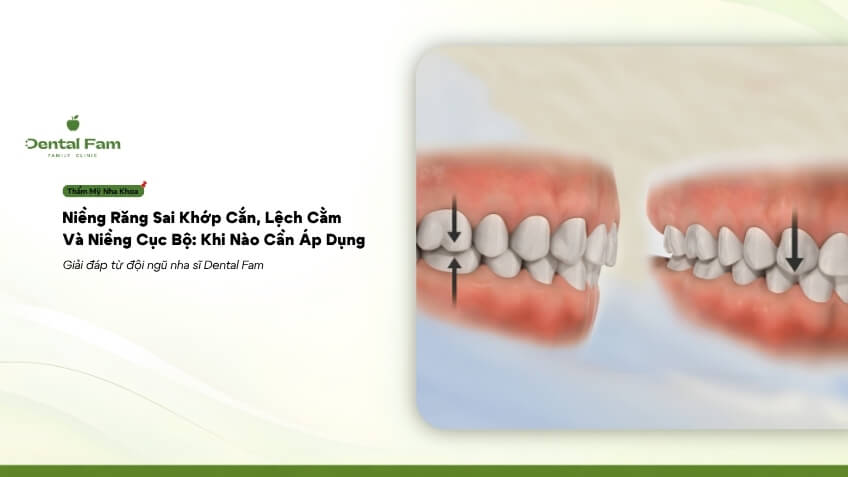
Malocclusion is a condition where the upper and lower jaws do not align correctly when biting, manifesting as open bite (upper and lower teeth do not touch at the front teeth), crossbite (some upper teeth bite inward on the lower teeth instead of outward), or overbite (upper incisors cover too much of the lower incisors).
This is a broader concept than overbite or underbite, as overbite and underbite are essentially two specific types of malocclusion (upper teeth/jaw protruding forward is overbite, lower jaw protruding forward is underbite), while open bite and crossbite are distinct types of malocclusion.
Braces can correct malocclusion if the primary cause is tooth position, but if the malocclusion stems from jaw bone misalignment (not teeth), braces alone will only partially improve it and often require jaw surgery for a complete solution. Distinguishing between dental and skeletal causes requires X-rays and direct examination; it cannot be determined solely through visual observation.
The principles for differentiating between dental and skeletal malocclusion are similar to those discussed separately in the article on orthodontic treatment for overbites, which is also a type of malocclusion that can be caused by either teeth or bone.
What is a deviated chin and can it be corrected with braces?
A deviated chin is a condition where the lower jaw or chin is not aligned correctly on the central axis of the face, causing facial asymmetry when viewed from the front, often accompanied by malocclusion on one side of the jaw. The cause of a deviated chin may be due to asymmetrical growth of the jawbone on both sides (one side developing more than the other), or due to misaligned teeth causing the lower jaw to shift to one side to find the correct bite.
If the chin misalignment is primarily caused by teeth (the lower jaw has to shift to one side to achieve proper bite due to misaligned teeth), orthodontic treatment (braces) to correct the tooth position can significantly improve the chin misalignment without surgery; if the chin misalignment is due to actual jaw bone asymmetry, braces will only help improve the bite and will not change the position of the lower jaw.
How to know if your case is due to teeth or bone before deciding on braces?
To determine whether the cause of malocclusion or chin misalignment is due to teeth or bone, the examination process includes two mandatory steps: a direct clinical examination to observe the bite relationship, and X-rays to assess the underlying jaw bone structure that is not visible to the naked eye.
Cephalometric X-rays allow the doctor to accurately measure the relationship between the upper jaw, lower jaw, and skull base, thereby distinguishing whether the misalignment comes from the tooth position or from the bone structure itself. Panoramic X-rays provide an overall view of the entire jaw, while 3D Conebeam CT scans are used for cases requiring more detailed assessment of the bone structure in three dimensions.
After obtaining the X-ray results and conducting a clinical examination, the doctor will determine whether the case is due to dental issues (which can be addressed with braces alone) or skeletal issues (requiring surgery). This is a mandatory step before developing a formal treatment plan and cannot be skipped, regardless of whether the visual misalignment is mild or severe. This examination and X-ray imaging is applied to all dental and skeletal conditions requiring diagnosis, not just malocclusion or chin misalignment.
What is Localized Braces, and How Does It Different from Full-Arm Braces?
Localized braces are an orthodontic treatment that only affects specific teeth (usually in a small area of the dental arch) instead of the entire arch. They are applied to cases of localized misalignment, such as a few slightly misaligned teeth while the rest of the arch is already in the correct position. Unlike full-arch braces (which treat all teeth on both arches simultaneously to ensure overall occlusion), localized braces have a narrower scope, usually shorter treatment time, and lower cost correspondingly.
Localized braces are not suitable for cases with overall occlusion between the two arches, as adjusting only a small area does not solve the overall occlusion problem; in this case, full-arch braces are still needed even if the degree of tooth misalignment is not significant.
When is jaw surgery combined with braces necessary?
Jaw surgery is often indicated in combination with braces when malocclusion or chin misalignment originates from a genuine skeletal cause (not a dental issue), and the misalignment is so severe that braces alone are insufficient to compensate by moving the teeth. The common procedure involves braces first to align the teeth correctly in each jaw, then surgery to adjust the jawbone position, and finally braces after surgery to achieve the final correct bite.
This is a similar treatment approach to the severe underbite case due to bone; see the article on underbite correction with braces for more details.
If the bite is still partially misaligned due to bone after braces, is it considered a failed case?
No. When the doctor has already identified the case as having skeletal issues and clearly advised that orthodontic treatment alone will only partially improve the condition (without surgery due to health reasons, personal preferences, or because the degree of skeletal misalignment does not require surgery), then the ""partial improvement"" is in line with the initial treatment goal and is not a failure or error in the treatment process.
Treatment failure is understood as a result that does not meet the goals agreed upon between the doctor and the patient before starting the treatment. Minor remaining misalignment due to unaddressed bone is a known and clearly explained limitation from the planning stage and not an unforeseen event.
The crucial point here is that the treatment goals for cases with skeletal issues must be clearly agreed upon between the doctor and the patient from the first consultation: to what extent will orthodontic treatment improve the bite and aesthetics, and what aspects of the jawbone can only be addressed through surgery? Understanding the expected range of results before treatment helps avoid misunderstandings later when comparing actual results to initial expectations.
Frequently Asked Questions about Malocclusion, Chin Misalignment, and Local Braces
Is Braces Required for Mild Malocclusion?
It's not mandatory if it doesn't significantly affect chewing function, speech, or aesthetics, but a consultation is recommended to assess the risk of long-term temporomandibular joint problems if left untreated.
Does Surgery Need to Address Mild Chin Misalignment?
Not necessarily. If the chin misalignment is primarily caused by tooth position, orthodontic treatment can significantly improve it without surgery; a direct examination is needed to determine the specific cause.
Are localized braces faster and cheaper than full-arch braces?
In general, because the treatment area is narrower, the time and cost are usually lower than full-arch braces. The specific difference depends on the number of teeth that need treatment in that localized case.
Do I need to wear a retainer after localized braces?
Yes. The principle of wearing a retainer after removing braces applies to both localized and full-arch braces, because teeth that have just moved in the treated area still need time to stabilize in the alveolar bone, even though the treatment area is smaller. See the article on retainers after braces for details.
In short, malocclusion, chin misalignment, and localized braces are three separate concepts but share the most important principle: the level of intervention depends on whether the cause is due to the teeth or the jawbone, determined through clinical examination and imaging (Cephalometric, Panorama, 3D Conebeam CT when needed).
Cases caused by teeth can often be treated with braces alone, while cases caused by bone usually require a combination of orthodontic and jaw surgery. A ""partial improvement"" in cases with bone issues that cannot be treated surgically is not considered a failure if clear goals have been agreed upon from the outset.