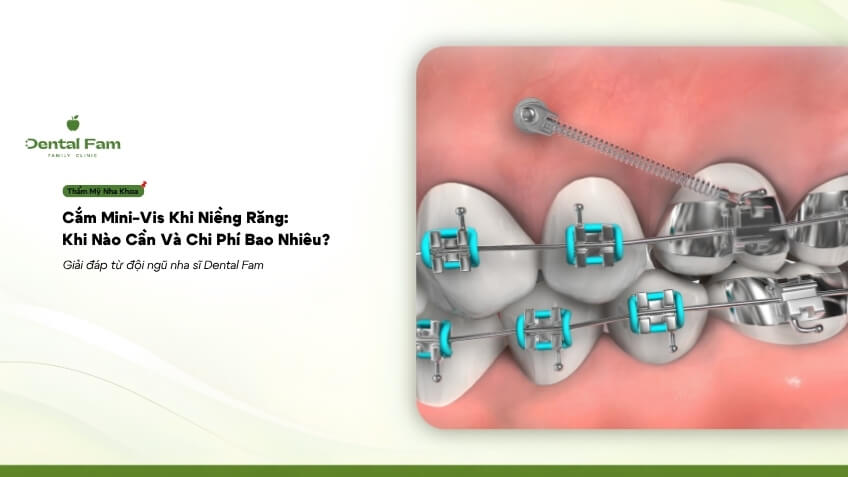
What are Mini-vis and Why Are They Used in Orthodontic Treatment?
Mini-vis are small titanium screws temporarily implanted in the jawbone between the roots of teeth. They act as anchor points to create traction for the teeth that need to move, instead of using other teeth in the jaw as anchors as in conventional braces.
In orthodontic treatment without mini-vis, the traction force on a group of teeth always creates a reaction force, causing the teeth used as anchors to also partially shift in the opposite direction. This makes it difficult to control the overall treatment plan in cases requiring the movement of multiple teeth simultaneously.
When are Mini-vis Needed in Orthodontic Treatment?
Mini-vis are usually indicated in cases requiring the simultaneous retraction of multiple teeth in the same direction. This is most common in severe cases of overbite requiring the entire upper incisor group to be moved inward, or in cases requiring the closing of large gaps after tooth extraction without affecting the position of the molars behind. Not all cases of overbite require mini-screws; this decision depends on the degree of movement needed and the number of teeth involved in the specific treatment plan.
Details about the different degrees of overbite requiring intervention, including those requiring mini-screws, are analyzed in the article on orthodontic treatment for overbites.
How is the mini-screw placement procedure performed?
Mini-screw placement is a minor procedure performed under local anesthesia. The dentist directly inserts the screws into the jawbone at the location determined on X-ray images. This process is usually quick, completed in a single appointment, and does not require incisions or sutures of soft tissue. After placement, the mini-screws are attached to elastic bands or springs connected to the teeth that need to be moved, and maintained in that position throughout the period requiring additional traction. They are then removed when no longer needed.
The placement of mini-screws is determined beforehand through X-rays, but the actual placement is usually scheduled as part of a regular follow-up appointment in the treatment plan, not necessarily a separate appointment from the regular orthodontic treatment schedule.
X-rays to determine the precise placement are usually taken beforehand during the treatment planning phase or at the most recent follow-up appointment before placement. The doctor then proceeds with the placement as soon as they have all the necessary information, saving the patient from having to return to the clinic for an additional appointment outside of their regular schedule.
Is mini-screw placement painful?
The mini-screw placement process is not painful because local anesthesia is used. A slight soreness at the placement site usually occurs after the anesthetic wears off in the first 1-2 days, similar to the feeling after other minor dental procedures. While the mini-screws are still implanted in the jawbone, most patients do not experience significant discomfort in their daily lives, except for the need to carefully clean the area around the screws to avoid soft tissue infection.
In the first few days after implantation, prioritize soft foods and avoid chewing directly near the mini-screws to reduce pressure on the newly implanted tissue. Gently clean the area around the screws with a soft-bristled toothbrush instead of brushing vigorously as usual. Strict dietary restrictions are not necessary; these precautions only apply in the initial period when the tissue around the screws is still sensitive. Afterward, normal eating and drinking habits can be resumed throughout the orthodontic treatment.
The level of pain during mini-screw implantation is similar to other procedures that may occur during orthodontic treatment, as discussed in the article ""Is orthodontic treatment painful?"".
Does Mini-Screw Placement Incur Additional Costs?
Mini-screw placement is an additional cost beyond the standard orthodontic price, calculated separately based on the number of screws needed in the treatment plan. This is one of the common additional costs (along with tooth extraction) that patients should be clearly informed about during the initial treatment planning phase to avoid surprises regarding the actual total cost compared to the listed price. The specific cost for each mini-screw will be clearly stated during the treatment planning consultation, depending on the number of screws needed for each case.
For patients considering the total cost including additional fees, detailed installment payment options are analyzed in the article on installment payments for orthodontic treatment.
Frequently Asked Questions about Mini-Vinyl Implants in Orthodontic Treatment
Can I still get braces without mini-vinyl implants if my dentist recommends them?
In principle, it's still possible to get braces, but controlling the movement of teeth requiring significant traction will be more difficult and less precise without anchor points. This could affect the position of alternative anchor teeth and prolong the treatment time.
How long should mini-vinyl implants be worn before they need to be removed?
The duration of mini-vinyl implant wear is tied to the phase requiring additional traction in the treatment plan, usually lasting only for a portion of the entire orthodontic process, not the entire course. The implants are removed as soon as the target tooth movement requiring those anchor points is achieved.
What should I do if the mini-vinyl implants become loose or fall out?
Contact your dentist immediately if you notice the mini-vinyl implants are loose or have fallen out. Do not attempt to fix it yourself at home. Depending on the treatment stage and whether the traction target is still unfulfilled, the doctor will decide whether a new screw needs to be inserted or if a different anchorage method is needed to continue the treatment plan.
Can mini-screws be rejected or broken during treatment?
This is uncommon if proper hygiene is maintained and follow-up appointments are followed for regular monitoring by the doctor. If any loosening or abnormalities are detected, early treatment as instructed above will help minimize the impact on the overall treatment progress.
Is removing the mini-screws painful after completion?
No, it is not painful. The removal process is also done under local anesthesia, similar to the insertion, and is faster because it does not require screwing deep into the bone as in the initial insertion.
Can mini-screws be used with both braces and clear aligners?
Yes, mini-screws are a technique that supports the main appliance and can be combined with both braces and clear aligners depending on the treatment plan for each case.
In short, mini-screw placement is an additional procedure applied to orthodontic cases requiring significant traction or the simultaneous movement of multiple teeth, most commonly in cases of severe overbite. It is not a mandatory step for everyone undergoing orthodontic treatment. The procedure is painless thanks to local anesthesia, is usually integrated into the existing follow-up schedule, and incurs additional costs beyond the standard orthodontic price list. Therefore, clear consultation is necessary during the treatment planning stage to avoid unexpected total costs.