How Do Dentists Classify Periodontitis?
Dentists classify periodontitis using two pieces of information: Stage indicates how far the disease has progressed, and Grade indicates how fast or slow the disease is progressing. This method is more comprehensive than simply calling it mild or severe. The section below explains Stage, Grade, and how to interpret the combined results.
What Does Stage Indicate?
Stage (stages I to IV) indicates the severity and complexity of the disease at the time of examination. The dentist bases this classification on the degree of attachment loss (the extent to which teeth gradually lose their attachment to supporting tissues), the degree of bone loss on X-rays, tooth loss due to periodontal disease, and other factors that complicate the case. The higher the Stage, the more supporting tissue is lost and the more complex the treatment becomes.
What does the Grade indicate?
The Grade (A to C) indicates whether the disease is more likely to progress slowly or rapidly. Doctors consider the rate of tissue loss and risk factors such as smoking or poorly controlled diabetes. Two people with the same Stage can still have different Grades, so the monitoring plan may differ.
How to read ""Stage II, Grade B"" results
A ""Stage II, Grade B"" result can be simply understood as the disease being at a moderate level of spread and complexity (Stage II), with an intermediate rate of progression (Grade B). You can think of Stage as ""which level you're at"" and Grade as ""how fast or slow you're progressing.""
These two pieces of information complement each other and help doctors plan treatment and monitoring. Stage and Grade are not permanent labels: doctors reassess when the condition changes or at follow-up appointments.
Many professional guidelines often schedule follow-up appointments every few months; the specific schedule is determined by the Dental Family doctor based on each individual's condition. To help you visualize, the table below compares the familiar terminology for these two systems.
Which Stage and Grade corresponds to mild, severe, chronic, or acute periodontitis?
The term ""mild"" is usually closer to Stages I to II, ""severe"" closer to Stages III to IV, while ""chronic"" and ""acute"" are more related to the Grade and progression. The table below is for reference only and should not be used for self-diagnosis.
The stage cannot be determined solely by numbers. The number of attachment loss readings is only part of the information. Doctors also combine bone loss on X-rays, periodontal tooth loss, and individual factors. To understand the last two forms in the table, the following section compares chronic and acute.
How are chronic and acute periodontitis different?
Chronic periodontitis progresses slowly and is common, while acute periodontitis flares up rapidly and may be accompanied by abscesses. These two terms refer to the progression of the disease, not its severity. Chronic periodontitis can be insidious for a long time before symptoms become apparent, while the acute form usually causes immediate discomfort, for example, swollen gums and pus.
Therefore, ""chronic"" does not automatically mean mild, and ""acute"" does not automatically mean the most severe. If you see these signs, please refer to the article on periodontal disease signs. Because progression and severity are two different pieces of information, self-labeling can easily lead to confusion, as shown below.
Why you shouldn't self-classify periodontal disease severity?
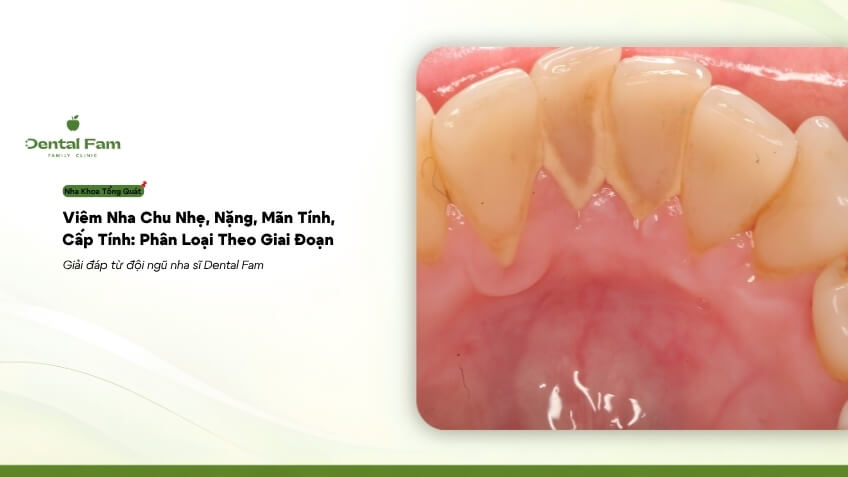
You shouldn't self-classify because the main damage is under the gums and in the bone, which is not visible to the naked eye. The gums may look only slightly red, but attachment loss or bone loss may have occurred, and vice versa.
To determine the correct severity, the doctor needs to measure the periodontal pocket depth, assess attachment loss, check for looseness, and take X-rays during the examination and diagnosis, and may add other diagnostic methods if necessary.
You can refer to the illustrations in the article on periodontal disease images at different stages, but the images are for reference only and do not replace an examination. After determining the severity, the next step is choosing the treatment plan.
How does the severity affect the treatment plan?
The treatment plan is chosen based on the actual condition of each tooth, not just based on whether it's labeled as mild or severe. At Dental Fam, the doctor will prescribe one of three options: non-surgical treatment from 500,000 VND per tooth, LASER (laser treatment) from 1,000,000 VND per tooth, and surgical treatment from 2,000,000 VND per tooth, including examination and consultation. LASER treatment is different in technology, not an upgrade, and does not necessarily mean the condition is more severe.
If surgery is needed from the outset, the doctor will prescribe surgery without requiring non-surgical treatment beforehand. For severe cases, please refer to the article on treating severe periodontitis. The summary below outlines the main points.
Mild, severe, chronic, and acute are common terms, but dentists classify periodontal disease into Stages I to IV and Grades A to C. Stage indicates the severity, Grade indicates the rate of progression, and the stage isn't determined solely by numbers. Since the lesions are below the gum line, you shouldn't self-classify.
At Dental Fam, our doctors measure, take X-rays, and then select the appropriate treatment, starting from 500,000 VND per tooth. Schedule an appointment to find out which stage you're in.
Dental Fam - Family Clinic
- Address: NOTT 28, 29, 30, Phuoc Long A Urban Area, Nha Trang, Khanh Hoa
- Hotline: +84 582 582 345 / +84 983 001 768
- Email: info@dentalfam.vn
| Common Name | Similar to | Loss of interdental attachment (reference) | Meaning |
| Mild | Stage I | 1 to 2 mm | Initial stage, little support tissue loss |
| Moderate | Stage II | 3 to 4 mm | More pronounced loss of attachment, requires treatment Specialty |
| Severe | Stage III to IV | From 5 mm | Significant tissue and bone loss, may affect chewing, more complex |
| Chronic | Usually close to Grade A or B | Undetermined by measurement | Slowly progressive, the most common form |
| Acute | Usually close to Grade C or periodontal abscess attack | Undetermined by measurement | Rapid outbreak, possibly with abscesses |