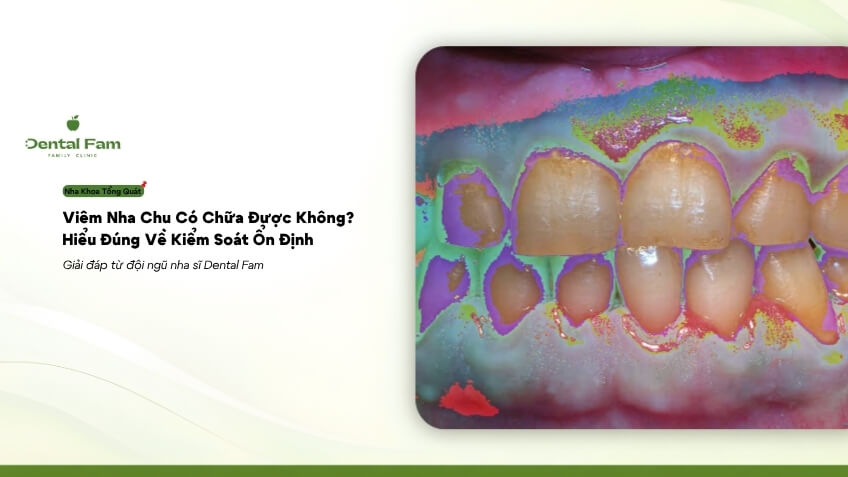
How Curable Is Periodontitis?
Periodontitis can be controlled long-term with proper treatment and follow-up appointments, but this should not be understood as a return to the point where the disease never occurred. The realistic goal of treatment is to bring the disease to a state of cessation of progression and gum healing.
This is also the understanding of ""complete cure"" in the context of periodontitis, and it is not about hoping that the lost tissue will return to its original state, nor is it a pessimistic view that treatment is ineffective. The following section clearly distinguishes which parts can be restored.
Which parts can be restored, and which usually cannot?
Gums can heal and the inflammation subsides, but the lost bone and supporting tissue usually do not fully recover. In some cases, partial regeneration may be possible depending on the extent and treatment method, and the doctor will assess this possibility during the examination. Once bone loss has occurred, the dentist doesn't just monitor the condition: depending on the case, they may control inflammation, adjust chewing force or bite, and stabilize loose teeth when necessary.
Therefore, you should expect the disease not to progress further and the teeth to be preserved as best as possible. If you are concerned about severe periodontal disease, see the article ""Treatment of Severe Periodontal Disease"" or the services page for more information on treatment options. Even when the disease is stable, it can still return, so the following section discusses the risk of recurrence.
Why can periodontal disease recur?
Periodontal disease can recur when bacterial plaque and risk factors are not controlled after treatment. Common causes include inadequate cleaning of the subgingival area, inconsistent maintenance care, or unaddressed risk factors such as smoking or poorly controlled diabetes.
This is a fairly common and manageable situation. If you attend all follow-up appointments and the disease returns, it doesn't automatically mean the treatment was wrong, as individual risk factors can still cause recurrence; seek medical attention promptly if you notice signs of recurrence. Since the feeling of stable gums isn't enough to conclude anything, your doctor will monitor using measurable indicators; you can find information on how to monitor in the article ""Criteria for Assessing Stable Periodontitis."" Once you understand the risks, you can set realistic expectations.
What are realistic expectations when treating periodontitis?
A realistic expectation is long-term, stable control and consistent maintenance, not a one-time cure.
| Appropriate Expectations | Adjusted Expectations |
| Disease stops progressing, gums heal | Lost bone and tissue regrow as before |
| Maintenance and follow-up appointments as scheduled by the doctor | Treatment is complete and no further care is needed |
| Assessment using measurements and X-rays | Assessment based solely on sensation |
The time and number of treatment sessions to achieve a stable state are explained in the article ""How long does it take for periodontitis to heal?"". What does Dental Fam do? The dentist will assess each tooth using measurements and X-rays, prescribe appropriate treatment (from 500,000 VND/tooth, including examination and consultation), and schedule follow-up appointments to maintain the results.
Periodontal disease can be controlled and stabilized long-term, but lost bone and tissue often do not fully recover, and the disease may return if maintenance is not consistent. The realistic expectation is that the disease stops progressing, the gums heal, and you maintain good care and attend follow-up appointments as scheduled.
If you want to know your current condition and how it can be managed, schedule an appointment at Dental Fam so the dentist can measure, assess, and advise on the appropriate treatment plan.
Dental Fam - Family Clinic
- Address: NOTT 28, 29, 30, Phuoc Long A Urban Area, Nha Trang, Khanh Hoa
- Hotline: +84 582 582 345 / +84 983 001 768
- Email: info@dentalfam.vn