Before whitening your teeth, determine which teeth type you have
Before thinking about which method or product to use, there's a more important question: are your teeth suitable for self-whitening? Generally, there are two groups: those with external staining due to food, coffee, tea, and tobacco; and those with internal abnormalities such as poorly mineralized enamel, sensitivity, or gingivitis. The table below quickly summarizes how to distinguish between the two groups.
| Criteria | Suitable for at-home whitening | Caution required, consult a dentist |
| Source of discoloration | External (food, coffee, tea, tobacco) | Yellow/brown spots not from food, suspected molar incisor hypomineralization (MIH) |
| Age | 20 years and older | Under 20 years old |
| Condition of gums and enamel | Healthy, no inflammation | Sensitive or inflamed gums |
From baking soda, activated charcoal, lemon and apple cider vinegar, coconut oil, to salt, banana peels, and rice water, these are folk remedies compiled by Dental Fam from popular methods passed down through generations. To make it easier to understand, imagine the case of Ms. Lan, an office worker in Nha Trang, who, like many others, started by trying baking soda and lemon for a few weeks after reading about it online, before delving deeper into how these remedies actually affect teeth.
In general, most home remedies only affect plaque and stains on the surface of the teeth, without changing the actual color of the teeth underneath. Some remedies, if used incorrectly or in the wrong frequency, can even risk eroding tooth enamel.
| Tips | How to do it | Recommended maximum frequency | Caution required |
| Baking soda + hydrogen peroxide | Mix diluted, brush gently | 2-3 times/week | Medium |
| Activated charcoal | Dip onto toothbrush, brush gently | 2-3 times/week | Medium (less than equal to (Effectiveness) |
| Lemon, apple cider vinegar | Dilute, gargle, then rinse with clean water | Once a week | High (acid that erodes enamel) |
| Coconut oil (oil pulling, i.e., swishing oil in the mouth) | Glue and gargle for 10-15 minutes | No clear limitations, only helps with antibacterial action | Low, but not a whitening method |
| Salt, banana peel, rice water | Rub or gargle | No clear recommendations yet | Least scientific basis |
Baking soda has mild abrasive properties that help remove surface plaque, while hydrogen peroxide provides temporary brightening. It should not be used more than 2-3 times per week, as frequent or vigorous brushing can wear down tooth enamel.
Activated charcoal
Activated charcoal absorbs some surface plaque, but it is also abrasive. There is currently no clear scientific evidence to prove the effectiveness of this method in whitening teeth.
Lemon, apple cider vinegar (acid-containing group)
This is the group that requires the most caution among folk remedies, as the acidity can erode tooth enamel if used incorrectly or too frequently. If you want to try it, the maximum frequency should be once a week.
Coconut Oil Pulling
Oil pulling, which involves swishing and rinsing coconut oil in your mouth for about 10-15 minutes before spitting it out, has mild antibacterial properties and aids oral hygiene. There is currently no scientific evidence to suggest this method actually whitens teeth. It should be understood as a habit to help clean your mouth rather than a whitening method.
Salt, Banana Peels, Rice Water
This is the most commonly passed-on tip, but it has the least scientific basis. Salt can help with mild cleaning due to its antiseptic properties; banana peels and rice water are also believed to have similar effects, but the specific mechanism has not been clearly verified.

After trying the above tips for a few weeks without noticeable whitening results, many people begin to wonder if there are more effective at-home methods. The answer lies in the specialized products below.
How to whiten teeth at home using specialized products
Unlike folk remedies, the following products, including toothpaste/mouthwash containing peroxide (whitening agents based on hydrogen peroxide or carbamide peroxide), strips, gels, and trays, contain tested whitening agents. The concentration of at-home whitening agents, according to Dental Fam standards, is typically 16-22%.
According to the American Dental Association (ADA, 2022), the concentration of carbamide peroxide in home dental products generally ranges from 10-38%, depending on the product.
| Product | How to use | Notes |
| Peroxide-containing toothpaste/mouthwash | Use as a replacement for regular products, regularly | Lowest concentration in the group |
| Teeth whitening strips | Apply to teeth for about 30 minutes/time | Can easily cause sensitivity if used continuously for many days |
| Gel pen/whitening gel | Apply with the brush tip, 1-2 times/day | Avoid letting the gel spread to the gums |
| OTC (over-the-counter) trays (purchased freely without a prescription) | Pour the gel into the pre-made tray, wear for a few hours/day | Pre-made trays, not custom-molded, therefore have a less snug fit than trays prescribed by a dentist |
Whether choosing a home remedy or a specialized product, there is an equally important question: how do you know you are using it correctly and not exceeding safe limits?
Safety Precautions When Whitening Teeth at Home
Regardless of which method you choose from the two sections above, there are three safety principles to remember:
-
Do not overuse. Each tip or product has its own recommended frequency (see table above); overuse will not whiten faster but will only increase the risk of enamel erosion.
-
Monitor sensitivity. According to the ADA (2022), mild sensitivity in the first few days is quite common and usually resolves on its own after about 4 days. If sensitivity lasts longer than that, stop and do not continue self-treatment.
-
Do not self-whiten if you belong to a group requiring caution. If you have unusual yellow/brown spots, are under 20 years old, or have sensitive teeth or gingivitis (see classification table at the beginning of the article), it is best to consult a dentist first.
Let's say you're like Ms. Lan in the example above: you tried some home remedies but started experiencing prolonged sensitivity, or you're unsure which category your teeth fall into. This is when you should consider another option: professional teeth whitening at a dental clinic.
Professional Teeth Whitening
If your teeth fall into the category requiring caution mentioned above, or you simply want clearer results under professional supervision, there are three common methods available at dental clinics: in-office light whitening, custom-made trays, and specialized kits. The biggest difference compared to at-home whitening is the higher concentration of whitening agent used, typically 15-35% according to dental standards, and the constant supervision by a dentist throughout the process.
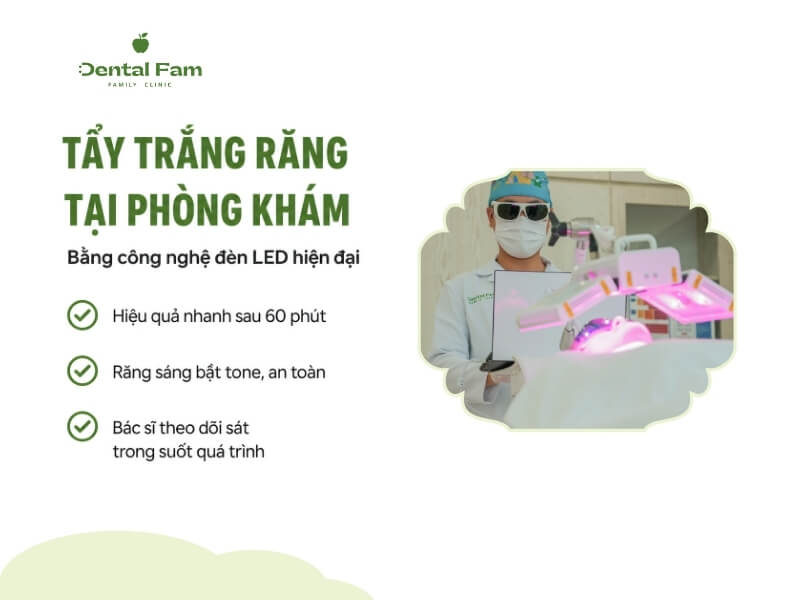
In-Clinic Teeth Whitening with Light
The dentist applies the whitening gel to the teeth and uses a light to activate it. This procedure is performed right in the clinic. This method yields the fastest results, often visible within a single session, and is suitable for those who want to see results quickly and have someone monitor them during the procedure.
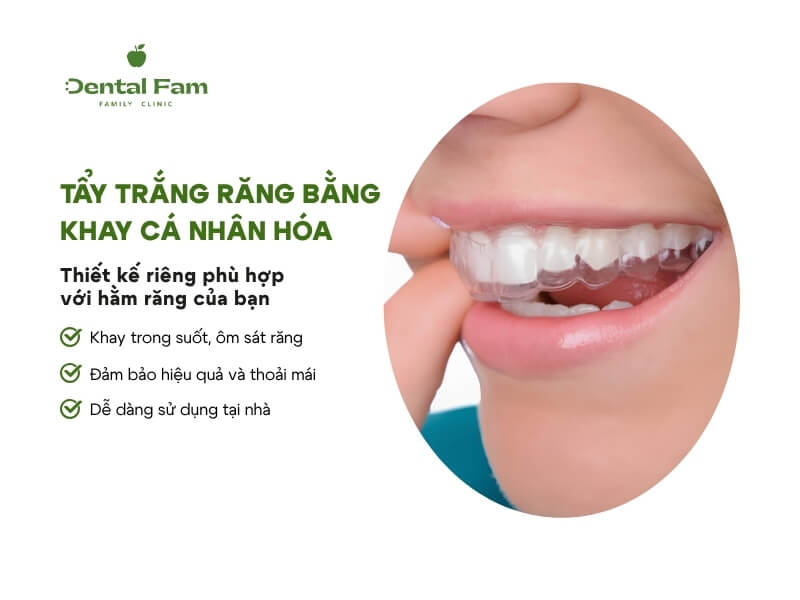
Dentally Prescribed Whitening Trays
Unlike the self-purchased trays mentioned above, these trays are custom-made by the dentist using impressions of each individual's teeth. They fit much more snugly, significantly reducing the risk of gel leaking onto the gums and causing irritation.
Professional Teeth Whitening Kit at the Clinic
The kit includes a high-concentration gel and supporting tools, prescribed and used according to a specific treatment plan by the dentist. It's an intermediate option between in-office whitening and wearing custom trays.
With the three professional methods and at-home options mentioned above, the next question is: which method is right for your teeth?
Should you choose at-home or in-office whitening?
The answer depends on two things: which tooth category you belong to in the classification table at the beginning of the article, and whether you prioritize low cost or supervision.
| Criteria | At Home | At the Clinic | ||
| Cost | Lower | Higher | ||
| Time to See Results | Slower, usually several weeks | Faster, possibly within the same session (with light therapy) | ||
| Level of Monitoring | Self-administration, self-monitoring | Yes The doctor will monitor you throughout the process. | ||
| Suitable for which tooth groups? | Groups suitable for self-treatment (see table at the beginning of the article) | Groups requiring caution, or wanting quick results |
So when should you proactively seek dental care instead of making decisions on your own?
When Should You Consult a Dentist Before Teeth Whitening?
If you're unsure which group you belong to, have tried several home remedies without success, or experience sensitivity lasting more than a few days, these are signs that you should consult a dentist before proceeding. A consultation doesn't mean you have to start treatment immediately. The main purpose is to accurately determine your dental condition and the appropriate method, avoiding wasted time and money on a treatment unsuitable for your teeth.
As Mr. Fam always says: ""I'm here to remind you that oral care can be clear, understandable, and worry-free. We'll work with you to assess your actual condition before making any decisions."" At Dental Fam, pre-treatment consultations always include clear explanations of costs and options, so you can make the final decision.

Below are some other frequently asked questions about teeth whitening, to quickly answer any questions not addressed in the sections above.
Frequently Asked Questions about Teeth Whitening
This section quickly answers questions about the causes of tooth discoloration, cost, safety, time to see results, and the case of porcelain veneers.
Why do teeth become yellow or discolored?
There are two main groups of causes: external staining from food, coffee, tea, and tobacco; and internal discoloration due to age, certain medications, or poor enamel mineralization.
How much does teeth whitening at home and at the clinic cost?
Home whitening is generally less expensive but takes longer to see results, while at the clinic it's more expensive but faster and supervised by a dentist. For specific prices, please see the Dental Fam teeth whitening price list.
Does teeth whitening harm tooth enamel?
If used at the correct concentration, frequency, and with proper monitoring, teeth whitening does not permanently harm tooth enamel according to current ADA recommendations (2022). The main risks come from the misuse of home remedies or products of unknown origin, and incorrect frequency of use.
How long does it take to see results when whitening teeth at home?
With specialized products, it usually takes several weeks of continuous use to see noticeable results. Regarding folk remedies, there is currently no clear, scientifically proven timeframe.
Can porcelain veneers be whitened?
According to the ADA (2022), porcelain veneers or composite fillings do not change color when whitened, as the whitening agents only affect the natural teeth. If you want your porcelain veneers to match the color of your natural teeth after whitening, it is best to discuss this directly with your dentist for a suitable solution.
Not all yellowed teeth can be whitened in the same way. Before trying any home remedies or products, determine whether your teeth are suitable for self-whitening or require caution. Folk remedies only affect the surface and are not guaranteed to be effective; specialized products and methods at clinics have a clearer basis but still require the correct dosage and indications.
If you are unsure about your dental condition, the Dental Fam team is always ready to advise you on the right method before starting, not to pressure you into a treatment plan.
Dental Fam - Family Clinic
- Address: NOTT 28, 29, 30, Phuoc Long A Urban Area, South Nha Trang, Khanh Hoa, Viet Nam
- Website: dentalfam.vn
- Email: info@dentalfam.vn
- Hotline: +84 582 582 345 / +84 983 001 768