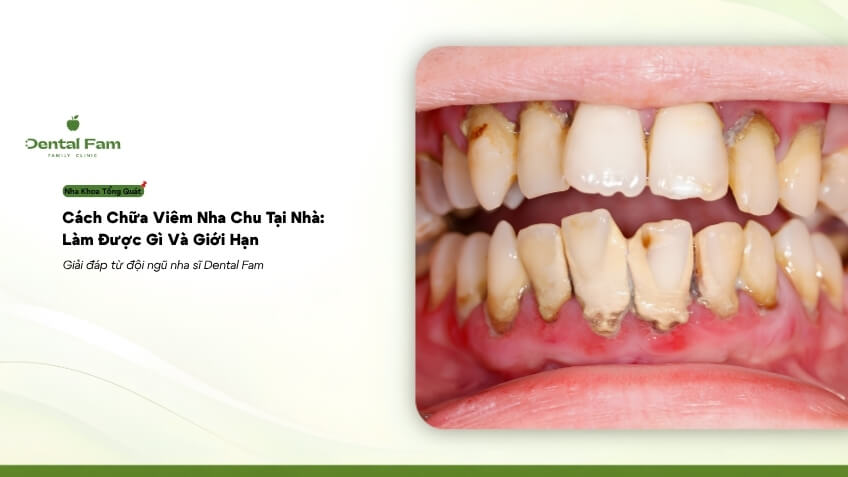
What can you do with treating periodontal disease at home?
At home, you can maintain the results and limit new plaque buildup, but you can't create the treatment results yourself. Daily care helps keep gums clean and slows progression, but established periodontal pockets require treatment by a dentist.
Therefore, the two approaches have different roles: at home to support and maintain results, and at the clinic to address the underlying cause as directed. At home, you also can't tell the stage of the disease, as the severity is only determined during an examination. The following section explains why at home treatment has this limitation.
Why can't toothbrushes and mouthwash address the root cause?
Because the root cause is bacterial plaque located beneath the gums, where toothbrush bristles and mouthwash cannot reach. When plaque accumulates in the gum area, prolonged inflammation gradually destroys the supporting tissues of the teeth. Tartar isn't the direct cause, but it provides a surface for plaque to adhere to, making home cleaning less effective.
Once periodontal pockets have formed, the plaque inside is beyond the reach of a toothbrush and mouthwash. Brushing thoroughly every day helps clean the gums after treatment, but it doesn't clean the existing pockets. This explains why some people with very careful care still experience bleeding gums: the problem lies in areas they can't reach. Once you understand this limitation, you can focus on the truly helpful home remedies, which include the following four measures.
Four Proper Home Support Measures
The four support measures include proper brushing technique, interdental cleaning, using mouthwash as prescribed, and not smoking. These four things range from daily mechanical cleaning to reducing risk factors, and they are all supportive measures, not replacements for treatment. The first three are oral care practices, and the last one is a lifestyle habit.
Proper Brushing Technique
Proper brushing technique means cleaning the gum line without causing further damage. You should choose a soft-bristled toothbrush and gently brush close to the gum line on all tooth surfaces, avoiding strong pressure as excessive force can damage the gums. If your gums are bleeding, don't ignore the area: bleeding is a sign of inflammation, and neglecting to brush will allow plaque to build up further. You should brush your teeth twice a day. If you are unsure whether you are brushing correctly, your dentist can provide direct guidance during your appointment.
Cleaning Between Teeth with Dental Floss or Water Flosser
Dental floss or a water flosser helps clean between teeth, areas that are difficult for a toothbrush to reach. Plaque easily accumulates between teeth and close to the gum line, so a toothbrush alone is often insufficient. You can choose dental floss or a water flosser depending on your preference and comfort level, and use it gently to avoid damaging your gums. Clean between your teeth daily. Both are still just daily care, not a replacement for professional under-gingivitis cleaning at the clinic.
Prescribed Mouthwash
Mouthwash should only be used as prescribed by your dentist, and its role is supportive. Antibacterial mouthwash can help reduce bacteria in the oral cavity, but it doesn't reach the periodontal pockets and doesn't provide a cure. The appropriate type and duration of use should be determined by your dentist based on your condition. Saline solution is a mild solution that can be used for gentle rinsing, but it doesn't replace the specific treatment prescribed by your dentist and doesn't clean plaque under the gums.
Don't Smoke
Not smoking is a risk factor you can completely do yourself. Smoking can make periodontal disease more likely to develop or worsen, although it doesn't always directly cause the disease. Poorly controlled diabetes is also a risk factor, so if you have underlying conditions, monitoring them is part of long-term care. Stopping medication doesn't replace treatment, but it helps reduce one factor that can worsen the condition. These four measures are helpful, but it's also important to know when they are no longer sufficient.
When is home care no longer sufficient?
Home care is no longer sufficient when there are signs that the damage is beyond the cleaning capacity of a toothbrush. The following signs should be examined by a dentist, instead of continuing to self-treat:
| Signs | Important Notes |
| Swollen, red gums that bleed persistently despite regular cleaning | Persistent inflammation, possibly due to plaque in areas you don't reach |
| Persistent bad breath | The cause needs to be found instead of just masking the smell |
| Receding gums, exposed tooth roots | Partial loss of supporting tissue may have occurred |
| Loose or spaced teeth | May be related to alveolar bone loss |
| Pus between teeth and gums | May be a periodontal abscess, which should be checked by a dentist early |
Clinic treatment differs in that it involves measurement diagnosis, subgingival cleaning, and a clear endpoint. The dentist examines the gums, measures the depth of the periodontal pockets, assesses the degree of attachment loss, checks for looseness, and takes X-rays before selecting the treatment options.
Each session usually lasts about 30 minutes, but can be longer depending on the individual, but is generally around 2 hours; Typically, 1 to 4 intensive treatment sessions are needed depending on the treatment plan; complex cases may require more. After treatment, many professional guidelines usually schedule follow-up appointments every few months; the specific schedule is determined by the Dental Clinic doctor based on each individual's condition.
| Criteria | At Home | At the Clinic |
| Periodontal Pockets Have Formed | Cannot Be Cleaned | Subgingival Cleaning, Root Surface Treatment |
| How to Know the Results | Based on Feeling | Based on Measurements and X-rays |
| End Point | No End Point | Intensive treatment, followed by maintenance and follow-up appointments. |
What does Dental Fam do? At Dental Fam, the doctor assesses the condition of each tooth and then prescribes one of three options: non-surgical (500,000 VND/tooth), LASER (laser technology) (1,000,000 VND/tooth), or surgical (2,000,000 VND/tooth), including examination and consultation. LASER is different in technology, not an upgrade, and does not mean the condition is worse.
After treatment, home care returns to its original role of maintaining the results, so the practical question is how long you should continue self-monitoring.
When should you go for a check-up after self-monitoring?
You should go for a check-up if the symptoms haven't improved after a period of regular care, and you shouldn't wait until you experience pain or loose teeth. This article doesn't specify a timeframe, as the appropriate timeline depends on individual circumstances and is determined by a doctor during a consultation.
If you only have mild gum swelling and no signs listed above, a safe approach is to apply the four measures above, self-monitor, and see a doctor if the condition doesn't improve after a short period of self-monitoring. If your gums are still bleeding or your breath still smells bad despite proper care for a while, schedule an appointment instead of prolonging self-monitoring. If pus is present, see a dentist as soon as possible. Seeing a dentist doesn't mean the condition is severe; it just helps determine your current stage.
Home care helps maintain results but doesn't create them, as bacterial plaque under the gums is beyond the reach of toothbrushes and mouthwash. The four measures—proper brushing technique, interdental cleaning, using mouthwash as directed, and not smoking—should still be maintained daily. If you experience persistent bleeding gums, bad breath, receding gums, loose teeth, or pus, schedule an appointment at Dental Fam for a dentist to measure and advise on appropriate treatment options.
Dental Fam - Family Clinic
- Address: NOTT 28, 29, 30, Phuoc Long A Urban Area, Nha Trang, Khanh Hoa
- Hotline: +84 582 582 345 / +84 983 001 768
- Email: info@dentalfam.vn