"## When Should Dentures Be Removed for Cleaning?
Dentures should be removed for cleaning after every meal and, importantly, before going to sleep. This section discusses two points in the day and the reasons for cleaning, which are also related to your natural teeth.
Both are mandatory instructions, not optional advice. Many people think dentures only need cleaning for freshness and cleanliness, but with partial dentures, there's another reason. The metal clasps that hold onto the natural teeth can weaken the supporting teeth, and plaque buildup is one of three causes, in addition to pressure, tension, and overload. You can find more information in the article on removable partial dentures.
Knowing when to remove them, you need to know what to do each time you remove them.
Steps for Daily Denture Cleaning
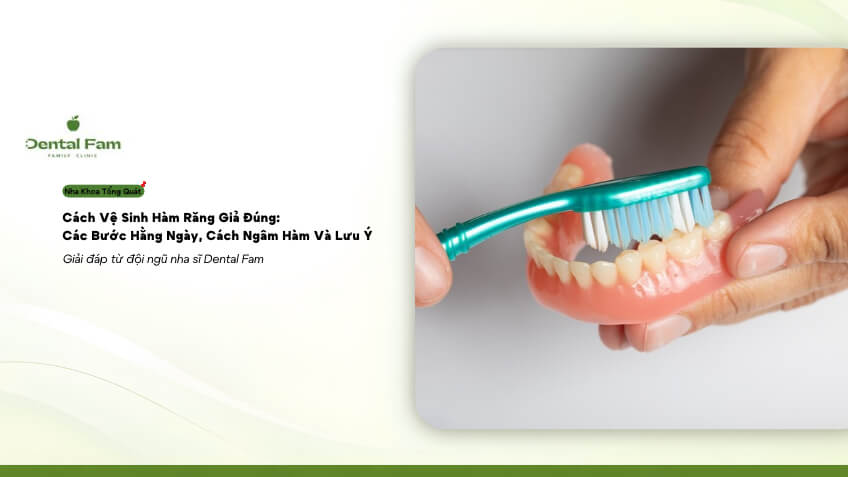
Daily cleaning consists of 5 steps: removing the dentures and rinsing, gently brushing, soaking the dentures, cleaning the oral cavity, and rinsing the dentures again before putting them back on. Each step is as follows.
-
Remove and rinse dentures: Remove dentures from your mouth and rinse with clean water or saline solution.
-
Gently brush: Use a soft-bristled toothbrush with mild soap, diluted dish soap, or toothpaste specifically designed for dentures. Brush thoroughly between the dentures and on the denture surfaces to remove food debris.
-
Soak dentures: After brushing, soak dentures in diluted salt water, diluted vinegar solution, or a specialized denture soaking solution for 15 to 20 minutes, or overnight.
-
Clean the oral cavity: Before putting dentures back on, use a soft toothbrush to brush your natural teeth, tongue, cheeks, and palate to remove bacteria.
-
Reinstall dentures: Rinse off any soaking solution residue with warm or cold water before putting them back on.
Step 2 mentions avoiding regular toothpaste, and this is the most frequently asked question.
Can I use toothpaste to clean dentures?
No, you should not use regular toothpaste to clean plastic dentures, as plastic dentures are fundamentally different from real teeth and gums. This section compares common cleaning methods.
After brushing, the soaking step is where the solution determines whether the dentures will last.
Which solution should you use to soak your dentures?
Three common options are specialized effervescent tablets, 0.9% saline solution, and diluted white vinegar. Each is suitable for a different purpose.
-
Specialized effervescent tablets: Drop one tablet into a glass of warm water (around 40°C), soak for 3 to 5 minutes or 15 minutes depending on the type, then rinse. This type is designed to clean plaque and deodorize without damaging the resin. You can refer to popular brands on the market such as Polident, Efferdent, FittyDent, or Clene.
-
0.9% saline solution: A safe, readily available, and economical solution for soaking dentures overnight. The saline solution keeps the dentures moist, preventing the resin from drying out, which can lead to brittleness, shrinkage, or deformation.
-
Diluted white vinegar: Mix white vinegar with clean water in a 1:1 ratio. The mild acidity helps clean tartar buildup on the dentures. If the dentures have metal clasps, you shouldn't soak them in vinegar frequently as the acid can corrode the metal.
Even after choosing the right solution, you still need to avoid some habits that can damage your dentures.
Important Notes on Cleaning and Using Dentures
There are 5 things to do and 5 things not to do for durable dentures and a healthy mouth. The two lists below summarize everything above.
5 Things to Do
-
Remove dentures when sleeping: This allows the gums and jawbone time to rest, preventing prolonged pressure.
-
Remove the dentures after each meal: This is mandatory.
-
Have a dental check-up every 3 to 6 months: The dentist will check your oral health and the condition of the dentures, and adjust them if they become loose due to bone loss.
-
Rinse the dentures after soaking: Rinse off any solution residue with water before wearing them.
-
Visit the clinic if the dentures are loose, cracked, chipped, or broken: Don't try to endure a damaged denture.
5 Things You Shouldn't Do
-
Do not use hot or boiling water to wash or soak the dentures: Heat will deform and warp the plastic material.
-
Do not use excessive force: Avoid scrubbing vigorously or using a hard-bristled brush that could scratch the plastic surface.
-
Do not attempt to repair them yourself: If the dentures are cracked, broken, or loose, do not grind them yourself or use adhesives not intended for dentures.
-
Do not use regular toothpaste: Plastic dentures are completely different from real teeth and gums.
-
Do not soak dentures with metal clasps in vinegar frequently: Acid can corrode the metal.
Among these points, knowing when to visit a dentist is crucial if you have problems with your dentures.
After cleaning, when should you visit a dentist?
Dentures don't have a fixed schedule for follow-up appointments; you only need to visit the dentist when you have problems requiring treatment, but regular general dental checkups are still recommended. This means there are no scheduled appointments to remind you to check, so removing and cleaning your dentures daily is also when you can detect problems yourself.
Care instructions are in the final step of the process; see the article on how to make removable dentures. This section lists the signs that require a visit to the dentist, then delves into the most common case: loose dentures.
| How to Clean | Should you use it? | Notes |
| Regular Toothpaste | No | Dental prostheses are completely different from real teeth and gums |
| Specialized Toothpaste for Dentures | Can be used | Specifically for Dentures |
| Mild soap, diluted dish soap, biological detergent | Can be used | Diluted and rinsed thoroughly with water |
| Specialized vibrating device and cleaning tablets | Can be used | Similar to cleaning clear aligners |
| Signs | Treatment |
| Loose dentures, no longer fitting properly | See the section on treating loose dentures below |
| Broken, cracked, or chipped dentures | Repairing dentures |
| Broken metal clasps | Remaking clasps, or making new dentures with a framework |
How to treat loose dentures?
Loose dentures after a period of use are usually due to bone resorption and natural gum recession creating gaps, not because the dentures themselves are stretched. Depending on the degree of looseness, you have solutions Temporary solutions at home and permanent solutions at the clinic.
Temporary solutions at home: You can use specialized denture adhesive, applying a small amount to the denture lining before wearing it to create a cushion that helps the denture stay securely in place throughout the day. The adhesive is only a supplementary solution and does not address the underlying cause; details can be found in the article on denture adhesives.
Permanent solutions at the clinic: There are three approaches.
-
Dental padding: When the denture base and teeth are still in good condition, the dentist adds a layer of resin to the denture lining to restore a snug fit. Denture padding costs 1,000,000 VND per denture, while soft denture padding costs 2,000,000 VND per denture.
-
New dentures: When the denture is severely damaged, the resin degrades, or there is significant bone loss, the dentist takes a gum impression to create a new denture.
-
Removable dentures on implants: These use implant posts (grafting posts) as support for the denture, suitable when there is significant bone loss. At Dental Fam, a double implant denture costs 60,000,000 VND per denture. See the article on removable dentures with implants.
What if the denture is so loose that it affects speaking?
When the denture is so loose that it affects speaking or has caused ulcers, adhesive is only a temporary solution, and you should see a dentist as soon as possible. At that point, all three options above require a dentist's examination: re-cushioning for temporary use if the denture base and teeth are still good, taking new impressions to make a perfectly fitting denture, or inquiring about implant abutments if finances allow.
Frequently Asked Questions
If using adhesive, do I still need to remove the denture for cleaning?
Yes, you still need to remove the denture for cleaning after each meal and before going to bed, whether you use adhesive or not. Adhesive only aids in adhesion; it does not replace cleaning.
What to do if elderly people have difficulty cleaning their dentures themselves?
Family members can help remind and assist elderly people in removing their dentures for cleaning on time. Elderly people often have difficulty ensuring proper cleaning and maintenance of their dentures. You can read more about dentures for the elderly.
How long do removable dentures last?
Removable dentures typically last about 3 to 5 years, depending on the material, usage habits, and bone loss. This is a general guideline, not a warranty period. Dental Fam offers a 6-month warranty for Japanese dentures, a 1-year warranty for American dentures, and a 3-year warranty for composite dentures.
You need to remove your dentures for cleaning after each meal and before going to bed. Brush gently with a soft toothbrush and soak them in a specialized effervescent tablet or diluted saline solution. Do not use regular toothpaste, hot water, or apply strong pressure. If the dentures become loose, cracked, or broken, visit the clinic for padding, repair, or a new denture instead of attempting to repair them yourself.
All dentists at Dental Fam can perform removable dentures. This article is based on the clinic's post-treatment usage instructions. You can view an overview of the service on the removable dentures page.
The appropriate cleaning method depends on the denture material and the individual's oral condition, so you can ask your dentist during your visit. The 100,000 VND consultation fee is waived if you have dentures made immediately.
Dental Fam - Family Clinic
- Address: NOTT 28, 29, 30, Phuoc Long A Urban Area, Nha Trang, Khanh Hoa
- Opening Hours:
- Monday to Saturday: 8:00 AM to 6:00 PM;
- Sunday: 8:00 AM to 12:00 PM
- Hotline: +84 582 582 345 / +84 983 001 768