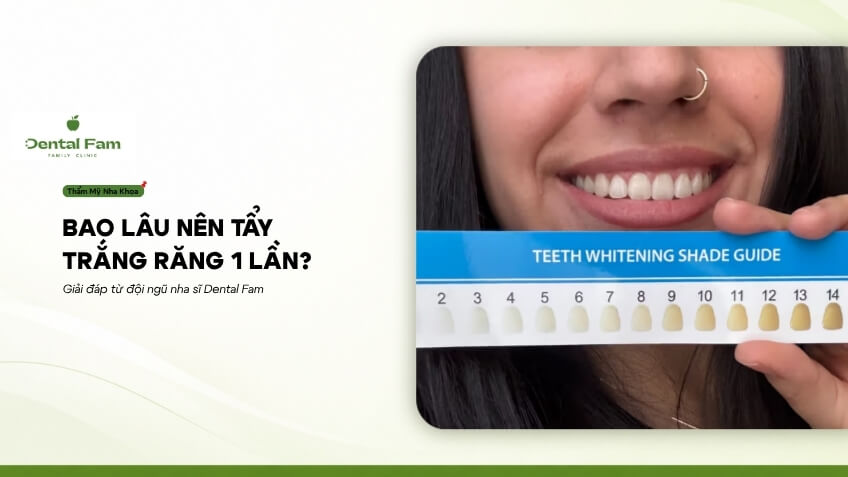
Re-whitening Milestone: 1-2 years, depending on your lifestyle
Based on our experience at Dental Fam, after a whitening treatment, the results last for approximately 1-2 years. The time you fall into this range depends on your eating and lifestyle habits: those who frequently drink coffee, strong tea, or smoke will tend to need re-whitening sooner, around the 1-year mark; those who eat light-colored foods and have less exposure to staining agents will maintain their whiteness longer, around the 2-year mark.
It's important to note: This 1-2 year milestone is for re-whitening, completely different from your regular 6-12 month dental check-up. Regular check-ups are for the dentist to check for cavities, gums, and other issues, not to assess whether your teeth need re-whitening. These two timeframes serve different purposes and should not be combined when planning your oral care.
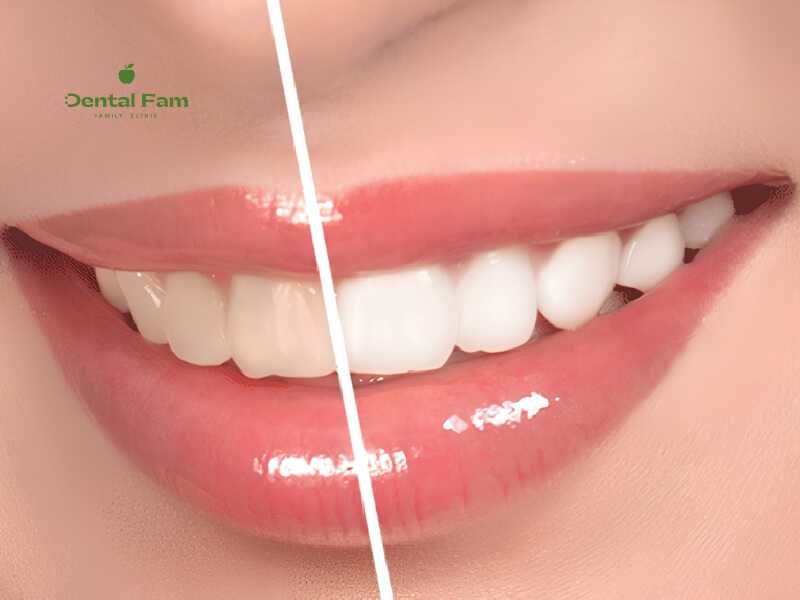
Why isn't there a fixed number for everyone?
If you've seen sources suggesting different whitening frequencies depending on the method (in-office versus at-home), note that the difference lies in the drug concentration and speed of seeing results, and there's currently no basis to suggest that your chosen method will extend or shorten the 1-2 year period mentioned above.
| Criteria | At the clinic | At home (individual trays) |
| Teeth whitening price | 3,000,000 VND/treatment | 1,500,000 VND/treatment |
| Drug concentration | 15-35% Peroxide | 16-22% Peroxide |
| Performer | Doctor directly performs the procedure at the clinic | You apply the medication to the tray yourself and wear it at home according to the instructions |
| Speed of seeing results | Fast, noticeable results after just one session (40 minutes - 1 hour) | Slower, requires wearing the tray for several consecutive days |
In other words, choosing to have it done at the clinic or at home is a question of budget, the time you have, and how quickly you want to see results, not a question of whether you will need to have it removed again sooner or later. The real factor determining the 1-2 year mark is your personal lifestyle habits, as mentioned above.
Imagine this: if you drink a cup of coffee in the morning, tea at noon, and occasionally smoke, your teeth are exposed to staining agents almost constantly throughout the day, and you're more likely to need a repeat whitening treatment around 1 year than 2 years. This isn't wrong, just a fact to consider when planning your dental care.
But speaking of ""needs a repeat whitening,"" there's a common misconception that needs clarification before we continue.
""Permanent whitening"" is a misunderstanding; the truth is the effect is that the color can revert over time
Teeth whitening is an effect that brightens tooth enamel, not a permanent change in tooth structure.
Many people believe that one whitening treatment is permanent, and when they see their teeth stain again after 1-2 years, they think the previous treatment was ""failed"" or the dentist used the wrong technique. This is a fairly common misconception, and also the source of much unnecessary disappointment.
According to the American Dental Association (ADA), whitening products contain peroxide-based active ingredients (hydrogen peroxide or carbamide peroxide) that penetrate the enamel to break down pigments causing discoloration. This process brightens the teeth, but does not ""lock"" them in a permanently white state.
It's similar to a white shirt: washing it doesn't mean it will stay white forever if you continue to wear it outdoors in dusty conditions every day. Teeth darken over time due to lifestyle factors (coffee, tea, tobacco) continuing to accumulate on the tooth surface, not because the whitening technique is faulty. Understanding this correctly helps you view the need for repeat whitening every 1-2 years as a normal part of oral care, not a cause for concern.
But when it comes to repeat whitening, there's another, more persistent concern: does repeated whitening really harm tooth enamel?
Does frequent whitening really harm tooth enamel?
The real risks of frequent whitening are temporary tooth sensitivity and mild gum inflammation, not ""permanent enamel erosion"" as many sources describe.
According to the ADA, teeth whitening, when performed correctly and under the supervision of a dentist, is safe:
-
Real risks: Temporary tooth sensitivity, mild gum inflammation, usually resolves on its own after a few days.
-
Exaggerated risks: ""Permanent enamel erosion"" is not a common side effect when whitening is performed correctly.
The same is true at Dental Fam: not all clients experience sensitivity after teeth whitening, and if they do, this condition lasts a maximum of 2 days; the clinic has not recorded any cases of sensitivity lasting longer than that. If you experience sensitivity lasting more than a few days, this is considered a separate issue, not caused by the whitening itself, and you should return to the clinic for a direct examination.
This doesn't mean you can whiten your teeth as many times as you like in a short period. The real risk arises when whitening is repeated too frequently, not allowing enough time for enamel to recover, or when using products of unknown origin or with uncontrolled concentrations. This is also why the 1-2 year mark mentioned above exists, instead of whitening every few weeks or months as needed.
So how do you know exactly when is the right time to whiten your teeth again?
What are the signs that it's time for a repeat whitening treatment?
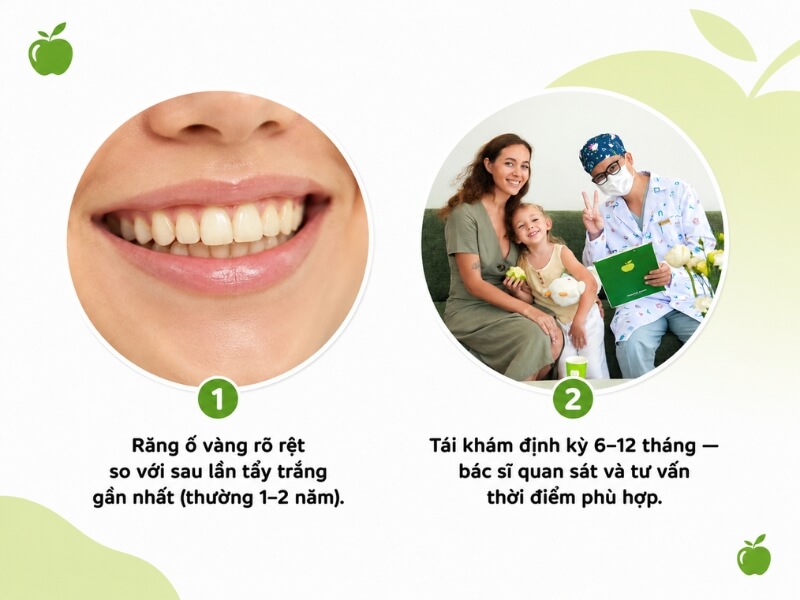
There are two practical signs that help you identify the right time, instead of trying to remember a date on a calendar:
-
Noticeable yellowing of teeth compared to immediately after the last whitening treatment usually occurs about 1-2 years after the previous treatment, depending on your lifestyle habits.
-
During your regular check-up (every 6-12 months), your dentist will observe the actual condition of your teeth and advise if it's time to consider a repeat whitening treatment.
These two signs are more reliable than trying to remember ""how many months have passed,"" because they are based on the actual condition of your teeth, not on an average number for thousands of other people.
But if the ""noticeable discoloration"" is still subjective, what is the most reliable way to be sure?
Why should you have a dentist assess your teeth directly, instead of applying a general timeframe yourself?
The 1-2 year timeframe is a reference point, not a fixed appointment date. Your lifestyle habits, the actual rate of discoloration, and the current condition of your enamel are the most accurate indicators.
At Dental Fam (https://dentalfam.vn/en), teeth whitening consultations are integrated into regular check-ups every 6-12 months: the dentist directly observes the tooth color and enamel condition, and then advises on the appropriate time to whiten teeth instead of applying a general number to all clients. According to clinic records, there are no official statistics on the return rate, but most clients are satisfied with the results and rarely need a second whitening session sooner than expected.
bac-si-dental-fam-danh-gia-bao-lau-nen-tay-rang.jpg
After knowing how to determine the right time, you can also proactively extend that interval by taking proper care at home.
How to Extend the Time Between Teeth Whitening Sessions
There are three groups of things that help extend the time between whitening sessions: immediate care after whitening, adjusting diet and lifestyle, and maintaining good hygiene and regular check-ups.
1. Care in the First 24 to 48 Hours After Whitening
This is the period when teeth are most sensitive to re-staining, as the enamel has just been ""opened"" during the whitening process.
-
Completely avoid dark-colored foods and drinks (coffee, tea, soy sauce, wine) for at least 24 hours, preferably 48 hours.
-
Limit foods and drinks that are too hot or too cold because teeth are more sensitive than usual.
-
Prioritize soft, light-colored foods such as rice, porridge, and milk for the first 1 to 2 days.
2. Diet and Lifestyle to Limit Staining
Daily habits largely determine whether you reach the beginning or end of the 1-2 year mark.
- Limit coffee, strong tea, and wine: these are beverages with strong pigments that easily stain teeth.
- Avoid smoking, one of the leading causes of teeth yellowing again.
- Prioritize light-colored, high-fiber foods to support natural teeth cleaning during chewing.
3. Oral Hygiene and Regular Check-ups
Regular check-ups are a proactive approach instead of guessing when you need whitening again.
- Brush your teeth at least twice a day, use dental floss daily (it's not mandatory to use fluoride toothpaste, regular toothpaste is fine).
- Have check-ups every 6-12 months so your dentist can monitor your oral health and advise on the right time for whitening.
There are a few other questions you may have; the following section will answer them quickly.
Frequently Asked Questions
Is it okay to whiten teeth twice in a short period of time?
No. Too short a gap between whitening sessions doesn't allow enough time for enamel to recover, increasing the risk of prolonged sensitivity. A reasonable interval is 1-2 years between whitening sessions, rather than repeating it every few weeks or months.
Do at-home whitening trays need to be spaced out like in-office whitening?
Yes. Although the concentration of the whitening agent is lower (16-22% peroxide compared to 15-35% peroxide at the clinic), overuse of whitening trays over a long period can still cause sensitivity and damage enamel, so it's still necessary to follow your dentist's recommended frequency.
What should I do if my at-home whitening trays are damaged?
Dental Fam will remake them for free, at no extra cost to the customer.
Should you whiten your teeth at home using products of unknown origin?
No. Products of unknown origin often have uncontrolled concentrations of chemicals, which can damage tooth enamel and gums without medical supervision to address any adverse reactions promptly.
Do I need a follow-up visit after whitening?
Yes, a follow-up dental check-up every 6-12 months is recommended, separate from the 1-2 year maintenance period.
The frequency of teeth whitening isn't fixed, but there's a clear reference point: 1-2 years, depending on your personal habits. Instead of arbitrarily setting a timeframe found online, the most accurate approach is to observe two actual signs (noticeable discoloration returning, or as advised during your 6-12 month follow-up visit) and have a dentist assess the situation directly before deciding to whiten again.
If you're wondering if it's time for your teeth to be whitened, a visit to Dental Fam can give you a much more accurate answer than guessing.
Dental Fam - Family Clinic
- Address: NOTT 28, 29, 30, Phuoc Long A Urban Area, South Nha Trang, Khanh Hoa, Viet Nam
- Hotline: +84 582 582 345 / +84 983 001 768
- Website: dentalfam.vn
- Email: info@dentalfam.vn