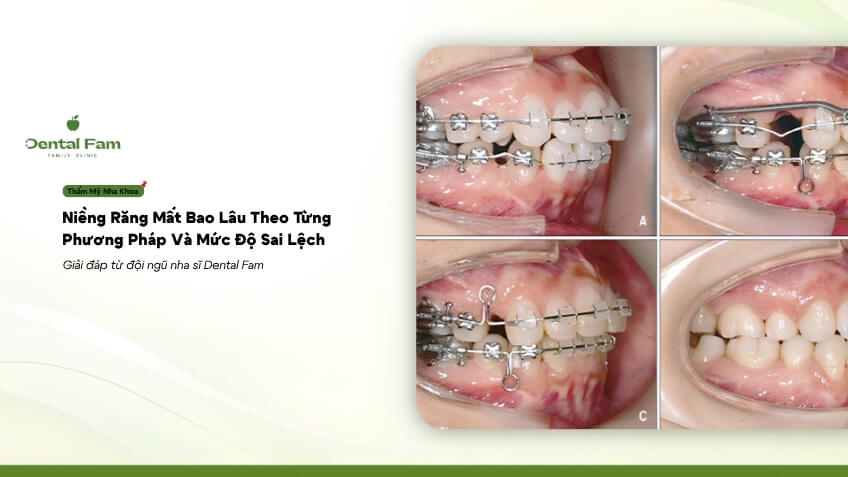
How long does orthodontic treatment take depending on the method?
Metal braces and ceramic braces usually have similar treatment times (24-36 months on average) because they both use the same mechanism of continuous fixed force, while clear aligners (Invisalign, SMILER) may be faster or slower depending on the level of compliance with wearing the aligners. Fixed braces create continuous force 24/7, so progress is less dependent on the patient's awareness, while clear aligners are removable, so the actual treatment time may be longer than initially expected if the patient does not wear them for the recommended 20-22 hours/day.
How Does the Degree of Tooth Misalignment Affect Treatment Time?
Mild to moderate misalignment cases (slightly spaced teeth, minimal crowding) are typically completed within an average of 24-36 months, while severe misalignment cases requiring tooth extraction or the use of mini-screws, or jaw surgery (severe overbite/underbite due to bone structure) can extend to 45-48 months. The degree of misalignment determines the number of teeth to be moved and the distance to be covered. The more teeth are misaligned from their ideal position, the longer the force application time is needed to avoid damaging the tooth roots due to overly rapid movement.
Cases requiring tooth extraction to create space usually take longer than those without extraction, as the space must heal before teeth can be moved into position. Similarly, cases requiring mini-screws as anchors (commonly seen in severe overbite cases requiring significant tooth retraction) also require longer installation and stabilization of the mini-screws before the main traction force can begin.
Why are regular check-ups necessary during orthodontic treatment?
Regular check-ups (usually every 4-6 weeks) allow the dentist to change the archwires, tighten the traction, and check the progress of tooth movement against the initial plan. This allows for timely adjustments if teeth move slowly or deviate from the expected direction. Skipping check-ups or delaying appointments too long does not shorten the total treatment time; it usually prolongs it because the traction force is not maintained consistently at the necessary level.
Will orthodontic treatment take longer than expected?
Yes, orthodontic treatment may take longer than initially expected in three common cases: not adhering to wearing the clear aligners for the required number of hours, frequently missing check-ups, or brackets/archwires becoming loose or detached multiple times without timely intervention. Each time a bracket comes loose and isn't repaired immediately, the traction force is interrupted at that point, slowing down the overall progress of the entire set of teeth, not just the affected tooth.
If you notice that the treatment time is being extended, you should address the specific cause, not a general ""speed-up"" solution: wear clear aligners for 20-22 hours/day if the cause is excessive bracket removal, keep your appointments every 4-6 weeks if you're missing appointments, and address any loose brackets immediately instead of waiting a few days before contacting your dentist. There's no way to shorten the treatment time by applying more force or more frequent appointments than recommended, as applying force beyond safe limits can cause root resorption instead of speeding up the process. In other words, you can't ""shorten"" an already extended treatment time; you can only prevent it from prolonging by addressing the root cause.
Frequently Asked Questions About Orthodontic Treatment Time
What is the Fastest Orthodontic Treatment Time?
The fastest orthodontic treatment time is approximately 6 months to 1 year for mild cases of misalignment, or a minimum of 14 months for standard cases requiring more movement in the prime age.
Is orthodontic treatment painful throughout the process?
Pain mainly occurs in the first few days after each tightening of the force, and does not last continuously throughout the entire treatment.
Does orthodontic treatment for adults take longer than for children?
Orthodontic treatment for adults usually takes longer than for children because the jawbone and teeth have fully developed and are more solid.
Is it necessary to wear a retainer after braces are removed?
Yes, wearing a retainer is mandatory after braces are removed to prevent teeth from shifting back to their original positions, and this is a separate phase after the completion of the main orthodontic treatment.
In short, the average orthodontic treatment time is 24-36 months, with difficult cases up to 45-48 months, depending on the method of treatment, the degree of tooth misalignment, and the level of adherence to follow-up appointments/wearing the retainers as prescribed.
There is no way to shorten the time by skipping follow-up appointments or not wearing the retainers for the required hours; if progress is slower than expected, the only solution is to address the root cause of the interruption instead of trying to ""speed up"" with stronger force.