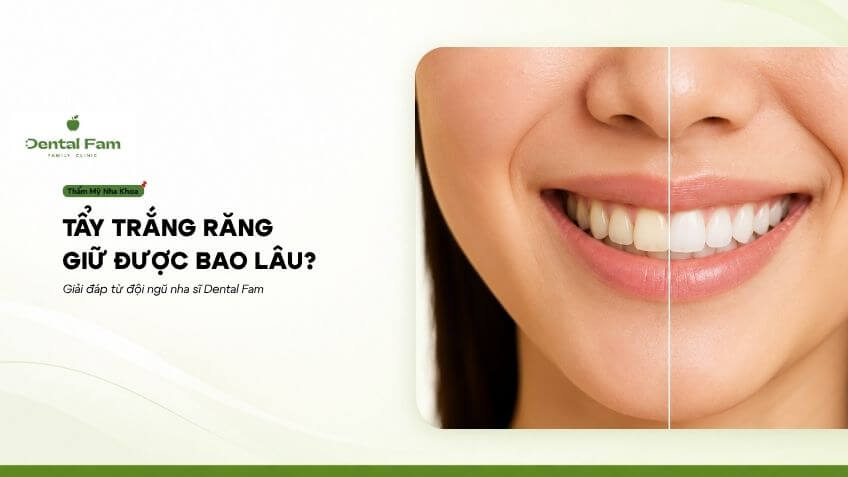
HOW LONG DOES TEETH WHITENING LAST?
How long the results last depends mainly on which whitening method you choose, not on chance. A study by Tay et al. (2012), conducted at the State University of Ponta Grossa (Brazil), followed 60 participants over 2 years, comparing two groups: in-office whitening and at-home whitening.
The results showed that both methods maintained stable color for around 1-2 years with proper care. The two sections below take a closer look at each method. But do these two methods really differ as much in durability as many people assume? The answer might surprise you.
HOW LONG DOES IN-OFFICE WHITENING LAST
This method uses Hydrogen Peroxide (a high-concentration whitening agent, about 15-35%), applied in a short session under a dentist's direct supervision.
According to Tay et al. (2012), tooth color showed no significant change even 2 years after the whitening session, as long as good oral hygiene habits were maintained.
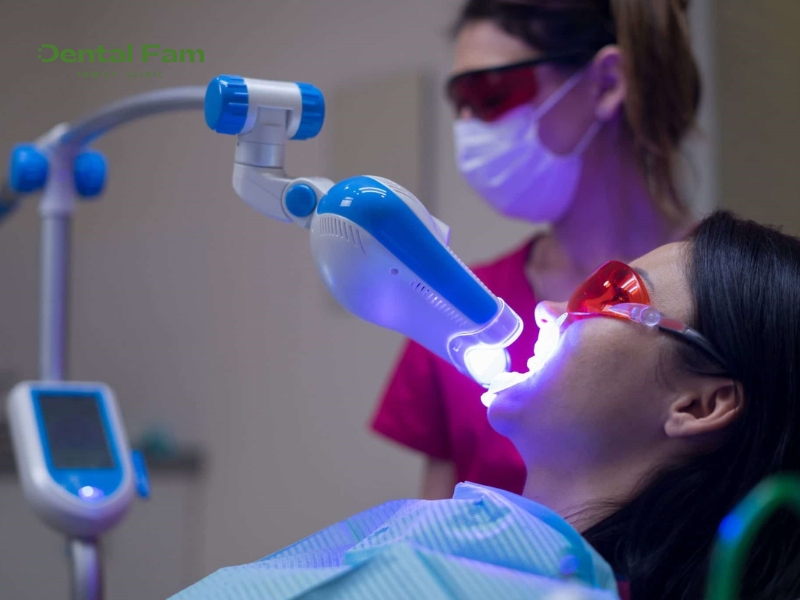
HOW LONG DOES AT-HOME WHITENING (TRAY WHITENING) LAST
This is where many people, including Ms. Lan at first, get it wrong. This method uses Carbamide Peroxide (a lower-concentration whitening agent, about 16-22%), applied through a custom tray over a longer period. Many assume that because the concentration is lower, the results won't last as long.
But the same 2012 study by Tay et al. found the opposite: the at-home group maintained color stability almost as well as the in-office group after 2 years.
| Criteria | In-Office | At-Home |
| Active ingredient | Hydrogen peroxide ~35% | Carbamide Peroxide ~16% |
| Treatment time | Short, one session | Longer, multiple days with tray |
| Color stability after 2 years | Stable | Stable |
This is a rather surprising finding compared to common belief, and it's exactly why choosing a method should be based on your actual needs (time available, tooth sensitivity) rather than fear of "not lasting long enough."
WHY MIGHT TEETH TURN SLIGHTLY YELLOW AGAIN AFTER A FEW MONTHS?
The three sections below explain the mechanism of color relapse, the specific timeline according to research, and how to tell "normal mild yellowing" apart from "abnormal yellowing due to incorrect technique."
WHAT IS COLOR RELAPSE
It can be understood simply as a stain that's temporarily removed but gradually fades back over time. Mechanically, this happens alongside the natural remineralization (rebuilding of minerals) process in tooth enamel.
A study by Duong et al. (2022), conducted at the University of Medicine and Pharmacy, Hue University, showed that the whitening process works through free radicals generated by Hydrogen Peroxide, penetrating enamel and dentin to break down color-causing molecules into smaller, lighter-colored ones.
This is a chemical reaction, and like any chemical reaction, it can partially reverse over time. That's why color relapse isn't a "failure," but simply part of the nature of the process.
HOW OFTEN COLOR RELAPSE HAPPENS, ACCORDING TO CLINICAL RESEARCH
| Time point | Reported relapse rate |
| After 18 months (tray whitening) | around 26% of cases |
| After 2 years | around 10% |
| After 5 years | around 25% |
| After 8 years | around 49% |
(Source: compiled from Haywood's research, cited in a systematic review on teeth whitening published on ScienceDirect (2022); and a study published in the Indian Journal of Dental Research (2018))
Color relapse doesn't happen suddenly or abnormally, it increases gradually according to a fairly clear pattern over time, consistently observed by multiple independent research groups.
If you're only 2 months post-whitening, the mild yellowing you might notice falls well within the normal range, in fact, much earlier than the statistical milestones above.
DOES COLOR RELAPSE MEAN THE WHITENING WAS DONE INCORRECTLY?
This is the core question Ms. Lan, and many others after whitening, really want answered.
Dr. Nguyen Thi Chau, Deputy Director of the Advanced Dental Technology Center at Hanoi Medical University, notes that if teeth whitening is performed incorrectly, teeth can also discolor in an abnormal way. She therefore recommends having the treatment done at a qualified medical facility rather than trying unverified home remedies.
In other words:
- Mild yellowing, occurring gradually, in line with the normal physiological timeline → normal
- Rapid, uneven yellowing, or unusual sensitivity → needs a dentist's check-up
Mild yellowing over time is normal; only rapid, abnormal yellowing calls for a dentist's check.
WHAT FACTORS AFFECT HOW LONG WHITENING RESULTS LAST?
The three main factors are dietary habits (especially tea and coffee), smoking, and regular dental hygiene care. Let's look at each factor to understand why some people keep their white smile longer than others, even with the same whitening method.
DIETARY HABITS (TEA, COFFEE, DARK-COLORED FOODS)
Not all colored beverages "damage" teeth equally. A study by Duong et al. (2022) directly compared the effects of tea, coffee, and cola on tooth enamel and found that tea caused noticeably more staining than cola, while coffee and cola showed almost no difference.
This is explained by the fact that the coloring compounds in tea (tannins) adhere more easily to tooth surfaces, and tea's acidity is also higher than that of coffee.

SMOKING
Beyond the direct effect of smoke on tooth enamel, data from the Tay et al. (2012) study showed that smokers tend to consume staining beverages more frequently, indirectly reducing how long whitening results last.
ORAL HYGIENE AND REGULAR DENTAL SCALING
This is a factor everyone can actively control themselves. According to Dr. Nguyen Thi Chau's recommendation (Hanoi Medical University), getting dental scaling every 6 months combined with proper oral hygiene significantly extends how long whitening results last. This is also why regular dental check-ups aren't just for preventing cavities, they're also part of maintaining the investment you've made in your whitening results.
Understanding the causes is one thing, but what really helps is knowing what you can actively do starting now.
WHAT SHOULD YOU DO TO KEEP YOUR SMILE WHITE LONGER?
Three important things to do are: avoiding certain foods and drinks correctly in the first few hours, limiting long-term exposure to colored beverages, and re-whitening at the recommended interval.
The two sections below answer specifically: how long to avoid certain foods and drinks, and when you should whiten again.
HOW LONG SHOULD YOU AVOID CERTAIN FOODS AND DRINKS AFTER WHITENING
In the first 2 hours after whitening, you should avoid eating entirely and only drink water at room temperature. This is when tooth enamel is most sensitive to color and temperature.
Over the next 24 to 48 hours, avoid foods and drinks that are too hot, too cold, dark-colored (such as tea and coffee), or high in acid, to reduce sensitivity and limit teeth from picking up color again too soon.
WHEN SHOULD YOU WHITEN AGAIN (RE-WHITENING)
For at-home whitening, you can consider repeating the treatment after about 4-6 months. For in-office whitening, many cases don't need to be repeated even after several years, as long as good care is maintained.
The 4-6 month interval for at-home whitening follows the recommendation from the Vietnam Odonto-Stomatology Association. As for in-office whitening, since its effectiveness has been shown to remain stable much longer through the Tay et al. (2012) study mentioned earlier, repeating it too soon isn't necessary if you maintain good oral hygiene.
FREQUENTLY ASKED QUESTIONS (FAQ)
HOW LONG DOES A TEETH WHITENING SESSION TAKE?
An in-office whitening session usually takes about 1-3 hours depending on the condition of your teeth. This refers to treatment time, which is different from how long the whitening results last, as discussed earlier, these two concepts are often confused with one another.
HOW LONG AFTER TEETH WHITENING CAN YOU EAT?
After the first 2 hours, during which you should only drink water, you can eat and drink normally again. However, you should avoid foods that are too hot, too cold, dark-colored, or high in acid for the next 24-48 hours to protect your whitening results and reduce sensitivity.
HOW LONG DO NATURAL WHITENING METHODS (LEMON, SALT, BAKING SODA) LAST?
There is currently no clinical research that precisely measures how long the effects of these methods last. Some natural ingredients are also acidic and may harm tooth enamel if used incorrectly or too frequently. It's best to consult a dentist before trying any at-home natural remedy.
Slight yellowing a few months after whitening is a normal physiological phenomenon with a clear timeline documented by clinical research, not a sign of being deceived or of incorrect technique. Both at-home and in-office whitening can maintain stable results for 1-2 years with proper care, and you can actively extend your results by adjusting your eating habits and keeping up with regular dental scaling.
Instead of worrying whether your whitening was done incorrectly, you can book a free check-up and consultation at Dental Fam to find out for certain whether your teeth are experiencing normal physiological relapse or need additional care, before deciding whether re-whitening is necessary. You can also visit our teeth whitening service page to learn more!
Dental Fam - Family Dental Clinic
- Address: NOTT 28, 29, 30 Phuoc Long A, Nha Trang, Khanh Hoa
- Hotline: +84 582 582 345
- Website: dentalfam.vn
- Email: info@dentalfam.vn