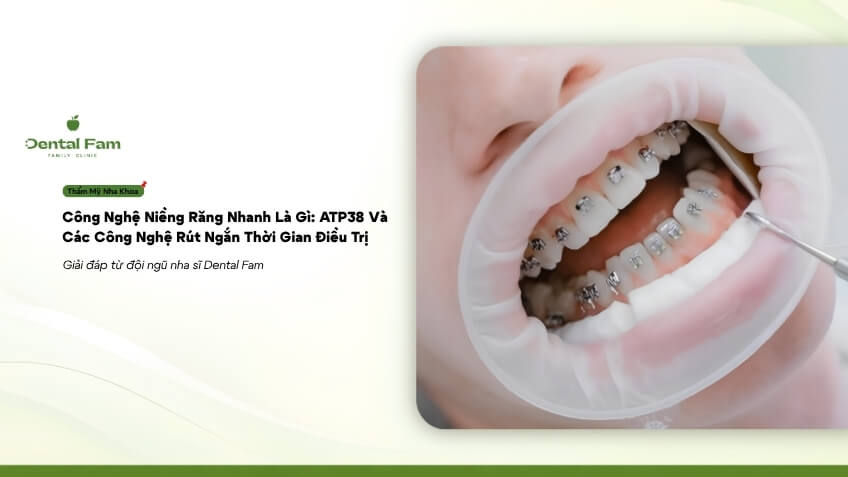
What is ATP38, how does it work, and how is it used?
ATP38 and similar assistive technologies operate on the principle of low-frequency mechanical vibrations applied to the teeth, stimulating faster alveolar bone regeneration. This allows teeth to move more quickly under the same pulling force from braces or clear aligners. This biological mechanism has been widely applied in orthodontic dentistry in recent years, not changing the direction of tooth movement but only accelerating the speed of reaching the planned target position.
Regarding usage, these assistive devices are typically used at home for short periods each day (usually a few minutes at a time), consistently throughout the period requiring accelerated movement, rather than being a single-use device once braces are fitted. Patients undergoing orthodontic treatment need to adhere strictly to the daily usage frequency instructed by their doctor to achieve the desired reduction in treatment time, similar to the ""use enough, use consistently"" principle applied to clear aligners (wearing them for 20-22 hours/day) as analyzed in previous articles.
How much can fast-acting orthodontic technology shorten treatment time?
There is no absolute number that applies to all cases, but based on general experience in orthodontics, vibration-assisted technologies like ATP38 usually help shorten the total treatment time by several months compared to conventional braces. The specific amount varies depending on the initial degree of tooth misalignment and the level of consistent daily use of the device. A reasonable expectation for customers is to view this as a factor that can partially shorten the treatment time, not a technology that ""doubles or triples the speed"" as some advertisements exaggerate, because each person's bone regeneration rate is different and cannot be forced beyond safe biological limits.
The actual degree of shortening still depends primarily on the initial degree of tooth misalignment, the main determining factor in the total treatment time analyzed in the article ""How long does orthodontic treatment take?""; the supporting technology only adds to that timeframe, it cannot replace it.
Does using supporting technology like ATP38 cause more discomfort or pain?
The sensation when using the vibrating supporting device is usually only a gentle vibration or slight warmth at the contact point, not causing significantly more pain or discomfort than the usual soreness experienced during orthodontic treatment as analyzed in the article on pain levels.
Because the device only vibrates at a low frequency, it doesn't create additional pulling force on the teeth, thus not increasing the feeling of soreness compared to wearing braces or clear aligners alone. Users may feel slight jaw fatigue if they have to keep the device fixed in their mouth for the entire time each day, but this is normal mechanical fatigue, not pain caused by the pulling force.
Can fast-acting orthodontic technology be applied to all orthodontic methods?
Technologies that shorten treatment time, such as ATP38, can, in principle, be combined with both braces (metal, ceramic) and clear aligners, because the mechanism of action on the alveolar bone is independent of the type of appliance that creates the main pulling force.
This is different from choosing an orthodontic method, which depends on budget, aesthetics, and compliance level as analyzed in the comparison of orthodontic methods; fast-acting technology is an additional layer on top, not a replacement for the decision on which method to choose.
Who Should Consider Fast-Acting Orthodontic Technology?
Clients who prioritize the shortest possible treatment time, such as those with important events to complete before a specific deadline, or those who want to shorten the total time wearing the appliance, are suitable candidates to consider this assistive technology during consultations with their dentist.
The decision on suitability should be based on an assessment of the specific dental condition and the ability to maintain consistent daily use of the device, as the effectiveness of shortening treatment time is only achieved with consistent use.
Frequently Asked Questions about Fast-Acting Orthodontic Technology
Is Fast-Acting Orthodontic Technology Safe?
Yes, this is a bio-vibration-based assistive technology widely used in orthodontics. It is non-invasive and does not alter the planned tooth movement direction; it only accelerates the speed of reaching the target position.
Does fast-acting orthodontics affect the quality of the final result?
No. The assistive technology only affects the rate of bone regeneration to allow teeth to move faster; it does not change the treatment plan or the target position calculated by the dentist, so it does not affect the accuracy or stability of the final result.
Is the assistive technology still effective if not used regularly every day?
The effectiveness of shortening treatment time is significantly reduced if not used regularly at the recommended frequency, because the mechanism of action needs to be maintained continuously to stimulate faster bone regeneration. Intermittent use does not provide the same effectiveness as regular daily use.
In short, fast-acting orthodontics technologies like ATP38 are assistive techniques based on low-frequency mechanical vibrations, used at home for a short period each day, helping to accelerate the rate of alveolar bone regeneration so that teeth move faster under the same pulling force from brackets or clear aligners.
The degree of time reduction varies depending on the case, rather than a fixed number, and effectiveness is only achieved with consistent use at the recommended frequency; it's not a ""double-fast"" solution as some advertisements exaggerate.