What Does Stable Periodontitis Mean?
Stable periodontitis means the disease has stopped progressing and the inflammation has subsided; it doesn't mean the supporting tissues of the teeth have returned to their original state. In dentistry, this state is also called stable control. The central cause of the disease is bacterial plaque in the gum area.
When the subgingival area is cleaned and you maintain good hygiene, the inflammatory response gradually decreases, the gums heal, and the teeth do not lose further attachment to the jawbone. Tartar only helps plaque adhere, so it is also removed during this process.
Why is measurement necessary? Periodontitis often progresses silently, so a feeling of relief is not enough to conclude that the disease has stopped. Therefore, the assessment consists of two complementary layers: signs you observe at home and measurements taken by your dentist at the clinic. The following section begins with the first layer.
How can you tell if your periodontal disease is stabilizing?
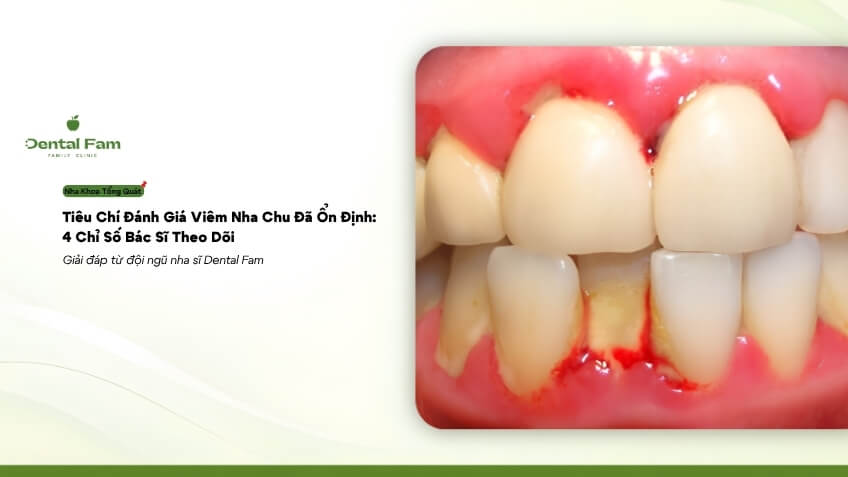
There are five positive signs: cessation of gum bleeding, firm, pink gums that tightly hug the tooth neck, elimination of pus, improved breath, and no further loosening of teeth. The tooth neck is the part of the tooth that is closest to the gum line. The table below lists the signs based on your observations.
| Signs | What do you see? | What does it suggest? |
| Gummial bleeding has stopped | Brushing and flossing no longer show blood | Inflammation is decreasing |
| Gums are pink, firm, and tightly hugging the tooth necks | Gums are no longer red, swollen, or shiny | Gums are healing |
| Pus is gone | Pressing on the gum area No more pus | Infection has been treated |
| Breath has improved | Bad breath has significantly reduced even without masking | Fewer bacteria in the gum area |
| No further tooth loosening | No increased tooth looseness | No further loss of supporting tissue |
What Four Indicators Does the Dentist Use to Assess Stability?
The dentist monitors four indicators: bleeding on probing (BOP), periodontal pocket depth (PPD), clinical attachment loss (CAL), and X-ray. Each indicator answers a separate question: whether the gums are still inflamed or have regressed, whether the pockets are shallow or deep, whether the level of attachment loss has increased, and whether bone resorption is still present or has stabilized. All four indicators are read together; no single indicator is self-sufficient. This article does not specify thresholds, as the conclusion is determined by the dentist based on each tooth and individual patient.
BOP Indicates Whether Gum Inflammation Remains or Has Regressed
Bleeding on probing (BOP) indicates whether gum inflammation remains or has regressed. The dentist inserts a periodontal probe, a small, thin measuring instrument, into the space between the tooth and the gum and notes whether the gum bleeds. Healthy gums bleed less during probing, while inflamed gums bleed more easily. Before and after treatment results are placed side-by-side to show how much the inflammation has decreased.
PPD indicates shallow or deep periodontal pockets
Periodontal pocket depth (PPD) indicates whether the periodontal pockets are shallow or deep. Periodontal pockets are the spaces between teeth and gums that are further damaged by disease, where plaque easily hides. The dentist uses a probe to measure this depth in millimeters. A shallower pocket after treatment is a positive sign, but it should be read in conjunction with BOP: a pocket that is still deep and bleeding needs closer monitoring than a pocket that is still deep but the gum inflammation has subsided.
CAL indicates whether attachment loss has stopped increasing
Clinical attachment loss (CAL) indicates whether the extent to which a tooth has lost its attachment to the supporting tissue has stopped increasing. Unlike PPD, CAL reflects the amount of tissue loss that accumulates over time. Therefore, the goal after treatment is to prevent this number from increasing, not to reduce it to zero. This is the most common misunderstanding patients face when looking at the measurement report.
X-rays indicate whether alveolar bone is still resorbing or has stabilized
X-rays indicate whether alveolar bone is still resorbing or has stabilized. Alveolar bone is the part of the jawbone that holds the tooth roots. On the film, the doctor observes the density and morphology of the bone around each tooth. Bone changes slowly, so the doctor compares films from different time points, and the timing of re-imaging is determined by the doctor based on your condition.
These four indicators are recorded as data for comparison before and after treatment, and the most familiar way to present them is in a measurement report.
Why does stability not mean lost tissue will regrow?
Because tissue and bone lost due to periodontal disease often do not fully recover, the goal of treatment is to preserve what remains. Some cases may see partial regeneration depending on the severity of the disease and the treatment method, but you shouldn't expect all lost tissue to return. The practical consequence is that gums may recede and more of the tooth roots may be exposed than before the disease, even if the measurements have stabilized.
Therefore, compare your measurements to your own at different times, not to teeth that were never affected. Stability means the disease has stopped, and this message aligns with the understanding of ""cured"" as discussed in the article ""Is periodontal disease curable?"". Once the disease has stopped, preventing its recurrence becomes the primary task.
After stabilization, how should you maintain and follow up with your dentist?
Stability is a state that needs to be maintained, so you still need to continue with maintenance care and follow-up appointments as scheduled by your dentist. The disease can return if the area under the gums is not thoroughly cleaned, if maintenance care is inconsistent, or if risk factors are not controlled, such as smoking or poorly controlled diabetes. This is quite common and can be managed.
At each follow-up appointment, the dentist will remeasure the indicators to assess the current condition instead of relying solely on feeling. Many professional guidelines recommend scheduling follow-up appointments every few months; the specific schedule is determined by the Dental Fam dentist based on each individual's condition.
If you want to know how long intensive treatment lasts, see the article on how long it takes to cure periodontitis. To see how these steps are performed in practice, the following section describes how Dental Fam performs the procedure.
How does Dental Fam assess and monitor these indicators?
Dental Fam examines patients based on measurements and X-rays, then re-measures to determine if the disease is under control. During the examination, the doctor measures the depth of the periodontal pockets, assesses the degree of attachment loss, checks for bleeding during exploration and tooth looseness, and takes X-rays to assess the extent and morphology of bone loss. X-rays for treatment are provided free of charge. Periodontal treatment costs from 500,000 VND per tooth, including examination and consultation.
After treatment, the doctor monitors the patient using these indicators, and you can ask the doctor about your measurements at different times. Before concluding, the following frequently asked questions will quickly answer any remaining concerns.
Frequently Asked Questions
This section answers four short questions: Is the cessation of gum bleeding sufficient to conclude anything? Does an improvement in only one indicator mean the condition is stable? Will the disease recur if it has stabilized? And is a repeat X-ray necessary?
Does the cessation of gum bleeding mean the periodontal disease is cured?
Not sufficient to conclude. The cessation of bleeding is a positive sign, but the doctor will need to examine the pocket depth, the degree of attachment loss, and X-rays to determine if the disease has stopped progressing.
If one indicator improves but others remain unchanged or worsen, does that mean the condition is stable?
No, because all four indicators are read together, and an improvement in only one indicator is not enough to conclude anything. The doctor will combine all four indicators before making a decision. If any indicator remains unstable, you may need further treatment or closer monitoring, depending on the doctor's assessment.
Can periodontitis that has stabilized recur?
Possibly, if plaque and risk factors are not controlled. Therefore, maintenance care and follow-up visits are still necessary.
Do I need another X-ray to know if the disease has stabilized?
Your doctor will decide when to have another X-ray depending on your condition. Bone changes slowly, so not every visit requires a new X-ray, but it helps compare bone loss over time.
Periodontitis is considered stabilized when the disease stops progressing, the gums heal, and the four indicators (BOP, PPD, CAL, and X-ray) do not worsen. You can recognize this yourself through the cessation of bleeding gums, firm and pink gums, and no further loosening of teeth, but the doctor's measurements provide a complete conclusion.
Loss of tissue often does not fully recover, so maintenance and follow-up visits are still necessary. To have measurements and follow-up data recorded, schedule an appointment at Dental Fam.
Dental Fam - Family Clinic
- Address: NOTT 28, 29, 30, Phuoc Long A Urban Area, Nha Trang, Khanh Hoa
- Hotline: +84 582 582 345 / +84 983 001 768
- Email: info@dentalfam.vn