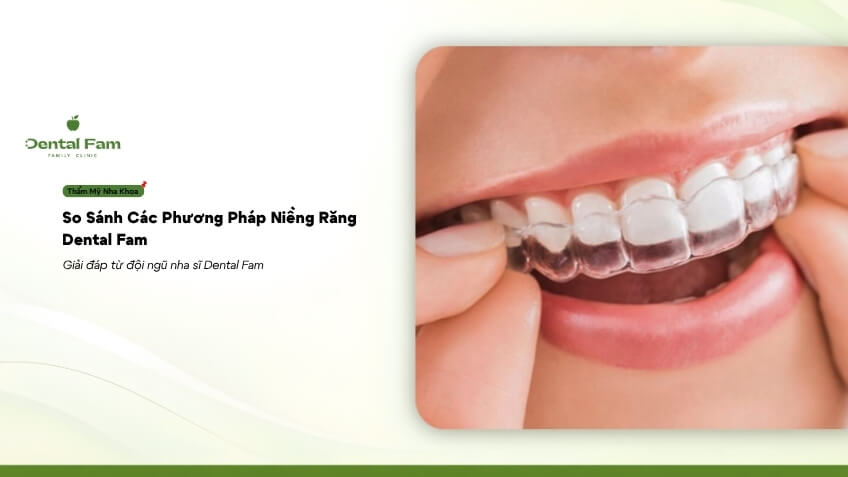
Overview of Orthodontic Treatment Methods at Dental Fam
Dental Fam offers five orthodontic treatment methods, divided into two main groups: braces (fixed to the teeth) and clear aligners (removable).
| Method | Material/Characteristics | Price |
| Metal Brackets | Traditional, using elastic bands to fix the archwire | 30-60 million VND |
| Self-ligating Metal Brackets | Self-closing latch, still requires chain/intermaxillary elastics to close | 40-70 million VND |
| Ceramic Brackets | Transparent/near-natural tooth color, more aesthetically pleasing | 50-80 million VND |
| SMILER clear aligners | Clear, removable plastic, made in France | 90-130 million VND |
| Invisalign clear aligners | Clear, removable plastic, global brand | 150 million VND (all-inclusive) |
The prices listed above are all-inclusive, including consultation and all X-rays. X-rays are used for treatment purposes (including all scheduled check-ups throughout the process, not just the first one), all follow-up appointments, and retainers after treatment is completed. The cost of retainers is only separate if the patient needs additional or new ones later (3,000,000 VND for both arches), and is not a mandatory addition to the listed price.
The three types of braces and SMILER are priced in ranges because the cost depends on the complexity of the case. Invisalign is the only exception: it's a fixed package price of 150 million VND, regardless of difficulty level, so a simple case and a complex case using Invisalign will cost the same amount, unlike the other four methods.
Some costs are still charged separately from the treatment price if the doctor prescribes them during treatment, for example, mini-vis implantation (2,000,000 VND/vis) or wisdom tooth extraction. This isn't a difference between methods, but rather a general cost, applicable to any method if the case actually requires it.
How long does treatment time vary between methods?
Treatment time depends primarily on the complexity of the case, not on the choice of metal, self-ligating, or ceramic braces, as all three types use the same archwire mechanism, so the rate of tooth movement doesn't differ significantly between them. Generally, with braces, simple cases take about 18-24 months, medium cases 24-36 months, and complex cases can last 36-48 months or more.
Clear aligners generally range from 12-36 months depending on the complexity and treatment plan. SMILER with ATP38 technology (a technology that helps accelerate tooth movement) can shorten treatment time within this range compared to not using the technology, but neither SMILER nor Invisalign have an absolute fixed timeframe, as the actual effectiveness depends on whether the patient adheres to wearing the aligners for the required number of hours each day.
The frequency of follow-up appointments throughout the treatment generally ranges from 2-4 weeks. The internal information sheet doesn't clearly differentiate this frequency between braces and clear aligners, so it's impossible to say which group requires less frequent appointments to suit busy individuals.
The price and treatment time are clear. But this price list is just the starting point: the three types of braces above look similar, all using archwires and brackets attached to the teeth, so what really creates the 20-30 million VND difference between them?
What are the differences between metal braces, self-ligating braces, and ceramic braces?
All three types of braces share a common mechanism: the archwire creates the force to move the teeth. However, they differ in how the archwire is secured to the bracket and the material of the brackets.
Metal Braces
Metal braces are the traditional type, using small elastic bands to secure the archwire to each bracket. This is the least expensive option, costing between 30 and 60 million VND, due to its simple structure and lack of complex manufacturing technology. The most noticeable drawback is aesthetics: metal braces are clearly visible when smiling, and the elastic bands need to be replaced periodically at each check-up.
Self-Ligating Metal Braces
Self-ligating metal braces use self-closing latches instead of elastic bands to hold the archwire, reducing friction as teeth move. However, this type still requires the use of additional elastic bands or intermaxillary elastics to close the gaps and intercuspate the teeth at certain stages of treatment; it's not entirely ""elastic-free"" as the name might suggest. The price ranges from 40-70 million VND, higher than regular metal braces due to the more complex locking mechanism.
Ceramic Braces
Ceramic braces are transparent or close to the color of natural teeth, making them less noticeable during communication, but they are still fixed to the teeth throughout the treatment like the other two types. The price of 50-80 million VND reflects the higher cost of ceramic material compared to metal.
All three types of braces are fixed appliances and cannot be removed until the end of treatment, which is why braces are the only type available for installment payments at Dental Fam. The fixed placement of aligners on the teeth also requires more thorough cleaning to prevent plaque buildup around the brackets. Details on the tools and proper cleaning methods are explained in the article on oral care during orthodontic treatment.
If the brackets are always present on the teeth for several years, the next natural question is: Is there a way to wear braces that are almost unnoticeable to others?
What are clear aligners, and what brands are available?
Clear aligners are a series of removable, transparent plastic trays, each designed to move the teeth slightly in stages, completely replacing the archwire and fixed brackets. Patients remove them themselves when eating or brushing their teeth, then put them back on and change to new trays according to a pre-programmed schedule. Dental Fam offers two brands of clear aligners:
SMILER
SMILER is a clear aligner brand originating from France, manufactured directly in a French factory, focusing on the European market. SMILER uses ATP38 technology to help accelerate tooth movement. Details about the mechanism of this technology are explained in the article on fast orthodontic technology. The price of SMILER at Dental Fam is 90-130 million VND.
Invisalign
Invisalign is a clear aligner system originating from the USA, manufactured by Align Technology in Mexico, Poland, and China. It has a stronger global brand recognition than SMILER. The price of Invisalign at Dental Fam is 150 million VND, all-inclusive and regardless of the complexity of the treatment.
Both are clear aligners, operate on the same principle, and require consistent daily wear. But if the technical aspects are almost identical, where does the 20-60 million VND price difference between SMILER and Invisalign come from?
What are the differences between SMILER and Invisalign?
SMILER and Invisalign don't differ much in terms of materials or treatment procedures; the main differences lie in their origin, brand recognition, and manufacturing location.
| Criteria | SMILER | Invisalign |
| Origin | France | USA |
| Place of Manufacture | Factory in France | Mexico, Poland, China (Align Technology) |
| Brand Coverage | Focused on Europe, not yet strong global communication | Communication Strong brand recognition, global popularity |
| Supporting technology | ATP38 (supports and promotes tooth movement) | No equivalent technology has been recorded |
| Price at Dental Fam | 90-130 million VND | 150 million VND (package deal) |
In other words, choosing Invisalign is largely choosing a brand with global recognition and familiarity, while choosing SMILER is choosing a lower price with ATP38 technology to further support the treatment process.
Knowing the mechanism and price of each method is one thing. But for many, the question that makes them hesitate the most before making a choice is: which method is less painful and less uncomfortable over the years of wearing them?
Braces or Clear Aligners: Which is More Painful and Uncomfortable?
Essentially, the feeling of soreness and tightness when the teeth begin to bear force is similar for both braces and clear aligners in the first few days, but braces have an additional source of discomfort that clear aligners almost never experience: physical friction against the lips, cheeks, and tongue.
With braces, soreness, tightness, or slight pain usually appears in the first few days after the braces are fitted, and recurs at a milder level each time the doctor adjusts the archwire force. Additionally, because braces and archwires are fixed appliances with edges, they can rub against the lips, cheeks, or tongue throughout the treatment, causing mucosal damage and requiring the use of orthodontic wax for temporary relief.
With clear aligners, the feeling of tightness, soreness, or tooth sensitivity mainly occurs when you first start wearing a new aligner, usually mild and gradually decreasing after a few days. Because the aligner surface is smooth plastic that hugs the teeth closely, clear aligners cause less friction against the oral mucosa than traditional braces.
In other words, if you only compare the pain caused by the force of tooth movement, the two methods are almost equivalent. However, if you consider the risk of mechanical discomfort due to the appliance rubbing against the teeth, clear aligners are somewhat more comfortable in daily life. For those who want to understand more details about the progression of pain throughout the entire treatment process, you can read more in the article Does orthodontic treatment hurt?.
Price, time, and pain level have been compared. But these three factors are only input data; the real question to answer is: which method should I choose?
Should you choose braces or clear aligners for orthodontic treatment?
The decision of choosing braces or clear aligners depends on the degree of misalignment, the ability to adhere to the appliance, and the budget; there is no one-size-fits-all answer.
Some factors to consider simultaneously:
-
Case complexity: Some severe misalignments cannot be treated with clear aligners and require braces. Severe overbite or underbite cases due to jaw bone structure often require tighter control, which braces handle better than clear aligners.
-
Age and target group: Children in their developmental stage are often prescribed braces or growth orthodontics (see details in the article on orthodontics for children); while adults, especially working professionals who prioritize aesthetics, often prefer clear aligners or ceramic braces (see more in the article on orthodontics for adults). 3. Compliance: Clear aligners are only effective if the patient voluntarily wears them for the prescribed number of hours each day. Failure to wear them for the recommended hours means the teeth won't receive the necessary force as planned for each aligner, leading to slower-than-expected tooth movement or misalignment with the next aligner. This requires the doctor to adjust the plan or remake the aligners at that stage, extending the overall treatment time beyond the initial estimate. Braces, on the other hand, do not have this risk because they are fixed to the teeth and do not depend on the patient's daily wearing habits.
-
Budget and Installment Payment Needs: If you need to break down the cost into monthly installments, only braces qualify for Dental Fam's internal installment payment plan.
-
Overall Oral Health Condition: This condition must be stable before starting any treatment.
There is no single ""better"" method, only methods that are more suitable for each specific situation. Regardless of the method chosen, a common requirement after treatment is wearing a retainer to maintain the results long-term. The most accurate way to know which method is right for you is still a direct examination, as each dental condition needs to be individually assessed by a dentist before consultation.
Frequently Asked Questions When Comparing Orthodontic Methods
Can I Switch from Braces to Clear Aligners Midway Through Treatment?
Switching methods midway through treatment is not a default option because the treatment plans for braces and clear aligners are designed differently from the start. This decision requires a direct assessment of your current progress by your dentist before determining whether it is feasible.
Which of the 5 methods above are eligible for installment payments?
Only three types of braces (metal, self-ligating metal, ceramic) are eligible for internal installment payments. SMILER clear aligners and Invisalign require 100% payment upfront; installment options are not available.
Does traditional braces affect communication or pronunciation?
A slight feeling of discomfort or impact on pronunciation may occur in the first few days after fitting the appliance, both with braces and clear aligners, and usually subsides as the patient becomes accustomed to the appliance in their mouth.