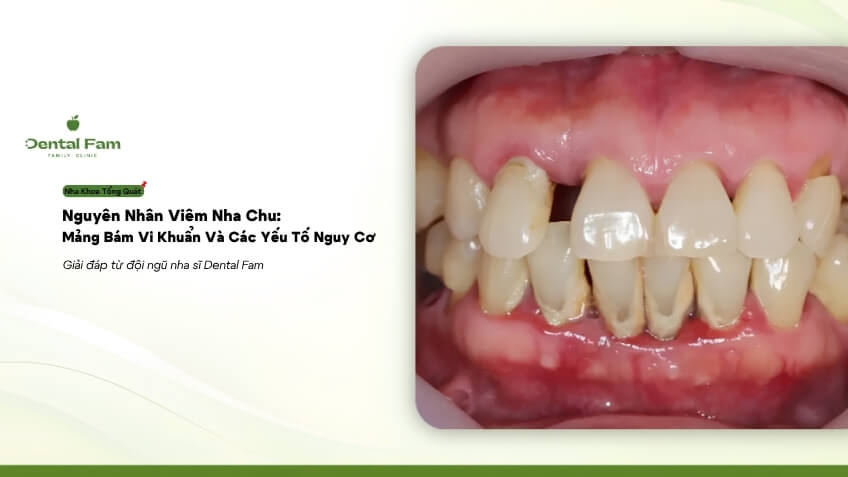
What is the main cause of periodontitis?
The main cause of periodontitis is bacterial plaque buildup in the gum area that is not cleaned promptly. When the bacterial balance in the plaque is disrupted, the body reacts with prolonged inflammation, and this reaction gradually destroys the supporting tissues of the teeth. This section includes two points: the mechanism from plaque to bone loss, and the true role of tartar.
How does bacterial plaque lead to bone loss?
Plaque leads to bone loss through four consecutive steps: plaque buildup, prolonged inflammation, loss of attachment, and then alveolar bone loss. Loss of attachment (the tooth gradually loses its attachment to the surrounding tissue) is the distinguishing feature of periodontitis from ordinary gingivitis.
| Step | What happens | Signs you may notice |
| 1. Plaque buildup | Bacteria cling to the gum line and between teeth | Often there are no obvious signs |
| 2. Prolonged inflammation | Gums react to bacteria | Gums are swollen, red, and bleed easily when brushing teeth |
| 3. Loss of attachment | Teeth gradually lose their attachment, forming periodontal pockets (deep gaps between teeth and gums) | Gum recession, persistent bad breath |
| 4. Alveolar bone loss | The bone supporting the teeth is gradually destroyed | Teeth become loose or spaced further apart |
Because the disease can progress silently, waiting until pain or looseness occurs often leads to missing a more controllable stage.
Is tartar the cause of periodontal disease?
Tartar is not the direct cause, but rather a breeding ground for plaque to firmly adhere to teeth. The rough surface of tartar makes plaque difficult to remove, so toothbrushes and dental floss at home are less effective. Therefore, people with a lot of tartar often need professional cleaning at a dental clinic, but the root of the problem remains bacterial plaque.
Many people wonder why plaque still accumulates even though they brush their teeth daily. The reason is that the gum line, interdental spaces, and inner surfaces of molars are difficult to clean; frequency of brushing does not equate to effectiveness. Understanding the role of tartar will help you avoid worrying that ""simply removing tartar will cure the disease,"" and also prevent you from considering tartar as the sole culprit. Besides plaque, several other factors also influence whether the disease appears and how severe it becomes.
What factors increase the risk of periodontal disease?
Smoking, poorly controlled diabetes, inadequate oral hygiene, hormonal changes, old age, immune system impairment, and genetics can all increase the risk or severity of the disease. The table below lists each factor along with what you can do about it.
Diabetes and cardiovascular disease are associated with periodontal disease, but it should not be understood that periodontal disease directly causes these diseases; the relationship is discussed in the article periodontal disease and chronic diseases. For pregnant women, see the article on periodontal disease in pregnant women. A common question is whether these factors are the cause of the disease.
Do Risk Factors Directly Cause Periodontitis?
Not always: risk factors often increase susceptibility or the rate of disease progression, while bacterial plaque remains the central cause. A non-smoker with no underlying conditions can still develop periodontitis if plaque buildup persists. Conversely, individuals with multiple risk factors need closer monitoring because the disease may develop more easily or worsen more quickly.
You don't need to determine which group you belong to. Your doctor will ask about your habits, underlying conditions, and medical history to assess your situation along with the examination results. From there, the more practical question is where to begin control.
Knowing the cause, where to start controlling periodontitis?
Controlling periodontitis begins with daily plaque reduction, managing risk factors, and having a dentist clean the area below the gum line. Home care helps maintain results, but toothbrushes and mouthwash don't reach the periodontal pockets that have formed.
Once you've identified the cause and signs, the next step is to visit a clinic to determine the exact extent, as described below.
What does Dental Fam do when finding the cause and treating periodontal disease?
Dental Fam examines, measures, and takes X-rays to determine the extent of the disease, then treats according to the doctor's prescribed treatment plan, starting from 500,000 VND per tooth, including examination and consultation. The doctor measures the depth of the periodontal pockets, assesses the degree of attachment loss, checks for bleeding during exploration, and the degree of tooth looseness. X-rays for treatment are provided free of charge. At the same time, the doctor asks about your smoking habits, underlying diseases, and other risk factors to create a treatment plan tailored to you.
Three treatment options—non-surgical, LASER (laser therapy), and surgical—are prescribed independently based on the condition of each tooth.
Periodontal disease originates from bacterial plaque buildup in the gum area, while tartar is merely a place where plaque adheres firmly. Smoking, poorly controlled diabetes, and other factors can make the disease more likely to develop or worsen it, but they don't always directly cause it. Home care helps maintain results, but subgingival areas require treatment by a dentist. If you experience persistent gum swelling, bleeding, or bad breath, schedule an appointment at Dental Fam for assessment and treatment starting from 500,000 VND per tooth.
Dental Fam - Family Clinic
- Address: NOTT 28, 29, 30, Phuoc Long A Urban Area, Nha Trang, Khanh Hoa
- Hotline: +84 582 582 345 / +84 983 001 768
- Email: info@dentalfam.vn
| Risk Factor | Significance | What you can do about it |
| Smoking | Increases the risk and severity of the disease; E-cigarettes are also an irritant that should be limited; the level of irritation has not been confirmed to be equivalent to that of traditional cigarettes. | Reduce or quit smoking |
| Poorly controlled diabetes | Associated with periodontal disease | Control underlying conditions as directed by your doctor, have regular dental checkups |
| Inadequate oral hygiene | Increased plaque buildup | Proper brushing technique, cleaning between teeth |
| Hormonal changes (such as puberty, pregnancy) | Gums may be more sensitive | Monitor your gums and seek early treatment if you notice any signs |
| Advanced age | Risk may increase with age | Regular periodontal check-ups |
| Immune system conditions | Your body may respond differently to plaque | Discuss your medical history with your doctor |
| Genetics | Some people are more sensitive to plaque | See a doctor early if a family member has had the disease |
| Stress long | It may be related through inflammatory responses and hygiene habits, but this has not been strongly confirmed. | Maintain good oral hygiene even when busy. |