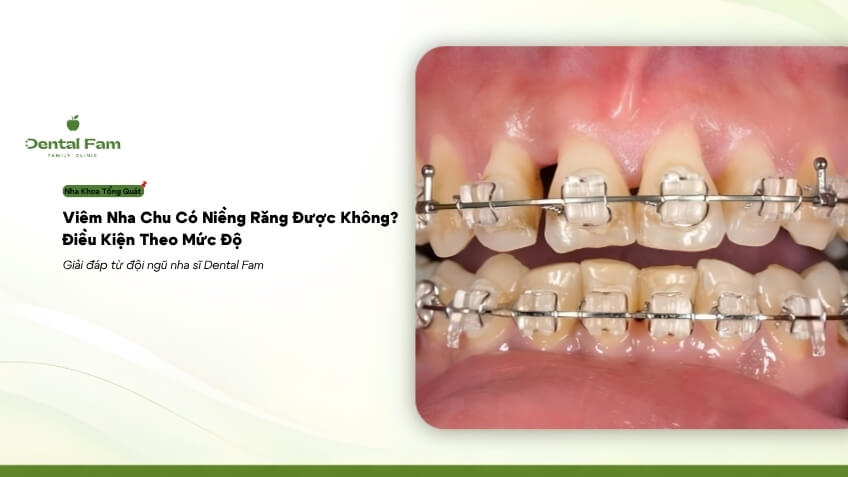
Why not get braces if periodontal disease is not controlled?
Because the tightening force of braces can further damage the supporting tissues of the teeth if the inflammation persists. Teeth with periodontal disease have already lost some of their attachment to the bone, so when subjected to additional force for movement, the supporting tissues are weaker than normal.
Braces also make cleaning more difficult because the brackets and wires allow plaque and bacteria to easily accumulate. Plaque is the central cause of periodontal disease, so if the disease is not controlled, braces can make it even harder to control. This is a common dental principle; the dentist will assess each individual specifically. This principle applies differently depending on the severity of the disease, as shown below.
At what level of periodontal disease can braces be used?
The severity of the disease determines the treatment approach: mild cases may be considered for braces after controlling the inflammation, while severe cases with significant bone loss may not be indicated for orthodontics. The table below summarizes three groups, and the next section explains each group.
| Condition | Common Treatment Methods |
| Mild gingivitis or periodontitis, good supporting tissue | Control inflammation first, then the doctor will consider braces |
| Uncontrolled periodontitis | Treat periodontitis first, no braces yet |
| Severe periodontitis, significant bone loss | The doctor may not recommend orthodontics |
The final conclusion is always given by the doctor after examination; you should not self-assess. Which group? The subheadings below discuss mild and severe groups.
Can I get braces if I have mild periodontitis?
Braces may be considered after the inflammation is controlled and the supporting tissues of the teeth are still good. Before getting braces, you need to treat your periodontal disease and maintain good oral hygiene. During treatment, you should have regular check-ups with your dentist to monitor your gums and bone.
Can I get braces if I have severe periodontitis with significant bone loss?
Your dentist may not recommend orthodontics if there is significant bone loss. When there is little supporting tissue, moving the teeth may not be safe. If the condition stabilizes after treatment and your dentist assesses it as feasible, orthodontics may still be discussed. To determine which group you belong to, you need to see how your dentist assesses it.
How Does Your Doctor Determine If You're Suitable for Braces?
Your doctor will determine whether braces are appropriate based on a periodontal examination, X-rays, and the level of inflammation control. Factors considered include periodontal pockets, attachment loss, bone resorption, and tooth mobility, along with whether the disease has stopped progressing.
The disease is considered stable when the doctor monitors measurable indicators rather than relying solely on feel; see the article Criteria for Assessing Stable Periodontal Disease for more information. Individuals with risk factors such as smoking or poorly controlled diabetes should discuss this further with their doctor. Once the assessment results are available, the order of treatment will become clearer.
What is the correct order between periodontal treatment and braces?
The correct order is to treat periodontal disease and inflammation control first, then braces, followed by maintenance and follow-up periodontal care throughout the process. Reversing the order increases the risk of damage to supporting tissues.
Dental Fam provides examination, measurements, and X-rays to determine the severity of the condition and advise on appropriate periodontal treatment, with prices starting from 500,000 VND per tooth, including examination and consultation. Once the condition is stable, you can discuss orthodontic treatment with the doctor.
The duration of periodontal treatment before braces depends on the severity of the condition and the treatment plan. The number of sessions is usually 1 to 4 intensive treatment sessions depending on the treatment protocol; complex cases may require more; see the article ""How long does it take for periodontal inflammation to heal?"". If you have braces and then notice signs of inflammation, the next section discusses how to handle it.
What to do if you discover periodontal inflammation while wearing braces?
You should inform your doctor as soon as possible, as they will assess and decide whether to adjust the orthodontic treatment while controlling the inflammation. There is no general answer to whether to remove the braces or continue: the doctor may decide to temporarily stop or adjust the orthodontic force depending on the severity of the inflammation and the condition of the supporting tissues.
If you are wearing braces and notice swollen, red, bleeding gums or loose teeth, you should see a dentist as soon as possible instead of waiting until your next appointment. During treatment, many professional guidelines suggest regular check-ups every few months; the specific schedule will be determined by the Dental Fam dentist based on each individual's condition.
Periodontal disease needs to be controlled and stabilized before orthodontic treatment. Those with mild cases and good supporting tissue may consider braces after treatment, while those with severe cases and significant bone loss may not be suitable candidates for orthodontic treatment. The conclusion will be made by the dentist after examination and X-rays.
If you are planning to get braces but experience bleeding gums, or if you are wearing braces and notice loose teeth, schedule an appointment at Dental Fam for a periodontal assessment.
Dental Fam - Family Clinic
- Address: NOTT 28, 29, 30, Phuoc Long A Urban Area, Nha Trang, Khanh Hoa
- Hotline: +84 582 582 345 / +84 983 001 768
- Email: info@dentalfam.vn