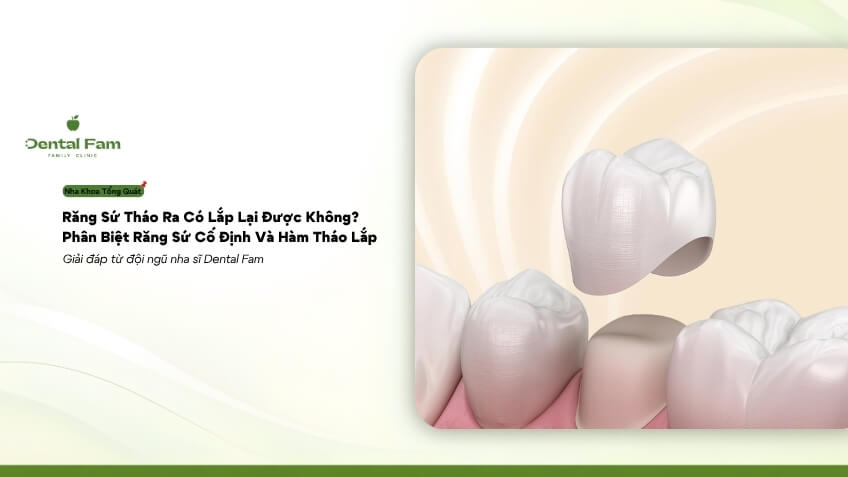
Why are fixed porcelain crowns almost impossible to reattach?
Because porcelain crowns are permanently attached to prepared teeth, removing them usually requires cutting or breaking the crown, making it difficult to reattach it intact.
Imagine a porcelain crown as a hat that fits snugly over a prepared tooth. The hat is tightly bonded, with no clasp to remove it, so when you try to remove it, the crown is often damaged or no longer fits as it did originally. Furthermore, after removing the crown for examination, the underlying tooth may require treatment or adjustment, and if the tooth shape changes, the old crown may no longer fit.
So, in what cases does a dentist need to remove a porcelain crown?
When does a dentist need to remove a porcelain crown?
A dentist only removes a porcelain crown when there is a clear reason, usually when the underlying tooth is decayed or inflamed, the crown is damaged, or you need a new crown. Specifically:
-
Decay or inflammation of the underlying tooth: The crown covers the underlying tooth, making it difficult to detect cavities or gum inflammation. When abnormalities are detected, the dentist will need to remove the crown to examine and treat the underlying tooth.
-
Cracked, chipped, or damaged crown: A damaged crown no longer provides adequate protection for the underlying tooth and needs to be replaced.
-
You need a new crown: For example, when the crown no longer fits the tooth and the dentist determines that a new crown is better than a repair.
What do you do after the crown is removed?
What to do after removing a porcelain crown?
After removal, you will usually have a new crown made once the underlying tooth has stabilized, at a cost of 4,000,000 VND per DDBio porcelain crown.
The reason for waiting for the teeth to stabilize is that the new crown needs to fit snugly onto the treated tooth; if done too early, the crown may not fit properly. You can view the pricing and procedure on our porcelain crown and fixed bridge services page.
If you're searching for ""removable porcelain crowns"" because you want a type of denture that can be removed and reinserted, that's a different story, discussed in the next section.
What are ""Removable Porcelain Crowns""?
""Removable porcelain crowns"" is how many people refer to removable dentures: a type of denture that you remove, clean, and reinsert yourself; it's not permanently fixed in your mouth.
Unlike fixed porcelain crowns, removable dentures consist of artificial teeth attached to a base that you can remove daily. At Dental Fam, there are three types of dentures: Japanese dentures (500,000 VND per tooth), American dentures (800,000 VND), and composite dentures (1,500,000 VND). The most expensive type is explained in detail in the article on composite removable dentures. If you need an overview of this type of denture, you can check out the removable dentures page.
These two types are quite different, so what are the differences when placed side by side?
Quick Comparison of Fixed and Removable Dentures
Fixed dentures are always preferred when you lose teeth, while removable dentures are a more practical option when your circumstances don't allow for fixed dentures.
| Criteria | Fixed porcelain crowns | Removable dentures |
| Attachment Method | Fixed to teeth | Not fixed, removable |
| Can it be removed by yourself? | No | Yes |
| Price per tooth | From 4,000,000 VND (DDBio porcelain crowns) | 500,000 VND to 1,500,000 VND (excluding the base of the denture) |
| Warranty | 7 to 19 years | 6 months to 3 years (full arch) |
The doctor will choose the option based on three factors: your budget, the bone structure and adjacent teeth, and the actual condition of your mouth. From there, you can compare as follows:
Fixed dentures should be chosen when:
-
Two healthy teeth are still close to the missing tooth: A dental bridge helps complete the treatment quickly at a lower cost than an implant, but those two teeth must be ground down to serve as abutments. * You prioritize long-term effectiveness and don't want to affect your surrounding natural teeth: Implants are currently the most recommended option because they provide stable chewing function almost like natural teeth and help limit jawbone loss, although the initial cost is higher.
-
You have high expectations regarding chewing function or aesthetics: Removable dentures are difficult to use and not very secure, so if your requirements are too high, the dentist may refuse to make them to avoid unsatisfactory results.
You should choose removable dentures when:
-
You have a limited budget: This is the lowest-cost option, starting from 500,000 VND per tooth.
-
You need to restore multiple teeth at once in a short time: Dentures are usually completed after about 3 appointments in a week.
-
You can't get fixed dentures: If bone loss or adjacent teeth are too weak, a dental bridge is not possible; if implants aren't yet possible, removable dentures are a common temporary solution.
In contrast, removable dentures are less stable during chewing. The plastic base and clasps rest on the gums and adjacent teeth, and combined with chewing movements, can cause faster bone loss in the jaw compared to dental bridges. You can see a more complete comparison in the article ""Should you choose removable or fixed dentures?"".
What if you have porcelain crowns and want to remove them yourself?
Should you remove porcelain crowns yourself at home?
No, you should see a dentist because self-removal can easily damage the crown and injure the underlying natural teeth.
Porcelain crowns are firmly attached to prepared teeth, so using force or tools at home can chip the teeth, injure the gums, and render them unattachable. If the crown becomes loose or comes off, you should keep it and go to the dentist for examination.
Frequently Asked Questions About Removing Porcelain Crowns
Is Removing Porcelain Crowns Painful?
The level of discomfort depends on whether the underlying tooth still has pulp or has undergone root canal treatment, and your dentist will advise you on appropriate ways to reduce discomfort.
-
Teeth with pulp: The tooth still has sensation, so you may feel aching when the crown is removed. The dentist will usually administer local anesthesia for your comfort.
-
Teeth that have undergone root canal treatment: The tooth no longer feels pain from the inside, but the surrounding gums are still sensitive, so you may still experience mild discomfort.
Before removal, you should tell your dentist about the condition of your teeth and your level of sensitivity.
Can the natural tooth under the crown be reused?
This depends on how much damage the underlying tooth has sustained after the crown is removed. Your dentist will examine it before making a decision.
-
Cases where the tooth can be saved: The tooth is still strong enough, the decay hasn't spread, and the gums are healthy. The dentist will treat the natural tooth (if necessary) and then make a new crown to cover it.
-
Cases where the tooth can be saved but requires further treatment: The decay is deeper, requiring root canal treatment or reconstruction of the tooth structure before a new crown can be placed.
-
Cases where the tooth cannot be saved: The tooth is decayed close to the root, cracked or broken below the gum line, or the root is loose due to bone loss. In this case, the dentist may recommend extraction, followed by restoration with a porcelain bridge, implant, or removable denture depending on your condition (see comparison above).
What to do if a porcelain crown comes loose?
You should keep the crown and go to the clinic as soon as possible; do not reattach it yourself at home. This is different from a crown being cut and removed: if the crown comes loose due to weak bonding and is still tight, the dentist may be able to reattach it.
-
If the crown can be reattached: The crown is intact, fits snugly, and the underlying tooth is not decayed.
-
If a new crown is needed: The crown is cracked or broken, or the underlying tooth is decayed or damaged.
While waiting for your appointment, you should store the crown in a clean, dry place, avoid chewing on the side where the tooth came loose, and do not use unknown types of adhesive as they may damage the tooth or make it difficult for the dentist to reattach.
Can removable dentures be cleaned daily?
Yes, and you should remove the dentures for cleaning after each meal, especially before going to bed.
In addition to regular brushing, you can use a vibrating device and cleaning tablets specifically designed for removable dentures, similar to cleaning clear aligners. Specific steps are guided in the article on how to clean dentures.
Is installment payment available for removable dentures?
Currently, the clinic does not offer installment payments for removable dentures. If you have a limited budget, you can choose Japanese-style crowns (500,000 VND per tooth) on a hard resin base (free of charge) to keep costs low, then discuss with the doctor to choose the most suitable option.
Fixed porcelain crowns are removable but almost impossible to reattach, so when removed, you usually get a new crown made, costing from 4,000,000 VND per DDBio crown. ""Removable porcelain crowns"" are dentures that you remove yourself for daily cleaning, with Japanese, American, or composite crowns ranging from 500,000 VND to 1,500,000 VND per tooth. You should not remove porcelain crowns yourself at home. If you need advice, you can schedule an appointment for a direct consultation with the doctor.
Dental Fam - Family Clinic
- Address: NOTT 28, 29, 30, Phuoc Long A Urban Area, Nha Trang, Khanh Hoa
- Hotline: +84 582 582 345 / +84 983 001 768
- Email: info@dentalfam.vn