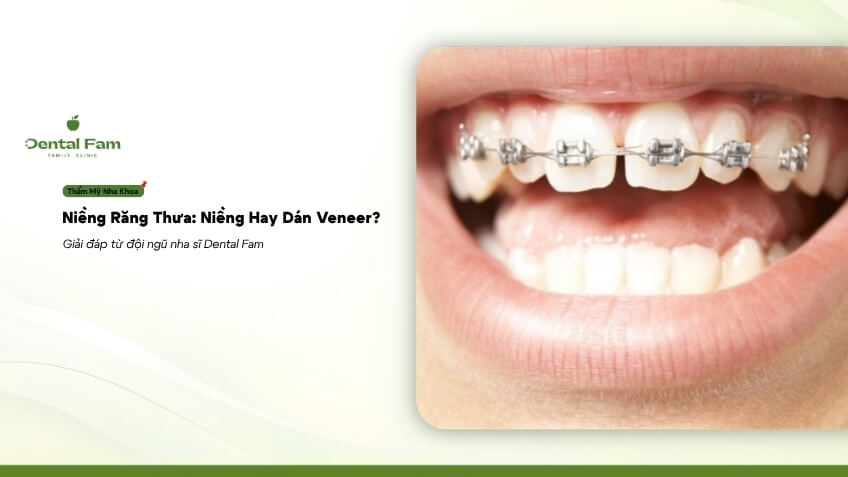
What are Gapped Teeth and What Causes Them?
Gapped teeth are a condition where there are gaps between teeth. The causes can stem from orthodontic treatment (misaligned teeth leaving gaps), tooth shape, tooth loss, or other causes not identified during examination. Identifying the correct cause directly determines the treatment approach: gaps due to misaligned teeth are usually completely closed with orthodontics, while gaps due to tooth shape or tooth loss may require additional restorative methods besides orthodontics.
The location of the gap also affects the choice of method. Gaps in the front teeth, especially the upper front teeth, are often most noticeable when smiling and are the most common location where many people seek braces or veneers to improve their smile.
Can Braces Completely Eliminate Gapped Teeth?
In many cases, orthodontics can completely close the gap, as the orthodontic force moves the teeth closer together until the gap is filled. This is the fundamental difference between braces and veneers: braces actually move the teeth into their original position within the jawbone, while veneers only cover the surface of the teeth without changing the actual position of the teeth underneath.
However, if the gap is due to abnormal tooth shape or tooth loss, moving the teeth with orthodontics alone may not be enough to completely resolve the issue, and additional restorative methods may be needed to achieve the desired aesthetic results. These two cases differ significantly in their treatment approaches, so they need to be clarified separately.
What additional methods are needed if the gap is due to small teeth or tooth loss?
Gaps caused by abnormal tooth shape (such as teeth smaller than normal) or tooth loss require additional treatment after braces, unlike gaps caused by purely misaligned teeth where simply moving the teeth is sufficient.
Do gaps due to small teeth (microdontia) require additional fillings or crowns after braces?
It may be necessary. When gaps arise from teeth being smaller than normal, braces only move the teeth closer together in terms of position, but do not change the size or shape of the smaller tooth itself. Therefore, after closing the gap with orthodontics, most cases require an additional restorative step to make the smaller tooth look balanced with the rest of the teeth. The most common is composite filling to reshape the tooth or porcelain crowns if greater durability and aesthetics are needed.
If the gap is due to tooth loss, can braces replace replacing the missing tooth?
Not entirely, and this is an important point to understand before choosing a treatment option. Orthodontics can close the gap caused by missing teeth by moving the surrounding teeth closer together; this is called closing the gap instead of replacing the tooth. This is completely different from dental implants or bridges, which maintain the gap and place a new tooth in the correct position. The choice between closing gaps with orthodontics or maintaining them with dental implants depends on the location and number of missing teeth, and the overall bite condition. A direct assessment by a dentist is necessary before making a decision, as these two approaches differ significantly in cost and technique.
After understanding the treatment options for each cause, the next question is: for simpler gaps, when is braces necessary, and when are veneers sufficient?
When should you get braces and when should you get veneers?
Veneers are a suitable option for small gaps in the front teeth, while braces are more appropriate for larger gaps, gaps in multiple locations, or gaps accompanied by other bite misalignments. Specifically, if the gaps are small in the front teeth, especially the upper front teeth, veneers without grinding can be considered. This option doesn't require grinding down the natural teeth and can be completed much faster than orthodontics. If the gap is small in the upper teeth with slight protrusion, minimally invasive veneers, meaning only light grinding of the outer surface of the teeth, are a worthwhile alternative to consult with your dentist.
It's important to note: veneers do not move teeth and do not improve the bite, so if the gap is accompanied by crowding, malocclusion, or gaps in multiple areas of the dental arch, orthodontics remains the best solution for addressing the root cause rather than just masking the external appearance. The final decision between the two options always requires a direct assessment of the degree of gap by the dentist; it cannot be made based solely on dental photos.
How long does it take to correct gaps between teeth with braces, and which method is used?
Closure of gaps between teeth with braces is usually considered simple to moderate if the gap is not accompanied by other complex misalignments. The specific treatment time varies depending on the method. Because closing gaps mainly involves moving teeth horizontally without creating additional space like in crowded cases, simple cases of gaps usually do not require tooth extraction.
Regarding methods, both braces and clear aligners can treat gaps between teeth. The specific choice depends on budget, aesthetic needs, and the degree of spacing.
How much does braces cost for spaced teeth?
The cost of braces for spaced teeth depends on the chosen method; there is no specific price for the degree of spacing, and it is usually lower than for more complex cases because there are no additional costs such as tooth extraction or mini-screws in most cases. For cases requiring additional options such as veneers or restoration of small/missing teeth instead of braces alone, the cost between options can vary significantly, so it's advisable to discuss and compare options with your dentist before making a decision.
If choosing braces, families or individuals can use Dental Fam's internal installment payment plan to spread the cost over several months instead of paying the full amount upfront.
Frequently Asked Questions About Braces for Gapped Teeth
Is braces necessary for mildly gapped teeth?
No, it's not mandatory. If the gap is small and only in the front teeth, veneers are a reasonable alternative that doesn't require orthodontics, as long as the overall bite remains stable and there are no other accompanying misalignments.
Are veneers as durable as braces?
Veneers and braces address the problem in two different ways, so their durability cannot be directly compared. Braces change the natural position of the teeth, so the results can last a long time if the retainer is worn correctly, while veneers are an outer covering, so their durability depends on the material and how they are cared for, not on the movement of the teeth.
Do children with gaps between their baby teeth need early intervention?
Gaps between baby teeth usually don't require immediate intervention, as this can be a normal phenomenon during the stage when baby teeth are preparing to give way to permanent teeth. Whether early monitoring or intervention is needed should be assessed during regular check-ups.
Will gaps between teeth reappear after braces?
Possibly, if the retainer isn't worn correctly after braces are removed. Gaps are one of the conditions that easily recur if the retention step is skipped.
Do I need to wear a retainer longer after braces treatment?
There is no basis to confirm whether gaps require a longer or shorter retainer wear than usual cases, as the duration depends on each individual and not solely on the initial condition. However, because gaps tend to reopen easily if the teeth are not kept in place long enough, adhering strictly to the retainer wearing schedule as instructed by your dentist is especially important for this condition.