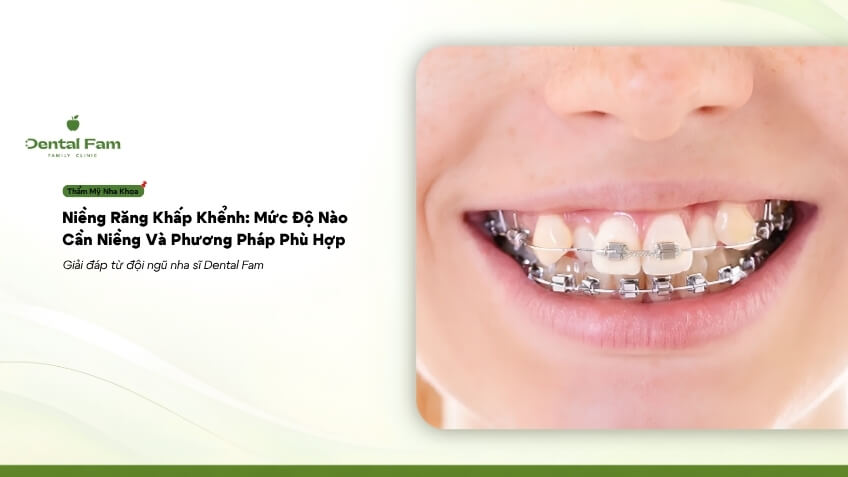
Why are teeth crooked and crowded?
Crooked teeth occur when the total size of the teeth is larger than the actual space available in the dental arch, causing the teeth to grow crowded, rotated, or overlap to make room in the limited space.
Common causes include insufficient dental arch development compared to tooth size (genetic factors), premature loss of baby teeth causing permanent teeth to erupt in the wrong direction due to lack of orientation, or bad habits from childhood (thumb sucking, tongue thrusting) affecting dental arch development.
What degree of crookedness requires braces?
A preliminary way to assess the degree of crookedness before an examination is to observe directly in the mirror: mild crookedness means 1-2 teeth are slightly rotated or misaligned but each tooth is still clearly visible; moderate crookedness means several teeth overlap in a few positions, most noticeably in the lower incisors; Severe cases involve noticeable crowding of many teeth, with some teeth pushed significantly outward or inward relative to the dental arch, sometimes to the point where the entire surface of some teeth is no longer visible when smiling.
This self-observation method is only for initial reference to estimate the severity of the condition; it cannot replace accurate measurements from X-rays during a dental examination, as the actual severity depends on the millimeter-sized gap that cannot be assessed with the naked eye.
Mild misalignment, if not treated with braces, usually does not worsen suddenly, but tends to worsen over time if the underlying cause (such as a congenitally narrow dental arch) continues, or if wisdom teeth erupt or the bite changes naturally with age.
Therefore, ""not mandatory"" for mild cases does not mean the condition will remain unchanged forever. Regular monitoring by a dentist is recommended to detect any signs of progression early, rather than indefinitely postponing treatment without follow-up check-ups.
Does orthodontic treatment for crooked teeth require tooth extraction?
Mild to moderate crooked teeth usually do not require extraction. Instead, the dentist may create more space by widening the dental arch or grinding the interproximal spaces between teeth (IPR - Interproximal Reduction). Severe cases, where the gap is significantly smaller than the total tooth size, often require the extraction of one or several teeth to create enough space for the entire dental arch to be realigned.
Orthodontic expansion involves widening the dental arch to increase the total tooth-containing area, suitable when the gap is not too large and the dental arch still has the capacity for expansion. Interdental grinding only slightly reduces the width of each tooth to a level safe for enamel, suitable for cases with only a small gap in a few specific locations. The dentist's choice of method depends on accurate measurements of the gap on X-rays, not on visual observation.
Tooth extraction to create space for severe misalignment does not significantly affect chewing function in the long term, as the remaining teeth will be shifted and rearranged to fully perform the chewing function of the dental arch.
Regarding facial appearance, the impact (if any) is usually less severe than in cases of tooth extraction to treat overbite, because misalignment does not require the entire anterior arch to be moved backward as much as in overbite; those concerned about facial impact from tooth extraction can refer to the detailed mechanism in the article ""Does orthodontic treatment cause sunken cheeks?"".
Which orthodontic method is suitable for crooked teeth?
Both braces (metal, ceramic, self-ligating) and clear aligners can treat crooked teeth. The choice depends on budget, desired aesthetics, and the ability to adhere to wearing the aligners for the required hours, regardless of the severity of the crookedness.
For severe cases requiring the simultaneous rotation of multiple teeth, fixed braces offer more precise control of rotational force in some cases, but modern clear aligners have also significantly improved the ability to handle complex tooth rotations.
Details regarding the process of determining whether tooth extraction is necessary during orthodontic treatment are analyzed in the article comparing different orthodontic methods, which also addresses the criteria for selecting the appropriate method for each degree of misalignment.
How long does it take to straighten crooked teeth with braces?
Treatment time depends on the degree of misalignment and whether tooth extraction is necessary. As analyzed in the article ""How long does it take to straighten teeth with braces?"", cases without extraction usually take about the average time for the entire group, while cases requiring extraction to create space usually take longer.
Frequently Asked Questions about Straightening Crooked Teeth with Braces
Is it mandatory to straighten teeth with braces for mild misalignment?
It is not mandatory if it does not affect chewing function or oral hygiene, but regular check-ups are recommended for monitoring because the condition may worsen over time if the underlying cause persists.
Can misaligned teeth caused by premature loss of baby teeth be straightened with braces?
Yes. Braces can still realign permanent teeth even if the misalignment is due to premature loss of baby teeth; the assessment and treatment process is no different from other causes.
Can misaligned teeth recur (shift back) after braces are removed?
Yes, there is a risk, like with any other orthodontic treatment, if a retainer is not worn properly after braces are removed. See the article on retainers after orthodontic treatment for details.
In short, orthodontic treatment for misaligned teeth is a viable solution for all levels, from mild to severe, with different approaches depending on the gap in the dental arch: mild cases may only require palatal expansion or interdental grinding, while severe cases often require tooth extraction to create enough space for realignment.
Readers can observe their own condition in the mirror before an examination, but the final treatment plan should still be based on accurate measurements from dental X-rays.