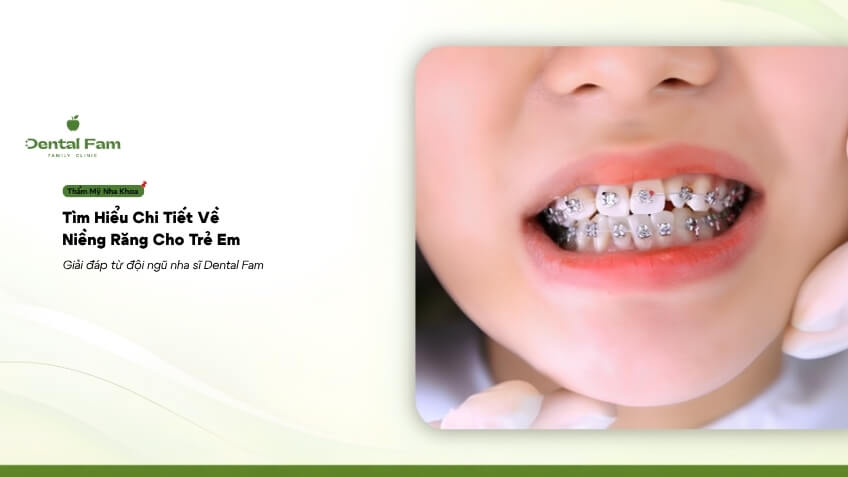
At what age can children get braces?
There isn't a fixed age that applies to all children. Determining the appropriate time for braces requires examination and assessment of the tooth replacement stage, jaw bone development, and the actual dental condition of each child. This is why regular dental checkups for children are more important than parents guessing ""at what age should my child get braces."" The specific age for each case needs to be confirmed by a dentist at Dental Fam.
In general, the two age groups will receive different treatment advice: children who are still developing and haven't yet had all their permanent teeth replaced are usually considered for growth orthodontics; children who have all their teeth replaced and whose jaw bones have stabilized can have braces with brackets or clear aligners, similar to adults.
So at what age should children have orthodontic screening?
This is different from the ""braces"" stage: screening is a checkup for the dentist to monitor the child's condition and doesn't necessarily mean immediate intervention. Many international dental organizations recommend that children have their first orthodontic screening around age 7, when they usually have some of their first permanent incisors and molars, allowing the dentist to observe the bite relationship and jaw bone development. An early examination doesn't mean the child will need to wear orthodontic appliances immediately, but it provides a benchmark for the dentist to monitor and avoid missing the appropriate intervention stage if necessary.
So, if the dentist recommends early intervention for a child, growth orthodontics, what exactly will the child have to get used to?
What is growth orthodontics, and how does it differ from regular braces?
Growth orthodontics is an intervention applied to children who are still in the developmental stage, possibly not yet having all their permanent teeth, with the goal of guiding the development of the jawbone and teeth from an early age, unlike regular braces which only focus on moving teeth that have already erupted. In other words, growth orthodontics intervenes in how the jawbone develops while it is still forming, whereas braces or clear aligners only move teeth within a relatively fixed bone structure.
What type of appliance is used in growth orthodontics?
Growth orthodontics typically uses functional appliances, some removable for most of the day at home, and others fixed and attached in the mouth, depending on the treatment goals prescribed by the doctor for each child. Removable appliances allow children to take them off when eating or brushing their teeth, while fixed appliances are worn continuously and can only be adjusted by the doctor during follow-up visits. The specific type of appliance used at Dental Fam for each case requires direct consultation with the doctor after examination and X-rays.
According to the doctors at Dental Fam, this is a ""very necessary"" intervention, and developed countries have considered growth orthodontics a normal part of a child's tooth replacement journey, not an additional service. The cost of growth orthodontics at Dental Fam is 5,000,000 VND per arch. Regarding the duration, growth orthodontics is usually monitored through multiple follow-up visits throughout the child's jawbone development, unlike the fixed 24-48 month period of conventional braces for individuals whose bone growth has stopped; the specific duration for each case needs to be confirmed by the doctor after assessment.
A natural question that many parents still hesitate to ask is: what if we don't take advantage of this period?
What happens if we miss the growth orthodontics period?
If we miss the growth orthodontics period and wait until the child has lost all their baby teeth, the jawbone will have already developed and stabilized, making intervention only possible by moving teeth within the existing bone structure. There will no longer be the opportunity to guide jawbone development as in childhood. In cases of severe jaw misalignment, waiting until adulthood may require additional jaw surgery, instead of just orthodontic treatment if intervention is started earlier. This is why regular check-ups and early screening are of practical value, not just a general recommendation.
Assuming a child has passed the growth orthodontic stage and has all their permanent teeth, how will orthodontic treatment proceed?
How is orthodontic treatment performed on children who have all their permanent teeth?
Once a child has all their permanent teeth, orthodontic treatment with braces or clear aligners is essentially the same as for adults and is no longer within the scope of growth orthodontics. At this stage, the treatment goal shifts from guiding jaw bone development to moving teeth and adjusting the bite, just as adults are treated.
The choice between metal braces, ceramic braces, or clear aligners for children at this age is based on the same criteria as for adults: the degree of misalignment, aesthetic needs, and the ability to adhere to wearing the appliance on time. The biggest difference between braces for teenagers and braces for adults is not in the treatment technique, but in the fact that children still need parental supervision to remind them about hygiene and follow-up appointments.
Cost of Orthodontic Treatment for Children at Dental Fam
The cost of orthodontic treatment for children at Dental Fam depends on the type of intervention: growth orthodontics costs 5,000,000 VND per arch, while braces or clear aligners, once children have all their baby teeth, follow the same price list as adults, ranging from 30 to 150 million VND depending on the method.
For cases requiring braces, families can consider paying in installments at Dental Fam to spread the cost over several months, instead of paying the full amount upfront. This policy applies equally to all ages, with no special conditions for children.
Knowing the cost is one thing, but for parents, the question that worries many the most is: how will their child feel throughout this process?
Does braces hurt children, and how should parents support them?
With growth orthodontics, the most common feeling in children is a slight discomfort or unfamiliarity when first wearing the appliance, rather than the intense pain of tightening the braces. The specific level of discomfort depends on the type of appliance and the individual child; further consultation with the doctor is needed if the child shows prolonged discomfort.
With traditional braces or clear aligners when children are older, the sensation is basically the same as with adults: mild soreness and tightness for the first few days after fitting and after each adjustment of force. The main difference is that children may not be used to clearly expressing their discomfort, so parents need to proactively observe and discuss with the doctor if their child shows unusually prolonged discomfort.
Parents' roles throughout their child's orthodontic treatment mainly revolve around three things: reminding them to maintain proper oral hygiene according to the instructions in the article on oral care during orthodontic treatment, ensuring the child attends follow-up appointments on schedule, and monitoring the treatment progress with the doctor, as the completion time depends on each case. After treatment is finished, children also need to wear retainers like adults to maintain the long-term results.
Frequently Asked Questions About Orthodontics for Children
Does it take to extract baby teeth before orthodontic treatment for children?
This depends on the progress of tooth replacement and the specific treatment plan for each child. A direct assessment by a dentist through examination and X-rays is necessary before making a decision.
Does growth orthodontics completely replace braces later on?
Not necessarily. Growth orthodontics guides the development of the jawbone when children are young, but in many cases, braces or clear aligners are still needed after the child has replaced all permanent teeth to complete the positioning of each tooth. The necessity of the next step depends on the results of the growth orthodontics phase.
Does wearing braces affect a child's daily eating and learning?
In the first few days after getting braces, children may eat more slowly or be slightly hesitant to talk because they are not yet used to it. However, this is a short-term adaptation period and does not have a long-term impact on the child's daily life or studies.