Teeth whitening uses professional-grade agents to break down the compounds that cause discoloration inside the tooth, making teeth brighter. It only works on natural teeth — it cannot be applied to porcelain crowns or fillings.
Most people researching this topic also want to know: why are their teeth yellow in the first place, which method is the right fit, how much it costs, and — most importantly — whether it hurts.
What few articles say plainly is that the level of sensitivity after whitening doesn't depend on your "body type" — it depends on three specific variables. Whoever controls those three variables determines whether your experience is comfortable or not. This article follows the exact order you need to make a decision: causes, methods, cost, procedure, and safety.
What Is Teeth Whitening?
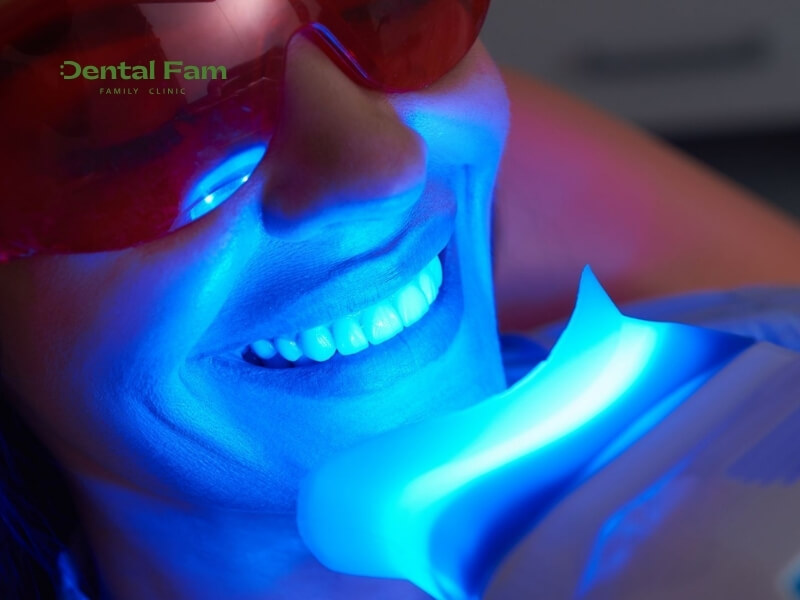
Simply put, teeth whitening is a way to "reverse" the discoloration that builds up in your teeth over time — through a chemical reaction, not by grinding or coating the tooth surface.
It's one of the most popular cosmetic dental procedures today, yet not everyone understands the mechanism behind it. According to the American Dental Association (ADA), whitening agents contain oxidizing compounds (commonly known as dental-grade hydrogen peroxide) that break the chemical bonds of color-causing compounds, preventing them from absorbing light in the way that creates yellow or brown tones. The process does not erode or cut the tooth — it simply changes the color from within.
What is teeth whitening?
An important distinction: whitening is different from polishing or scaling. Scaling only removes surface deposits, while whitening goes deeper and actually changes the true color of the tooth tissue. That's why many people who have had their teeth scaled still don't see them get whiter — the staining has penetrated the tooth structure itself, not just the surface plaque layer.
This mechanism also only works on natural teeth. According to the ADA, porcelain crowns, veneers, and fillings do not change color this way, no matter how many whitening sessions you have. This is exactly why many people finish a whitening treatment and still notice uneven results: if your mouth has both natural teeth and restorations, only the natural teeth will brighten — the crowns stay the same shade.
For anyone considering multiple whitening sessions over a lifetime, it's worth knowing that the degree of whiteness achieved will gradually diminish with each repeat, because the tooth structure has a limited capacity to absorb the whitening agent. This is why dentists generally recommend whitening only when truly necessary, rather than repeating it too frequently just to maintain peak whiteness.
Now that you understand the mechanism, the next question is: why are your teeth yellow? The answer determines which method will actually work for you.
Why Do Teeth Turn Yellow or Dull?
Yellow teeth come from two groups of causes: external factors (food, tobacco, plaque) and internal changes (age, fluorosis, tetracycline antibiotics).
External Causes
Coffee, tea, red wine, and tobacco are the most familiar culprits for rapid staining. Built-up tartar also plays a role, because plaque holds pigment from food more stubbornly than a clean enamel surface.
The good news is that this group of causes is preventable — and it's also the easiest to address with gentler whitening methods.
Internal Causes
Age causes enamel to thin gradually, exposing the naturally yellow dentin layer underneath. That's not a dirty tooth — it's the normal aging process of enamel.
More complex cases involve excessive fluoride exposure during the first eight years of life, or the use of Tetracycline antibiotics during childhood. Both cause discoloration from within the tooth structure, and usually require stronger in-clinic whitening methods to address — rather than at-home whitening strips.
Once you've identified the cause, the next step is to check whether you're a suitable candidate for whitening.
Who Should and Should Not Get Teeth Whitening?
People over 20 with healthy teeth and gums are good candidates for whitening. Those under 16, pregnant or breastfeeding women, and anyone with untreated dental conditions should wait.
Before discussing who is or isn't a candidate, it's worth being honest about why this procedure is worth considering — and where its limits lie. Teeth whitening is non-invasive; it doesn't involve grinding the tooth or altering its structure the way a crown does, and it delivers fast results that can be clearly visible after just one in-clinic session. However, the results aren't permanent, it can cause temporary sensitivity for a few days, and — as the ADA confirms — it doesn't work on porcelain crowns, veneers, or teeth severely stained by tetracycline. If you fall into any of these categories, whitening won't deliver the results you're hoping for, no matter how well the technique is applied.
Cases Where Whitening Is Appropriate
- Adults over 20 with healthy teeth and gums who want to improve their smile without an invasive procedure
- Teeth that are yellowed or dull due to age, food and drink, or hygiene habits
Cases Where Whitening Is Not Recommended
- People under 20, as the whitening agent can more easily irritate the tooth pulp, making teeth more sensitive
- Pregnant or breastfeeding women
- People with weak enamel, active gum inflammation, untreated cavities, or sensitive teeth
- People who already have porcelain crowns, veneers, or implants, as these surfaces do not respond to the whitening mechanism
- Teeth with yellow-brown spots — a sign of Molar Incisor Hypomineralisation (MIH) — where whitening is ineffective and can actually make the white spots more visible (similar to drawing out even more moisture from the tooth)
If you've recently given birth and are wondering about whitening, the short answer is: wait. Not because whitening directly harms breastfeeding, but because your body is still going through many changes, and your dentist needs to assess your overall oral health before carrying out any cosmetic procedure.
If you are a suitable candidate, the next question is: which whitening method is the right match for your teeth?
Current Teeth Whitening Methods
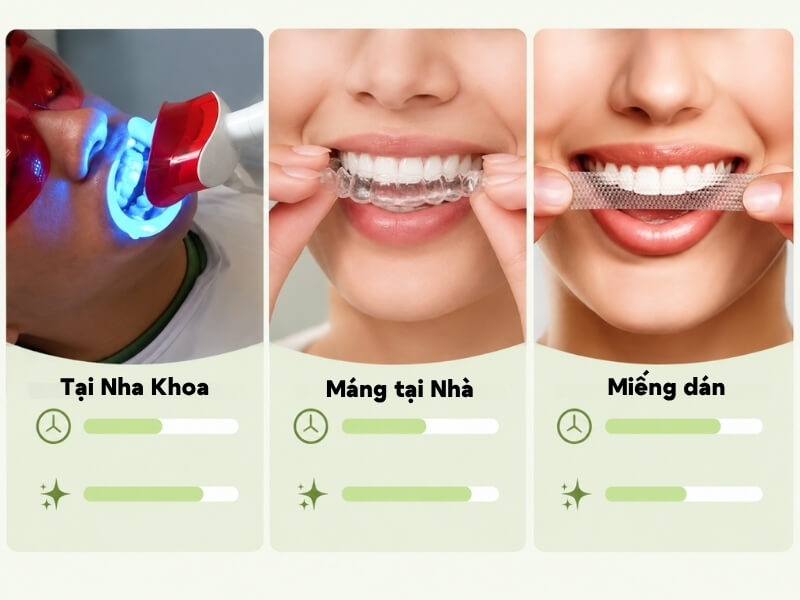
There are three main professional whitening methods recommended by dentists: in-clinic treatment, at-home custom trays prescribed by a dentist, and whitening strips — each suited to a different level of staining and a different budget.
If your staining is mild and external — from coffee or tobacco, for example — strips or at-home trays are usually effective enough. If your staining is intrinsic or severe — such as from tetracycline or long-term aging — in-clinic treatment with a higher-concentration agent will be more appropriate.
The 3 most popular teeth whitening methods today
In-Clinic Whitening (Laser / Plasma / LED Light)
This group delivers the fastest results — typically within one to two hours — by combining a high-concentration whitening agent with light activation.
The dentist applies a high-concentration whitening gel (around 15–35% peroxide, according to the ADA) and uses light to accelerate the chemical reaction.
The key difference between light types comes down to heat. Traditional lasers can generate heat, which may irritate the tooth pulp and increase post-treatment sensitivity. Cold LED technology — such as the Crystal system used at Dental Fam — operates without generating significant heat, helping to reduce sensitivity during and after the whitening process.
At-Home Whitening with Dentist-Prescribed Trays
This method uses a lower concentration of whitening agent — around 16–22% peroxide — safe enough for self-application at home, but still requires the dentist to take an impression of your teeth and prescribe the appropriate formula.
Your dentist takes an impression, then creates a custom tray that fits your mouth precisely. The cost is lower than in-clinic whitening, and you don't need multiple visits. The downside is that aesthetic results are generally not as dramatic as in-clinic treatment, and you need to wear the tray consistently to see meaningful results.
Note: this is completely different from using baking soda or lemon juice at home without a prescription. This method still involves a dentist prescribing the product and monitoring progress — you're simply applying the tray yourself.
Whitening Strips / Over-the-Counter Kits
This is the most affordable and convenient option, but the results are temporary.
The peroxide concentration in whitening strips is low, and without light activation, it's difficult to achieve or maintain results comparable to the two methods above.
Quick Comparison of the 3 Methods:
| Method | Effectiveness | Sensitivity Risk | Dentist Supervision Required |
| In-clinic (cold LED / laser / plasma) | High — visible immediately | Low to moderate (cold LED reduces sensitivity) | Yes |
| At-home prescribed trays | Moderate | Low | Yes (initial prescription) |
| Strips / over-the-counter kits | Low — temporary | Moderate if overused | No |
What if you're thinking of doing it yourself without a dentist — using baking soda or lemon juice, for instance? The next section addresses that question directly.
Should You Whiten Your Teeth at Home Without a Dentist's Guidance?
No. Baking soda and lemon juice have no clear scientific evidence for whitening effectiveness, and can damage enamel if used regularly.
It's important to distinguish this from the "at-home tray" method described above — that approach still involves a dentist taking impressions and prescribing the agent; you're simply applying it yourself. What we're talking about here is using readily available kitchen ingredients with no dental prescription or supervision whatsoever.
Many popular tips — such as brushing with baking soda or rubbing lemon juice on your teeth — are claimed to whiten naturally. But the acidity of lemon juice and the mild abrasiveness of baking soda can genuinely damage tooth enamel.
In other words, you'd be trading an uncertain result for a very real risk. If you want to save money, the dentist-prescribed at-home tray method described earlier is far safer than folk remedies where you have no control over concentration.
Once you've settled on a direction, the question most people ask next is: what does it actually cost?
How Much Does Teeth Whitening Cost?
The cost of teeth whitening varies quite a bit, depending on four factors: the degree of staining, the type of whitening agent used, the dentist's level of expertise, and the quality of the clinic's facilities.
- Degree of staining: heavily stained teeth may require additional preparatory steps before whitening, which increases the cost
- Type of whitening agent: specialized agents for particular cases (such as non-vital teeth) are more expensive than standard formulas
- Dentist's expertise: more experienced dentists are better placed to achieve the desired result while minimizing side effects
- Clinic facilities and technology: clinics with advanced equipment — such as dedicated LED lights — typically carry a higher price tag than those using basic devices
The relationship here is straightforward. The more severe the staining, the more steps involved, and the higher the cost. This isn't an arbitrary formula — it's the pricing logic that any transparent dental clinic should be able to explain to you before treatment begins.
Once you have a sense of the cost, the next step is easier to picture: what actually happens during an in-clinic whitening session?
What Does the In-Clinic Teeth Whitening Process Look Like?
The in-clinic whitening process involves 4 steps: examination and scaling, gum protection, gel application with light activation, and aftercare instructions.
Many people hesitate about whitening simply because they can't picture what the procedure involves. In reality, it's more straightforward than you might think.
- Examination and scaling: the dentist checks the condition of your teeth and gums, and removes any plaque before beginning the whitening
- Gum protection gel: a protective barrier is applied to prevent the whitening agent from coming into direct contact with gum tissue, avoiding irritation or burns
- Whitening gel application and light activation: the gel is applied evenly across the tooth surface, then a LED or laser light is used for 10–15 minutes per round, repeated 2–3 times
- Mouth cleaning and aftercare guidance: the dentist cleans your teeth again and explains how to care for them to maintain the results
Step two — gum protection — is often left out of procedure descriptions, but it's actually the step that determines whether you'll experience gum irritation or burns after whitening.
Does Teeth Whitening Hurt? Does It Weaken Enamel?
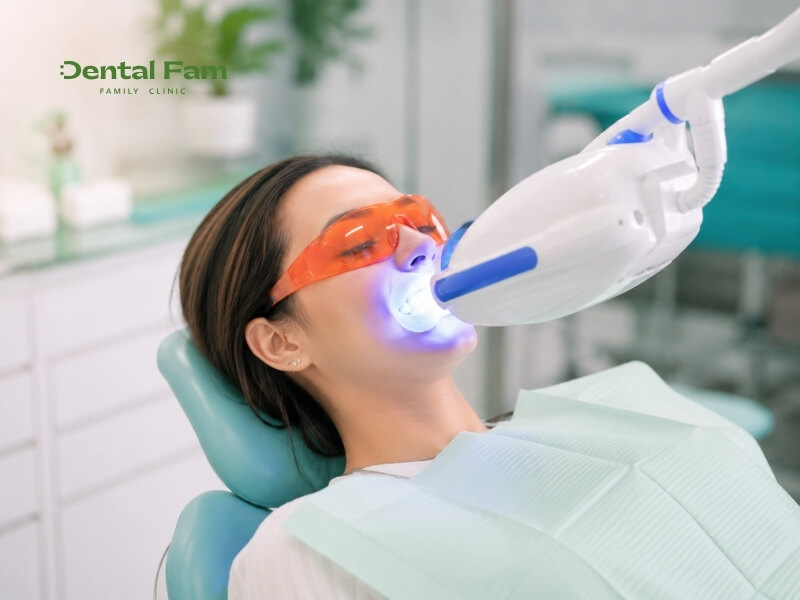
Teeth whitening generally does not cause pain. Temporary sensitivity is a common side effect that fades within a few days — it is not a sign that the enamel has been damaged.
Teeth whitening does not cause pain
What few people realize is that the safety of the whitening process depends on three specific variables — not some vague notion of "body type" as many assume. Those three variables are: the concentration of the agent, the contact time, and the condition of the teeth and gums before whitening.
These three factors are directly connected. The right concentration and contact time are what make the process safe. This is precisely why professional supervision matters: only a dentist can fine-tune this balance to suit each individual's actual dental condition, rather than applying a one-size-fits-all formula to every patient.
Temporary sensitivity is one thing. But real complications from poorly controlled treatment are another — and it's important to distinguish between the two, so you're neither unnecessarily alarmed nor overly complacent.
Complications from Incorrect Whitening or Low-Quality Providers
Whitening done incorrectly or at a low-quality clinic can cause enamel erosion, prolonged gum damage, and uneven tooth color. Unlike the temporary sensitivity described above — which is a normal reaction — these risks only occur when the whitening agent is used at the wrong concentration or when gum protection steps are skipped.
The line here is fairly clear. Sensitivity that lasts a few days and then resolves on its own is normal. Prolonged gum pain or swelling, patchy discoloration, or sensitivity that hasn't improved after a week — those are signs to return to your dentist promptly, rather than waiting and hoping it goes away on its own.
Will Teeth Turn Yellow Again After Whitening?
Yes. Teeth will gradually return to a yellower shade over time, and the recommended interval between whitening sessions is 1–2 years.
The rate at which they yellow again depends on your diet and oral care habits. People who smoke and drink coffee daily will notice their teeth dulling faster than those who consume less heavily pigmented food and drink.
Don't expect a single whitening session to last forever. That's simply not how the mechanism works.
Tips for Keeping Your Teeth Whiter for Longer:
- Avoid heavily pigmented food and drinks (coffee, tea, richly colored vegetables, colored soft drinks) for the first 24–48 hours after whitening
- Brush twice a day with a fluoride toothpaste
- Floss after meals to remove plaque early
- Limit smoking — it's one of the fastest ways to stain teeth again
- Schedule check-ups every 6–12 months to maintain your whitening results over the long term
Frequently Asked Questions
Will teeth turn yellow again after whitening?
Yes. Teeth will gradually return to a yellower shade over time, and the recommended interval between whitening sessions is 1–2 years.
Where can I get trusted teeth whitening in Nha Trang?
The three most important criteria when choosing a whitening provider are: a dentist with clear, verifiable qualifications; a transparent step-by-step procedure; and a fee that is communicated before treatment — with no surprise costs mid-way through. These are also the standards the Dental Fam team applies to every patient who comes in for a whitening consultation.
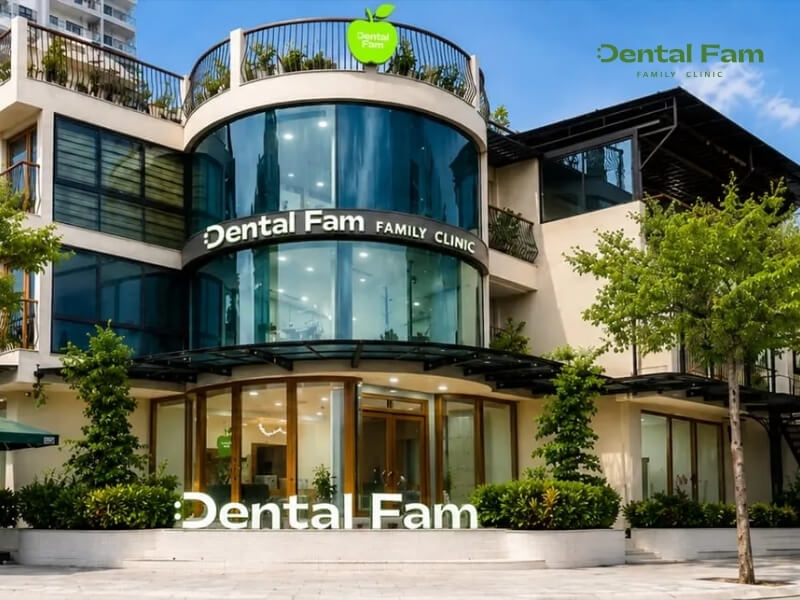
Dental Fam — Trusted family dental clinic in Nha Trang
Reference Price List for Teeth Whitening
At Dental Fam, at-home whitening trays are priced at 1,500,000 VND per course, and in-clinic whitening is priced at 3,000,000 VND per course. You can view the full price list at Dental Fam or book a whitening consultation to have your teeth assessed before deciding on the right method for you.
Teeth whitening is safe when you correctly identify the cause of discoloration, choose a method suited to your level of staining, and have a dentist supervising the process — rather than relying on unguided home remedies. A few days of sensitivity is normal, but controlling the agent concentration and contact time is essential to avoid genuine complications. At Dental Fam, the teeth whitening service uses cold LED technology to minimize sensitivity, with transparent pricing confirmed before treatment begins — so you never have to guess or worry about unexpected costs.
Dental Fam - Family Dental Clinic
- Address: NOTT 28, 29, 30 Phuoc Long A, Nha Trang, Khanh Hoa
- Phone / Hotline: +84 582 582 345
- Website: dentalfam.vn
- Email: info@dentalfam.vn
References: American Dental Association, "Whitening" (ada.org/resources/ada-library/oral-health-topics/whitening); ADA Guidelines for the Acceptance of Tooth-Whitening Products (PubMed).